













“Wealth screening is amazing at filling our donor pipeline!” – said no fundraiser ever.
When it comes to prospect discovery and pipeline development, no one strategy is as tried and tired as wealth screening. Not far behind is the recency/frequency/monetary (RFM) model used by almost every development shop to drive donor segmentation.
So far in this series on alumni identity, we’ve tested and busted some of the most pervasive myths around alumni fundraising. Now’s the time to demonstrate the power of alumni identity to accelerate philanthropy.
First, let’s set the stage.
Whether ramping up or winding down, in the nucleus, quiet, or public phase, many higher education institutions are pursuing capital and comprehensive campaign efforts at a near back-to-back pace. As a result, college and university advancement operations are struggling to sustain a steady current of prospect development due to constantly shifting campaign priorities and ever-lengthening campaigns.
Enter the wealth screen and RFM model — the two strategies that make up the backbone of prospect discovery.
Unfortunately, they’re no longer as useful at identifying prospects as they used to be.
Why?
Because wealth screens use property ownership as a proxy for giving capacity and RFM models require prior giving to be effective.
The problem is that property ownership and donations to colleges and universities are at historic lows for Generation X and Millennials — the very age groups that should now be in cultivation for future major giving. There is less and less property data to include in screenings and fewer alumni making gifts at a young age to use in predicting future philanthropy.
Alumni identity is the new tactic advancement needs to pinpoint alumni with the inclination and capacity to give.
Alumni identity scoring offers a reliable and valid quantitative measure of a graduate’s feeling of connection towards their alma mater that requires no pre-existing wealth screening or giving data (Dillon, 2017; McDearmon, 2011, 2013). By employing alumni identity as a discovery tactic, advancement professionals can identify graduates with inclination and capacity who would otherwise never surface in major gift portfolios or highly rated donor segments.
In a study of alumni giving at a mid-sized, liberal arts university on the West Coast, an analysis was conducted to compare the efficiency of RFM model scores and alumni identity scores in predicting the demonstrated giving behaviors of the study’s 4,094 participants. The methodology employed allowed for a direct assessment of which approach was best at forecasting whether or not a study participant was donor and their giving amount.
The results were stunning.
Alumni identity scores were found to be more efficient than RFM ratings at predicting which study participants were donors and how much they donated.
Participant-reported feelings of connection toward the institution proved to be an excellent proxy for inclination and capacity to give (Dillon, 2017).
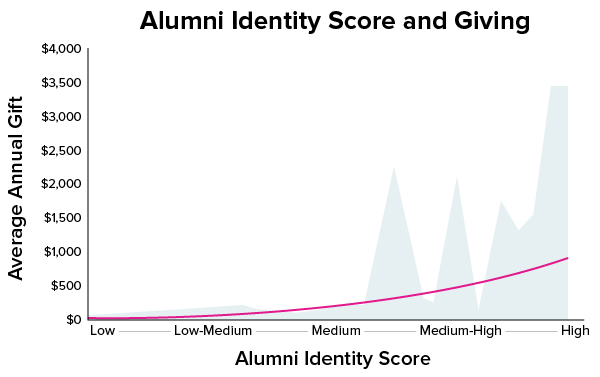
For a more tuned example, let’s look at the top quartile of both RFM ratings and alumni identity scores.
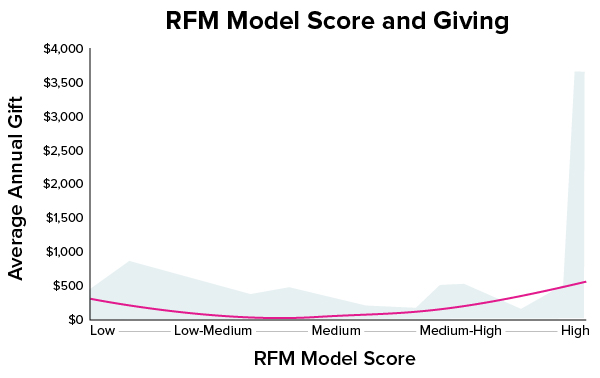
In total, 191 study participants reported alumni identity scores in the top quartile (“High”). However, just 57 of these 191 participants rated in the top quartile (“High”) of RFM scores. In the study’s fiscal year, the average gift among these 191 alumni was $675.
What does that mean?
By using alumni identity as an approach and alumni identity scores as a tool, a fundraiser at this university would have identified nearly three times as many donors and an additional $90,450 in gifts beyond what the RFM model would have predicted.
Let that sink in and then plan to join me for the final article in this series, where we’ll tackle the first steps you can take to start integrating alumni identity into your advancement practice.
Read Dr. Jay Le Roux Dillon’s entire series on alumni identity.
Part 1: Are You Missing Advancement’s Most Important Metric?
Part 2: The Story Behind Giving Has Little to Do With 1s and 0s
Part 3: Digital Engagement ≥ Event Engagement? Yes.
Part 4: Meaningful Volunteer Experiences Are Best, But Far Too Few
Part 5: Data-driven Prospect Discovery Needs to Include Graduate Feelings of Connection
Part 6: Raising Alumni Identity Raises Dollars
Need more? Connect with the author:
LinkedIn.com/in/jayldillon
Twitter @jayldillon
alumniidentity.com
Dr. Jay Le Roux Dillon is a social scientist and higher education consultant with 14 years of progressive leadership experience in advancement. Jay’s research and consulting practice focuses on broadening and measuring institutional value and impact among college and university alumni. He has served as Director of Alumni Engagement at the University of San Francisco and as Executive Director of Alumni Strategic Initiatives at UCLA. Jay is dedicated to improving philanthropy through data science in order to bring social justice and equity to education. He holds a doctorate in organization & leadership from USF and a master’s and bachelor’s degree in music from UCLA.