







New 1:many cadences with automated emails, reusable templates, and more in Signal

DonorSearch identifies prospects in your database with the capacity and intent to give.

Missed the live session? Watch our on-demand webinars anytime to get guidance from industry experts.

11 Tips for Crowdfunding Success

At Marquette University, we’ve been using crowdfunding for just over a year, and have raised more than $53,000 for 18 different projects in that time. Here is what we have learned.

1. People donate to a cause, not a website.

It’s easy to get really hung up on which website you should use for crowdfunding. Kickstarter? IndieGoGo? GoFundMe? A customized platform? We used IndieGoGo for its branding, name recognition, and ability to create a partner page. But remember, the website is only secondary—people donate to a cause, not a website.

2. Perks can impact the tax deductibility of a crowdfunding gift.

If this is of concern, monitor perks closely. Encourage creative, non-tangible perks as much as possible. Perks as simple as a Twitter shout out are very well received.

3. Engage your core audience long before you ask for money.

While people may find it annoying to be asked for money, they do want to be part of a movement they believe in. Emphasize the stories behind your campaign and share them through social media. Signal to your audience what’s coming, and ask for their support in spreading the word about your mission, not just in donating.

4. Set realistic expectations.

You can always raise MORE than the goal you set. A goal that’s set too high will simply turn donors off, and it will raise less than its potential because it looks like it doesn’t have momentum. Most of our successfully met goals were in the $1,000-$2,000 range.

5. Expect some level of failure.

About one-third of our projects met their goal. Crowdfunding, like social media, is an experimentation in what resonates with your audience and what doesn’t. It’s okay to take a risk and learn from it because most crowdfunding campaigns don’t have sunk up-front costs.

6. It’s a lot of work.

Crowdfunding is not a magic “if you build it they will come” formula. It takes a significant time investment around devising a communication strategy, creating perks, telling your story, and promoting it consistently. Our campaigns involved university advancement, marketing and communications, finance, and teams of students in a social media analytics class.

7. Service trips are a hard sell.

It’s not impossible to raise money for service trips, but it’s not the easiest type of project, either. The more common the type of project, the harder it is to differentiate yourself.

8. The most successful campaigns are novel.

They’re attention getting in some way. Our most successful campaigns involved building robots to compete in a world robot soccer competition and a triathlon team for at-risk youth.

9. Momentum out of the gate is extremely important.

Statistically, if you raise 30 percent of your goal in the first 48 hours, you will meet your goal. If you don’t, chances are you won’t.

10. Don’t forget about email.

Social media is good for building a buzz and raising awareness, but email is often where people will pause and actually take out their credit card.

11. Face to face is important, even in an online campaign.

When we launched our campaigns, we had a pizza party to involve potential donors. It also served as a reminder that what we’re doing impacts real people, not just Twitter handles and Facebook pages.

Want more inspiration? Check out our SlideShare featuring 20 other crowdfunding institutions!

Tim Cigelske is Social Media Director at Marquette University, ranked by Klout.com as one of the 10 most influential higher-ed Twitter accounts. He teaches Social Media Analytics and Measurement in the Diederich College of Communication, and his class has used social media crowdfunding to help raise more than $50,000 for research, scholarship, service, and innovation. You can read the first chapter of his social media analytics book for free by requesting it here.
Endowment Spending & Growth Calculator

Enter your fund's current value and adjust the return, spending, and inflation sliders to see how its value in today's dollars changes over time.

$
6.0%
0%12%
4.0%
2%7%
3.0%
0%8%
10
5 yrs25 yrs

Value in 10 years

$0

In today's dollars

$0

4. Continue to Steward Donors

Your relationship with the donors who give to your endowment doesn’t end when you secure their gifts. Because your endowment exists to make a difference in the long term, your supporters will want you to keep in touch about its progress. Ongoing stewardship means keeping donors updated about your endowment’s performance and impact. A report that strengthens your relationship with donors should cover:
  • The fund’s balance at the start and end of the year
  • Spending amounts and allocations
  • How the fund’s returns compare to your investment targets
  • A short narrative detailing the specific impacts the endowment achieved
Create a report for each endowment rather than sending an identical document to everyone. A donor who endowed a scholarship wants to hear about the students it supported, while a donor who endowed a building fund wants updates on construction projects.

5. Upgrade Your Endowment Management Tools

Your endowment management tools should make applying your spending policy across every fund easy. Investing in dedicated software is especially useful as your endowment grows. Handling unitization in spreadsheets might work for a few funds, but as you begin to manage dozens or hundreds of gifts, dedicated software can save your team time spent manually calculating gains and losses for each one.

Why Nonprofits Need Dedicated Endowment Management Software

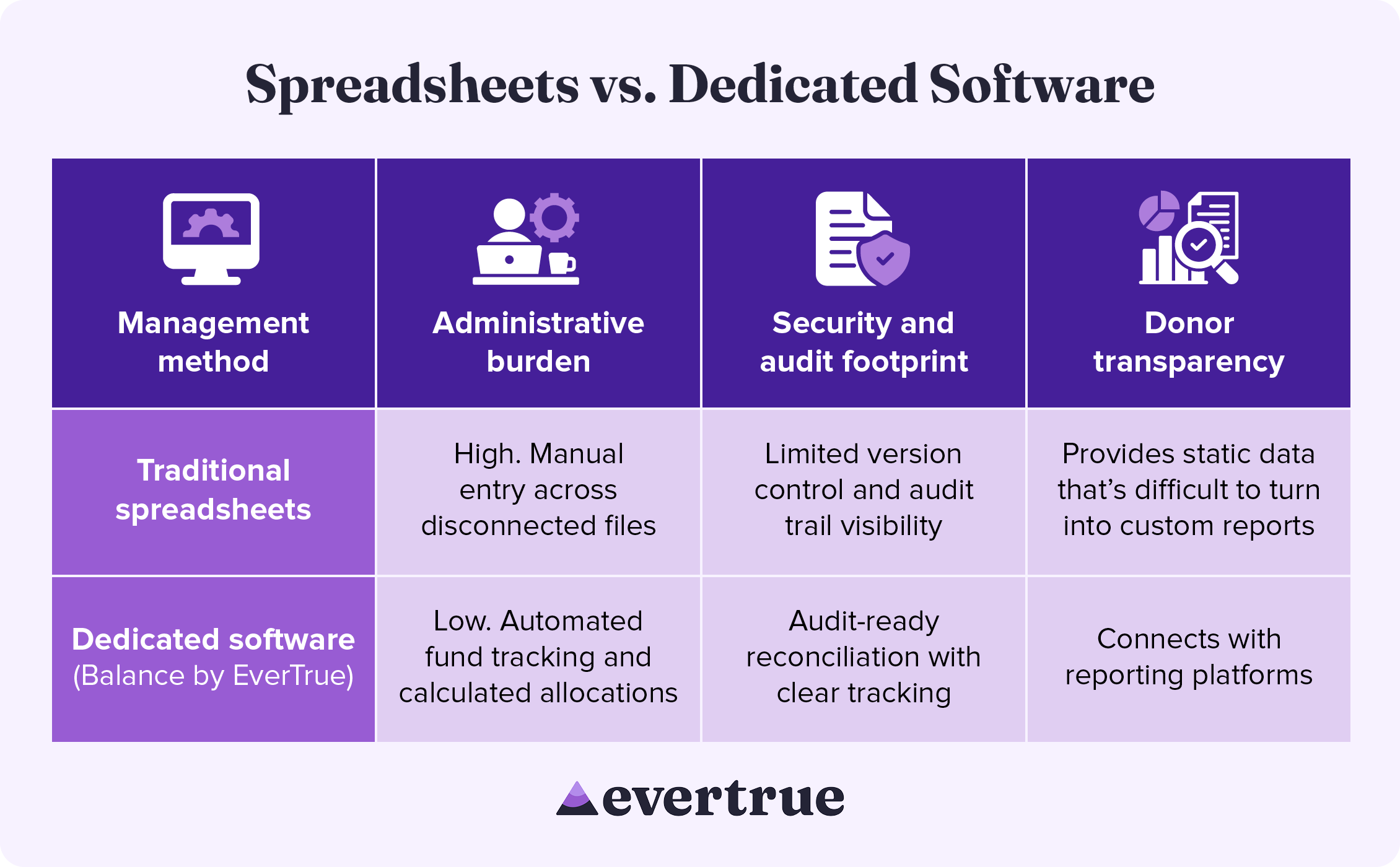
Dedicated endowment software brings accuracy and consistency to every part of the management process, from tracking individual funds to improving security. See how these solutions compare to a spreadsheet-based approach: nfographic table outlining the information below.

How These Methods Compare:

In managing your endowment with traditional spreadsheets, you may see:
  • High administrative burden: Manual entry across disconnected systems
  • Limited security and audit footprints: Reduced version control and audit trail visibility
  • Difficulty with donor transparency: Spreadsheets provide only static data that is difficult to turn into custom results.
By using dedicated software, you are likely to find the following improvements:
  • Lower administrative burden: Automated fund tracking and calculated allocations
  • Enhanced security and audit footprint: Audit-ready reconciliation with clear tracking
  • Greater donor transparency: Connects with reporting platforms
Dedicated endowment management software keeps your organization compliant while freeing up the time your team once spent manually managing spreadsheets.

Secure Your Endowment with Balance by EverTrue

Effective endowment management begins with excellent accounting. Balance by EverTrue handles unitization, applies spending rules, and produces audit-ready reports, so your team can spend more time on the donor relationships that built the fund in the first place.
  • Turn your data into a clear picture of long-term impact. Combine accurate fund accounting with donor reporting that showcases impact.
  • Connect with the tools you already use. Pair Balance with Impact by EverTrue and ODDER by EverTrue to create and deliver compelling digital endowment reports that you can send to donors with ease.
  • Know where every fund stands in real time. Check market values, gift history, and available spending for any fund. Then, share view-only versions with your team, so everyone stays informed.
With Balance, your team can stop spending all your time on manual management and instead add balance to your endowment workflow.

Additional Resources

To learn more about managing your endowment and other ways that technology can help your organization, check out these additional resources: Less stress, higher endowment funds. Discover how Balance provides the organization, security, and accuracy your endowment needs. Request a demo.
0 0 votes
Article Rating
Subscribe
Notify of
guest
0 Comments
Oldest
Newest Most Voted
Inline Feedbacks
View all comments
0
Would love your thoughts, please comment.x
()
x