













New 1:many cadences with automated emails, reusable templates, and more in Signal

DonorSearch identifies prospects in your database with the capacity and intent to give.

Missed the live session? Watch our on-demand webinars anytime to get guidance from industry experts.

Digital vs. In-Person Alumni Engagement: Making the Case for Digital

Part 1: The Choice

If you could only choose to have one of the following, would you prefer:

  • An alumnus who attends one big alumni association event annually while otherwise never connecting with your institution, or
  • An alumna who regularly follows your alumni association on its social media channels, frequently reacts and comments on posts throughout the year, but never attends an event

Choose A and you likely value in-person interaction, attendance, commitment, shared experiences, milestone or marquee events, celebrations, and community.

Choose B and you likely value alumni interaction, sustained connection, loyalty, shared experiences, the power of digital connectivity, and community.

At first glance, the difference between the two types of engagement appears stark. One is in-person, the other is virtual. One is a major celebration, the other is a sustained connection. One is traditional alumni engagement, the other is digital alumni engagement.

But then, looking at the potential justification for choosing one over the other, the distinction between the two types of engagement becomes blurred. Both empower interaction. Both require commitment. Both provide shared experiences. Both foster community.

So if they aren’t that different, why do advancement teams consistently prioritize in-person, event-driven alumni engagement over sustained digital connection?

Change of Heart

Let’s try the exercise again. Only this time, take off your staff hat and put on your alumni cap.

As an alum, if you could only choose one of the following, would you prefer to:

  • Attend one big alumni association event annually while otherwise never connecting with your institution, or
  • Regularly follow your alumni association on its social media channels, frequently react and comment on posts throughout the year, but never attend an event

If you chose the same response as you did as a staff member, did your reasoning vary? If you chose differently, why did you switch?

All or Nothin’

The reality is that alumni don’t face such a choice. Alumni who attend a single, major event are connecting on social media. And alumni connecting on social are attending big alumni events.

But while alumni may never consider this either/or dynamic, alumni relations leaders seem to be facing this very choice when it comes to budgets and resource allocation.

Despite the appeal of digital, in this context—and with the weight of history, familiarity, business-as-usual, and perception—traditional engagement often reigns while digital engagement continues to be vastly under-resourced.

Just look at alumni relations and advancement organization structures to see this disparity. Teams are stacked with roles focused largely on in-person interaction—dedicated to running major events, coordinating regional and affinity group programming, and managing volunteers. All the while, these same offices have skeleton crews for communications or a lone jill-of-all-trades handling a swath of digital needs ranging from communications to tech support.

Handle with Care

What is the justification for this? Why do alumni relations offices continue to prioritize traditional engagement methods? Should digital engagement efforts be elevated alongside traditional engagement? Or (dare we even ask) above them?

We’ll explore these questions and more in this series.

Click here to go to part 2 of our Digital vs. In-Person Alumni Engagement series.

Interested in learning more about how Facebook’s recent changes impact the future of alumni relations and development? Our EverTrue engineers wrote-up their experience at the annual f8 Developers Conference. 


Jon Horowitz’s 14 years of experience at the intersection of higher ed communications, technology, and engagement propelled him into his current role as an independent strategic consultant for higher education institutions. Prior to becoming a consultant, Jon drove digital engagement strategy at Princeton University and Rutgers University. Follow Jon on Twitter @hrwtz and check out horowitzstrategy.com for more on Jon and his work.
Endowment Spending & Growth Calculator

Enter your fund's current value and adjust the return, spending, and inflation sliders to see how its value in today's dollars changes over time.

$
6.0%
0%12%
4.0%
2%7%
3.0%
0%8%
10
5 yrs25 yrs

Value in 10 years

$0

In today's dollars

$0

4. Continue to Steward Donors

Your relationship with the donors who give to your endowment doesn’t end when you secure their gifts. Because your endowment exists to make a difference in the long term, your supporters will want you to keep in touch about its progress. Ongoing stewardship means keeping donors updated about your endowment’s performance and impact. A report that strengthens your relationship with donors should cover:
  • The fund’s balance at the start and end of the year
  • Spending amounts and allocations
  • How the fund’s returns compare to your investment targets
  • A short narrative detailing the specific impacts the endowment achieved
Create a report for each endowment rather than sending an identical document to everyone. A donor who endowed a scholarship wants to hear about the students it supported, while a donor who endowed a building fund wants updates on construction projects.

5. Upgrade Your Endowment Management Tools

Your endowment management tools should make applying your spending policy across every fund easy. Investing in dedicated software is especially useful as your endowment grows. Handling unitization in spreadsheets might work for a few funds, but as you begin to manage dozens or hundreds of gifts, dedicated software can save your team time spent manually calculating gains and losses for each one.

Why Nonprofits Need Dedicated Endowment Management Software

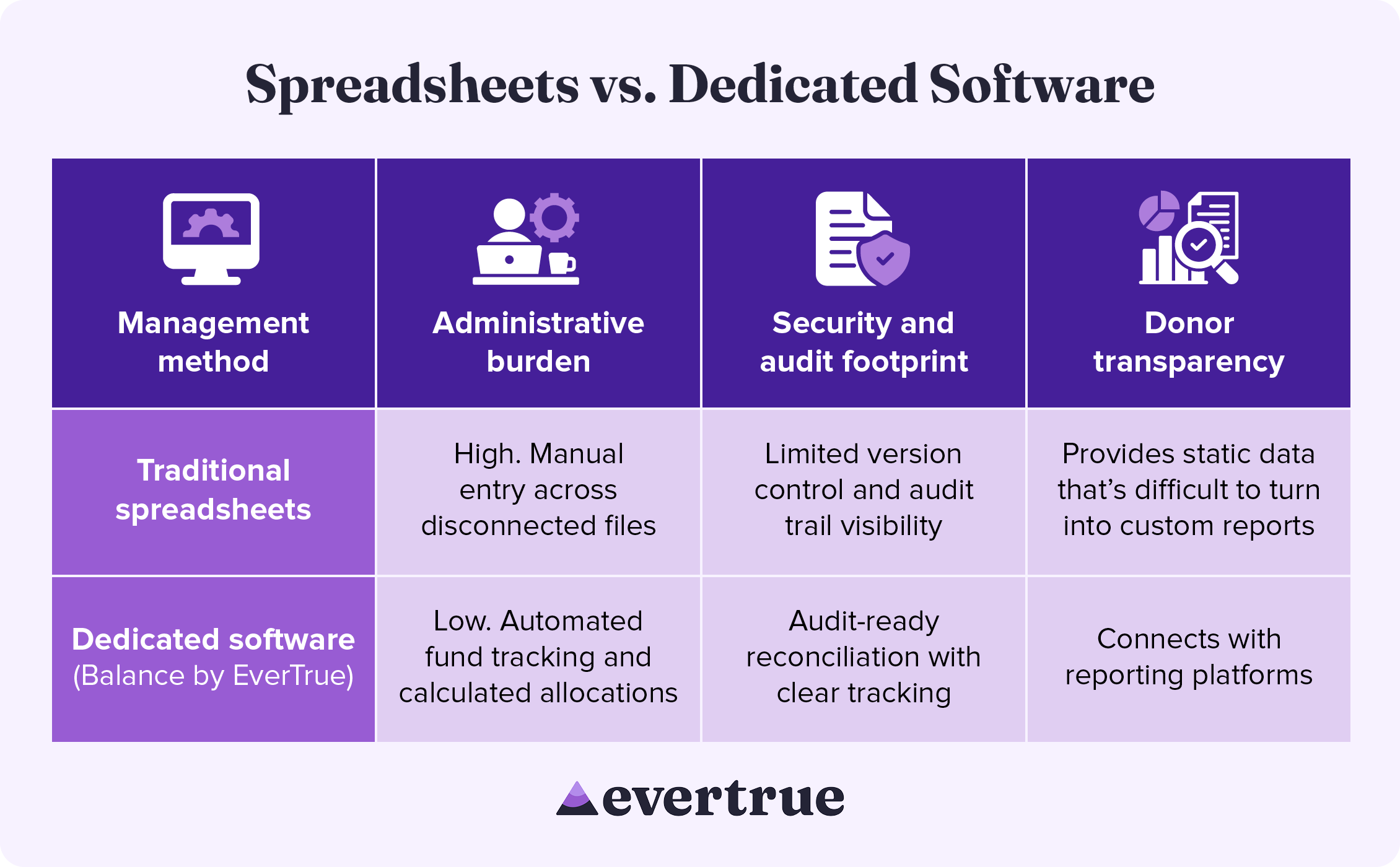
Dedicated endowment software brings accuracy and consistency to every part of the management process, from tracking individual funds to improving security. See how these solutions compare to a spreadsheet-based approach: nfographic table outlining the information below.

How These Methods Compare:

In managing your endowment with traditional spreadsheets, you may see:
  • High administrative burden: Manual entry across disconnected systems
  • Limited security and audit footprints: Reduced version control and audit trail visibility
  • Difficulty with donor transparency: Spreadsheets provide only static data that is difficult to turn into custom results.
By using dedicated software, you are likely to find the following improvements:
  • Lower administrative burden: Automated fund tracking and calculated allocations
  • Enhanced security and audit footprint: Audit-ready reconciliation with clear tracking
  • Greater donor transparency: Connects with reporting platforms
Dedicated endowment management software keeps your organization compliant while freeing up the time your team once spent manually managing spreadsheets.

Secure Your Endowment with Balance by EverTrue

Effective endowment management begins with excellent accounting. Balance by EverTrue handles unitization, applies spending rules, and produces audit-ready reports, so your team can spend more time on the donor relationships that built the fund in the first place.
  • Turn your data into a clear picture of long-term impact. Combine accurate fund accounting with donor reporting that showcases impact.
  • Connect with the tools you already use. Pair Balance with Impact by EverTrue and ODDER by EverTrue to create and deliver compelling digital endowment reports that you can send to donors with ease.
  • Know where every fund stands in real time. Check market values, gift history, and available spending for any fund. Then, share view-only versions with your team, so everyone stays informed.
With Balance, your team can stop spending all your time on manual management and instead add balance to your endowment workflow.

Additional Resources

To learn more about managing your endowment and other ways that technology can help your organization, check out these additional resources: Less stress, higher endowment funds. Discover how Balance provides the organization, security, and accuracy your endowment needs. Request a demo.
0 0 votes
Article Rating
Subscribe
Notify of
guest
0 Comments
Oldest
Newest Most Voted
Inline Feedbacks
View all comments
0
Would love your thoughts, please comment.x
()
x