















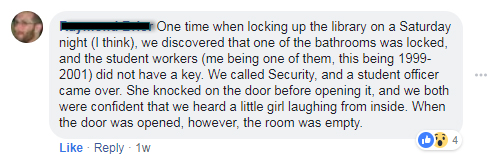
“One time, when locking up the library on a Saturday night, we discovered that one of the bathrooms was locked.
None of the student workers, myself included, had a key.
We called security and a student officer came over. She knocked on the door before opening it and we were confident that we heard a girl laughing from the inside. When the door opened, however, the room was empty.”
Northern Vermont University is a two-campus college comprised of two formerly separate institutions, Johnson State College and Lyndon State College. At NVU-Johnson, the alumni association runs a Facebook Group to drive engagement among graduates. It’s a small institution (about 12,000 alumni representing 5,900 email addresses), but it’s driving big engagement by crowdsourcing posts.
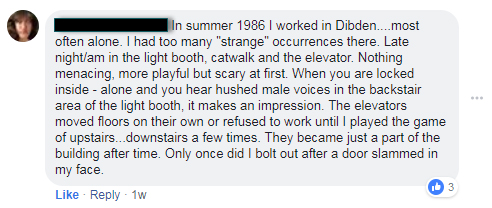
“In the summer of 1986, I worked in the Dibden Center for the Arts — most often alone. I had too many strange occurrences there, late at night in the light booth, on the catwalk, and in the elevator.
It was nothing menacing — more playful than scary — but when you are locked inside, alone, and you hear hushed male voices in the backstairs area of the light booth, it makes an impression.
The elevators moved floors on their own or refused to work until I played the game of ‘upstairs/downstairs’ a few times.
That just became part of the building after the time.
The only time I bolted was after a door slammed in my face.”
The NVU-Johnson Facebook Group has grown by 67 percent in the last year, mostly by word-of-mouth as group members and staff invited other graduates. Membership spiked this fall when NVU-Johnson drove alumni to the group via its e-newsletter by asking readers to share their campus ghost stories.
Mary Fafard, Digital Content Coordinator, talked about the importance of having alums drive the conversation.
“I reached out to Alumni Association President Steve Malo, who is the ‘king’ of our Facebook Group. His posts blow our posts out of the water when it comes to overall engagement, so that’s why I asked him to pose the question.
Steve posted the following: ‘Hey!!! NVU-Johnson is looking for any Johnson-related ghost stories! Please share below any stories that you may have heard during your tenure, or please send them to me through Messenger! Thanks for your help!!!’”
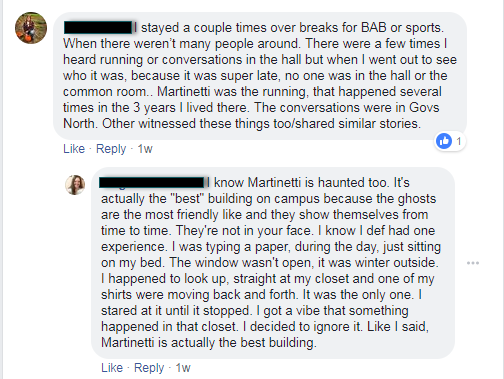
“I know Martinetti is haunted, too. It’s actually the ‘best’ dorm on campus because the ghosts are the most friendly and show themselves from time to time. They’re not in-your-face…
I was typing a paper during the day, just sitting on my bed. The window wasn’t open (it was winter). I happened to look up straight at my closet and one of my shirts was moving back and forth. It was the only one. I stared at it until it stopped.
I got a vibe that something had happened in that closet.”
Facebook recently added engagement metrics to Groups. The NVU-Johnson Group averages 39 daily active members, but in the five days following Steve’s post, the team increased activity by nearly 400 percent to 153 daily active members. The ghost story post now has 78 comments (the average number of comments per post is 4.6).
That’s a lot of engagement within a small community as alumni reflect back, share stories, and stay connected to their alma mater and each other.
These interactions on social media are critical components for increasing alumni identity — a measurement that reveals how connected graduates feel to their alma mater — and can boost the likelihood that an alum becomes a donor.
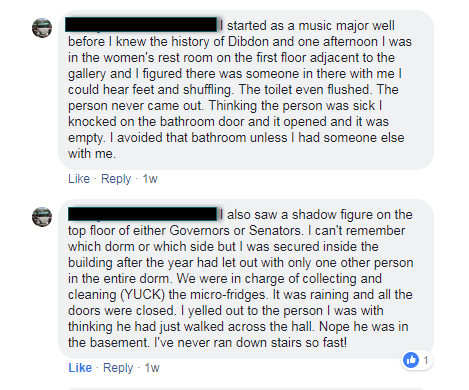
“I also saw a shadowy figure on the top floor of either Governors Hall or Senators Hall.
I can’t remember which dorm or which side, but I was secured inside the building after the year had let out with only one other person in the entire dorm. We were in charge of collecting and cleaning (yuck) the micro-fridges.
It was raining and all the dorms were closed. I yelled out to the person I was with thinking he had just walked across the hall.
Nope. He was in the basement. I’ve never run downstairs so fast!”
I love what the NVU-Johnson team did for a few reasons…
- They weren’t afraid to have fun.
Sharing ghost stories has nothing to do with “campaign priorities” or “academic excellence,” but that’s exactly why the post generated so much activity. Social media is about creating space for lively, shared experiences. Make it fun! - They used a social ambassador.
Sometimes it’s all about the messenger. Mary and her team knew their graduates were more likely to respond to a post from Steve, the alumni association president, than from staff. So they let him make the ask, driving more engagement and also giving an important volunteer new ways to contribute. - They’re not stopping with one post.
“Our goal is to have some alumni record their stories and email them to me, then we’ll send out a spooky email on Halloween that includes a few of them,” Mary said. Social-first content doesn’t have to stay on social. Great stories can fit anywhere! If you have a topic blowing up on your Facebook Page, think about how you can repackage that for an e-newsletter or the next issue of the alumni magazine.
Every school has its own ghost stories. Here’s a free idea for a post this October… ask your alumni to share their spooky tales from campus. Who knows what content you’ll unearth?
See why digital engagement matters. EverTrue looked at how 20 million graduates interacted with their alma mater online. Did you know that socially engaged alumni are 3.4x more likely to be donors?