











New 1:many cadences with automated emails, reusable templates, and more in Signal

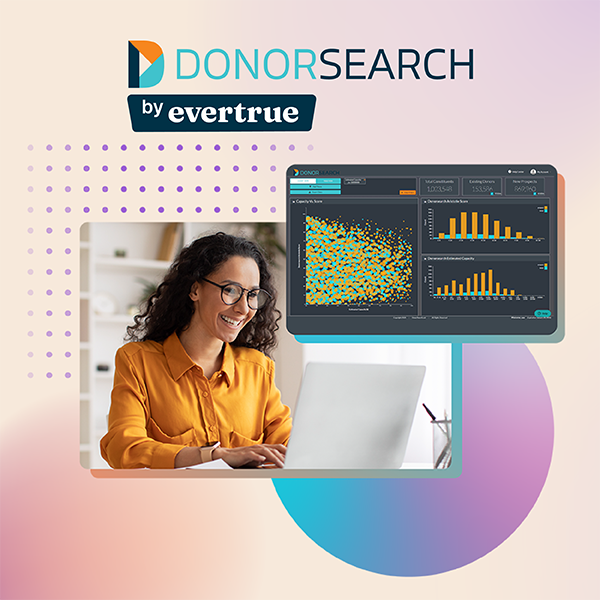
DonorSearch identifies prospects in your database with the capacity and intent to give.

Missed the live session? Watch our on-demand webinars anytime to get guidance from industry experts.

Prospecting and Yoga Have More in Common Than You’d Think

Prospecting is like yoga—what works for some doesn’t always work for others. What’s important, though, is that you experiment with new tactics.

This summer, as you embark on planning for the upcoming season, don’t stress about where to find the newest additions for your portfolio. Achieve inner peace by incorporating the following tips into your prospecting repertoire.


First, look within—your annual fund donor pool, that is.

Before devoting time and resources to finding the next Warren Buffett for your portfolio, try scanning your annual fund donor base for viable leads hiding in plain sight.

According to The Blue Ocean Strategy by W. Chan Kim and Renee Mauborgne, most companies work in “red ocean” conditions, where businesses viciously fight against each other for a share of the marketplace. Kim and Mauborgne argue that organizations should instead find a way to work in a marketplace free of competitors.

Rather than competing with other organizations for high-profile prospects like Buffett—who are often pursued by countless development officers—consider carving out your own “blue ocean” of prospects from within your annual fund. This is particularly beneficial for organizations that can’t rely on a self-replenishing pipeline of prospects, like alumni graduates.

More often than not, because of their familiarity and affinity for your organization, it takes less time and effort to increase these donors’ giving levels than to acquire high-profile prospects. Plus, the timeline for deliberation and decision-making may be shorter.

Second, strengthen your foundation by keeping your donors happy—and find others just like them.

“It’s more cost-efficient to keep the customers that you have,” preached my graduate marketing professor. It’s also more lucrative. Why? Because, in addition to keeping your acquisition costs low, retaining a loyal annual donor base increases the likelihood that you will eventually yield major gifts from them.

In 2004, The CORE Group, a private research organization that studies giving patterns at leading private and public institutions, published an analysis of University of Virginia alumni who made $1 million-plus gifts during the 1980s and 1990s. CORE found that the typical $1 million donor made gifts 12 times during this 20-year period, and that 80% of them made consistent gifts within the first five years after graduation. Interestingly, the individuals who contributed to the university consistently during these 20 years also increased the size of their gifts over time, providing nearly nine times more gift support than alumni who gave consistently during a 10-year period.

In other words, it pays (literally) to keep your existing donors engaged and giving.

Another reason is that, chances are, their personal networks are filled with people who share similar hobbies or interests—such as philanthropy. You might be able to enlist their help with prospect referrals, or better yet, with the hands-on recruitment of new supporters for your organization.

Lastly, communicate with your circles.

Thanks to countless social media platforms, people now have more opportunities than ever before to engage with your cause or organization. Listen to what they say and, should they contact you directly, take the time to respond to them accordingly.

“Return every phone call and reply to every message,” my mentor always told me. “You never know where it may lead you.” Take the initiative to start a dialogue with them. Same applies for how you integrate social media, or other forms of engagement, into your practice. People who engage or communicate with your organization on a regular basis do so because they harbor a special interest in your work. Chances are that if they care enough to communicate with you, they are open to giving to your organization.

Finally, as you look to expand your prospecting practice, remember to experiment and to strike a balance. Namaste. 

Learn more about incorporating social data into your prospecting repertoire in EverTrue’s whitepaper, “Donor Identification in the 21st Century”.


Patrick Rooney has worked in development for more than a decade, supporting organizations such as Dana-Farber Cancer Institute, Harvard Medical School, and, most recently, Massachusetts Institute of Technology’s Sloan School of Management. He lives in Boston with his wife, Nicole, and their two children, worships the Red Sox, and is obsessed with the classic movie Jaws. Send your questions, comments, and story ideas to him via LinkedIn or patrickfrooney@gmail.com.
Endowment Spending & Growth Calculator

Enter your fund's current value and adjust the return, spending, and inflation sliders to see how its value in today's dollars changes over time.

$
6.0%
0%12%
4.0%
2%7%
3.0%
0%8%
10
5 yrs25 yrs

Value in 10 years

$0

In today's dollars

$0

4. Continue to Steward Donors

Your relationship with the donors who give to your endowment doesn’t end when you secure their gifts. Because your endowment exists to make a difference in the long term, your supporters will want you to keep in touch about its progress. Ongoing stewardship means keeping donors updated about your endowment’s performance and impact. A report that strengthens your relationship with donors should cover:
  • The fund’s balance at the start and end of the year
  • Spending amounts and allocations
  • How the fund’s returns compare to your investment targets
  • A short narrative detailing the specific impacts the endowment achieved
Create a report for each endowment rather than sending an identical document to everyone. A donor who endowed a scholarship wants to hear about the students it supported, while a donor who endowed a building fund wants updates on construction projects.

5. Upgrade Your Endowment Management Tools

Your endowment management tools should make applying your spending policy across every fund easy. Investing in dedicated software is especially useful as your endowment grows. Handling unitization in spreadsheets might work for a few funds, but as you begin to manage dozens or hundreds of gifts, dedicated software can save your team time spent manually calculating gains and losses for each one.

Why Nonprofits Need Dedicated Endowment Management Software

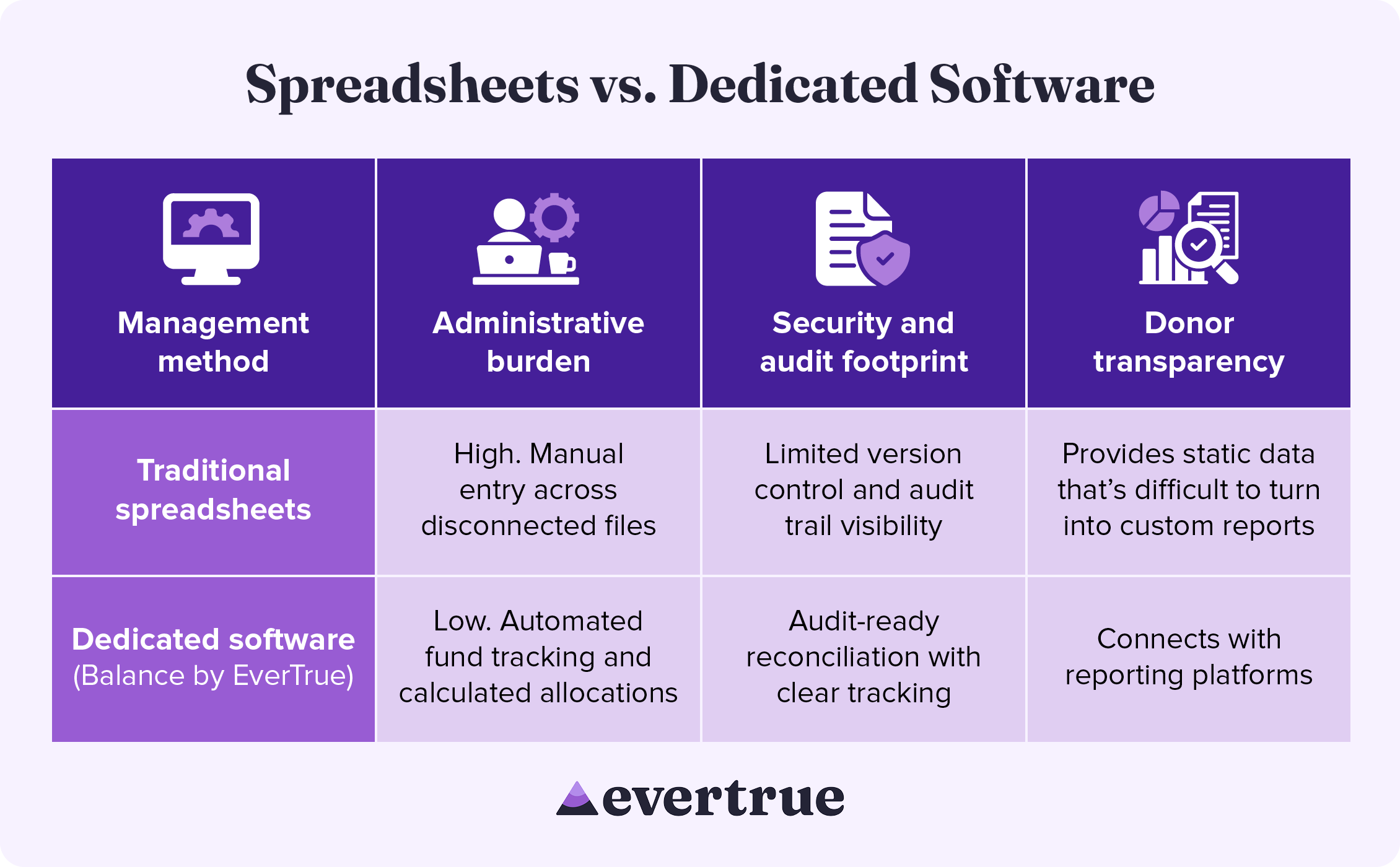
Dedicated endowment software brings accuracy and consistency to every part of the management process, from tracking individual funds to improving security. See how these solutions compare to a spreadsheet-based approach: nfographic table outlining the information below.

How These Methods Compare:

In managing your endowment with traditional spreadsheets, you may see:
  • High administrative burden: Manual entry across disconnected systems
  • Limited security and audit footprints: Reduced version control and audit trail visibility
  • Difficulty with donor transparency: Spreadsheets provide only static data that is difficult to turn into custom results.
By using dedicated software, you are likely to find the following improvements:
  • Lower administrative burden: Automated fund tracking and calculated allocations
  • Enhanced security and audit footprint: Audit-ready reconciliation with clear tracking
  • Greater donor transparency: Connects with reporting platforms
Dedicated endowment management software keeps your organization compliant while freeing up the time your team once spent manually managing spreadsheets.

Secure Your Endowment with Balance by EverTrue

Effective endowment management begins with excellent accounting. Balance by EverTrue handles unitization, applies spending rules, and produces audit-ready reports, so your team can spend more time on the donor relationships that built the fund in the first place.
  • Turn your data into a clear picture of long-term impact. Combine accurate fund accounting with donor reporting that showcases impact.
  • Connect with the tools you already use. Pair Balance with Impact by EverTrue and ODDER by EverTrue to create and deliver compelling digital endowment reports that you can send to donors with ease.
  • Know where every fund stands in real time. Check market values, gift history, and available spending for any fund. Then, share view-only versions with your team, so everyone stays informed.
With Balance, your team can stop spending all your time on manual management and instead add balance to your endowment workflow.

Additional Resources

To learn more about managing your endowment and other ways that technology can help your organization, check out these additional resources: Less stress, higher endowment funds. Discover how Balance provides the organization, security, and accuracy your endowment needs. Request a demo.
0 0 votes
Article Rating
Subscribe
Notify of
guest
0 Comments
Oldest
Newest Most Voted
Inline Feedbacks
View all comments
0
Would love your thoughts, please comment.x
()
x