














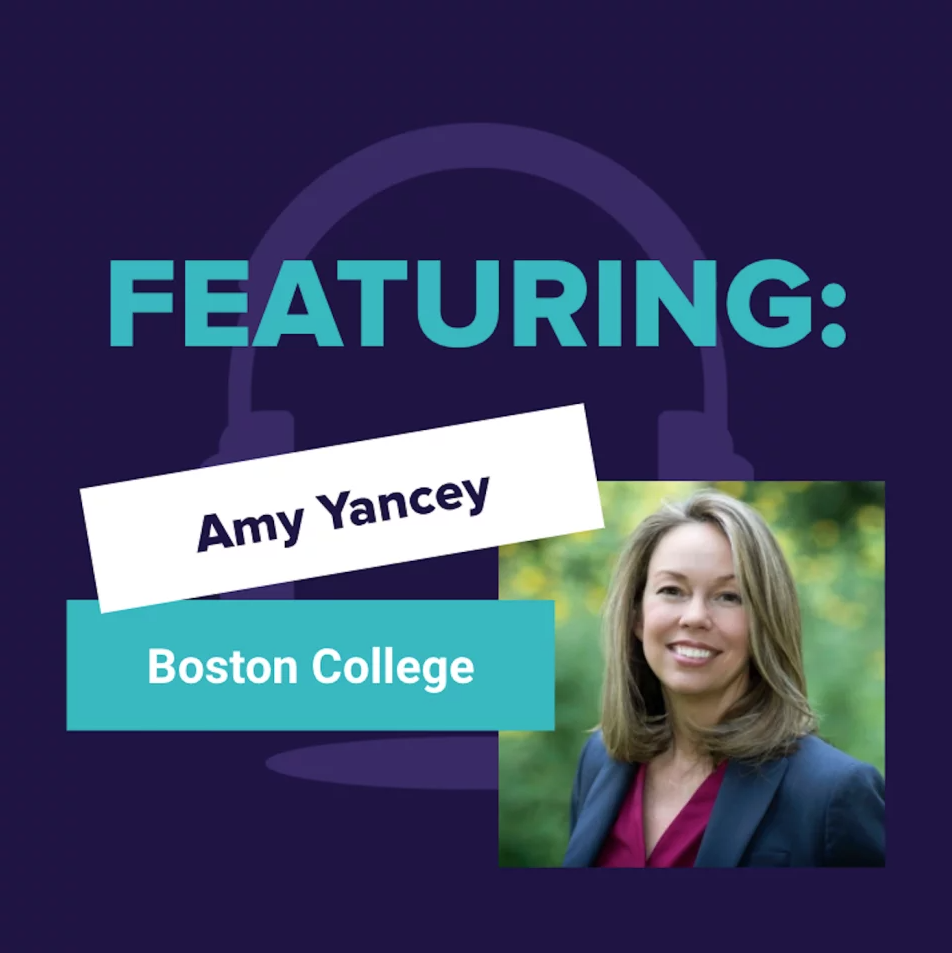
On this episode of the RAISE podcast, Brent chats with Amy Yancey, VP for Development at Boston College. Amy reflects on how (somehow!) her early career at a publishing company in the computer and video game industry led her to a career in advancement. Check out this recap featuring our favorite takeaways from the episode, and how to tune in yourself!
Here are some highlights from the episode…
Amy’s career centered around the Art of War (a computer game) before switching focus to the art of annual giving at her alma mater, the University of Tennessee.
Language matters. Our “prospects” would not like to think that they are “managed.” Perhaps a better turn of phrase, as Amy suggests, is “prospective donor.”
As the economy makes a k-shaped recovery, we’re going to have to get really good at making the case for donors to make a “high ROI” investment in our institutions.
Father Leahy, President of Boston College, shines on Zoom. And he is willing to Zoom-shine to lots of donors. And it’s paying off in myriad ways.
Advancement needs to reach outside of its age-old networks to recruit a new, more diverse wave of donors, alumni volunteers, and fundraising professionals.
When choosing a mentee, don’t gravitate towards the natural synergy. Extend your mentoring network and reach deeper into the organization to connect with those folks who might be left out of the equation. It’s an opportunity to advance inclusion and equity on our teams.
In Amy’s words, “Philanthropy is about more than dollars. It’s about a love for humanity.”
About Amy…
As we have learned through the RAISE podcast, the paths that lead folks to their careers in advancement are often winding. Amy Yancey’s might be the first one that began at a video game startup.
After completing her undergrad at University of Tennessee, Amy packed up and moved to Los Angeles with a group of friends with plans to take a year off before grad school. Instead, she met someone who just founded a publishing company to serve the computer game industry. Amy jumped at the opportunity and threw herself into content, print, production and fulfillment of written manuals that directed users on how to install and play computer games such as Art of War, Jane’s Fleet Command, and FLY, a Microsoft flight simulation game.
Pretty cool.
When Amy and her husband had their first daughter, they moved back to Knoxville to be closer to family. She had no idea what “advancement” was, but she had built great customer service, communication, writing, editing, and tech skills at the gaming startup in LA, so she was quickly hired into an entry-level communications coordinator position at the Institute of Agriculture at the University of Tennessee.
And so it began. From Art of War to Art of Advancement.
Amy recalls the first time she interviewed a major UT donor for a writeup in the alumni magazine. The donor repeatedly thanked her for allowing his family the opportunity to make their dreams a reality through an impactful gift to the University. At that moment, she was hooked. She knew she wanted to work in higher ed advancement.
So, she did. And along the way, she gathered some hard-earned wisdom, insights, and best practices.
Amy points out that we’re conditioned from a young age that it’s awkward and taboo to talk about money and wealth. That conditioning takes a lot to overcome, but Amy explains it in this way to junior fundraising professionals who are seeking to bring some ease to their solicitations: rather than thinking of fundraising as “asking for money,” approach it as presenting the opportunity for the donor to accomplish their personal and financial goals. Wealthy donors are accustomed to talking to financial advisors about their money and investments. Philanthropy is another side of the same coin. In higher ed fundraising, we are exploring whether donors’ financial goals align with the mission of our institutions. A donation could be the key to making their dreams come true.
Amy reflects on the importance of treating every person we interact with, both external folks like alumni and prospective donors as well as internal colleagues, as if they could be a six-figure donor. Because they could be. She recalls the story of an entry-level library administrator who had such a wonderful experience working at the university that her family documented a six-figure estate gift. It’s an important reminder to proudly represent our institutions in all of our interactions.
At Boston College, major gift fundraisers hold the title of “Philanthropic Advisors.” Amy encourages all of the fundraisers on her team to be extra-aware that right now, as the economy enters a k-shaped recovery, universities are going to have to convince donors that donating to their institution is a high-ROI investment.
And how do you prove ROI? Through social media stewardship campaigns. Through personalized student videos to donors using tools like Thankview. Through scalable, thoughtful, tech-enabled impact stories that reach as many donors as possible. Maybe BC’s approach can’t fully match Barstool’s recent (and very successful) crowdfunding campaigns to raise money for small local businesses, but it does give a template for an authentic, direct-impact video campaign.
Speaking of ROI, Amy agrees that the days of low ROI travel (cross-country discovery and qualification visits) are likely behind us. In-person visits will be saved for the complex, personal, and emotional work of major gift solicitations and stewardship. So, where will the money formerly spent on discovery travel be reinvested? In new tech tools and in talent management.
Amy reflects on how higher ed advancement is uniquely positioned to dissemble the systemic barriers that perpetuate racial and social inequities in the US. She remarks on how this has been a topic of discussion for over 20 years, but the sector has only moved the needle in very small ways. Why do our advancement teams and alumni leadership boards look so different from the alumni populations they serve and represent? Amy suggests that we have to disavow ourselves from the notion that we should be recruiting fundraisers and alumni volunteers from our pre-existing networks. If we want to diversify our teams and bring in new perspectives and opinions that will improve our work, we have to recruit and welcome folks from outside the traditional sources.
In her own words, “If we’re going to, in a deliberate and intentional way, fight what is like an echo box of talent recruitment, whether that’s for volunteers, donors, speakers, or for people we’re going to hire, we have to expand our network and disavow ourselves that our notion that somebody from a similar institution is best prepared to help us lead our institutions into the new challenges that we’re going face. If we don’t, we will leave an entire generation of alumni behind.”
Amy explains how BC made the decision to repurpose their international fundraising team when the pandemic hit. They reassigned portfolios so that, regardless of where a prospect physically lived, the highest-capacity, highest-inclination donors were finally being contacted on a regular basis by talented fundraising professionals. A divergence from the regional fundraising model has allowed the BC fundraising team to prioritize its most promising prospective donors. As Amy points out, “London is only one Zoom call away.” (And she can now easily bring the President, Provost, or a Dean into that Zoom call.)
Amy has had an incredibly successful career. She’s risen through the ranks, closed many major gifts, and worked with some of the biggest names in and out of the advancement world. But one thing that stands out about her is how humble she is. She is quick to point out that she has never gone on a joint visit with a faculty member, dean, or junior fundraiser where she didn’t learn something new and valuable from that person. She acknowledges that there is so much talent on our teams and our alumni and donors are immeasurably smart.
When asked what’s one thing she would change about the advancement sector, she answers, simply: Humility.
Amy, thank you for being a brilliant and humble RAISE podcast guest. We all have a lot to learn from you!
Want to work with Amy? Boston College is hiring! Check out BC’s Human Resources website for updated job posts. You can also reach out to Amy directly at amy.yancey@bu.edu, or message her on Linkedin.