










New 1:many cadences with automated emails, reusable templates, and more in Signal

DonorSearch identifies prospects in your database with the capacity and intent to give.

Missed the live session? Watch our on-demand webinars anytime to get guidance from industry experts.

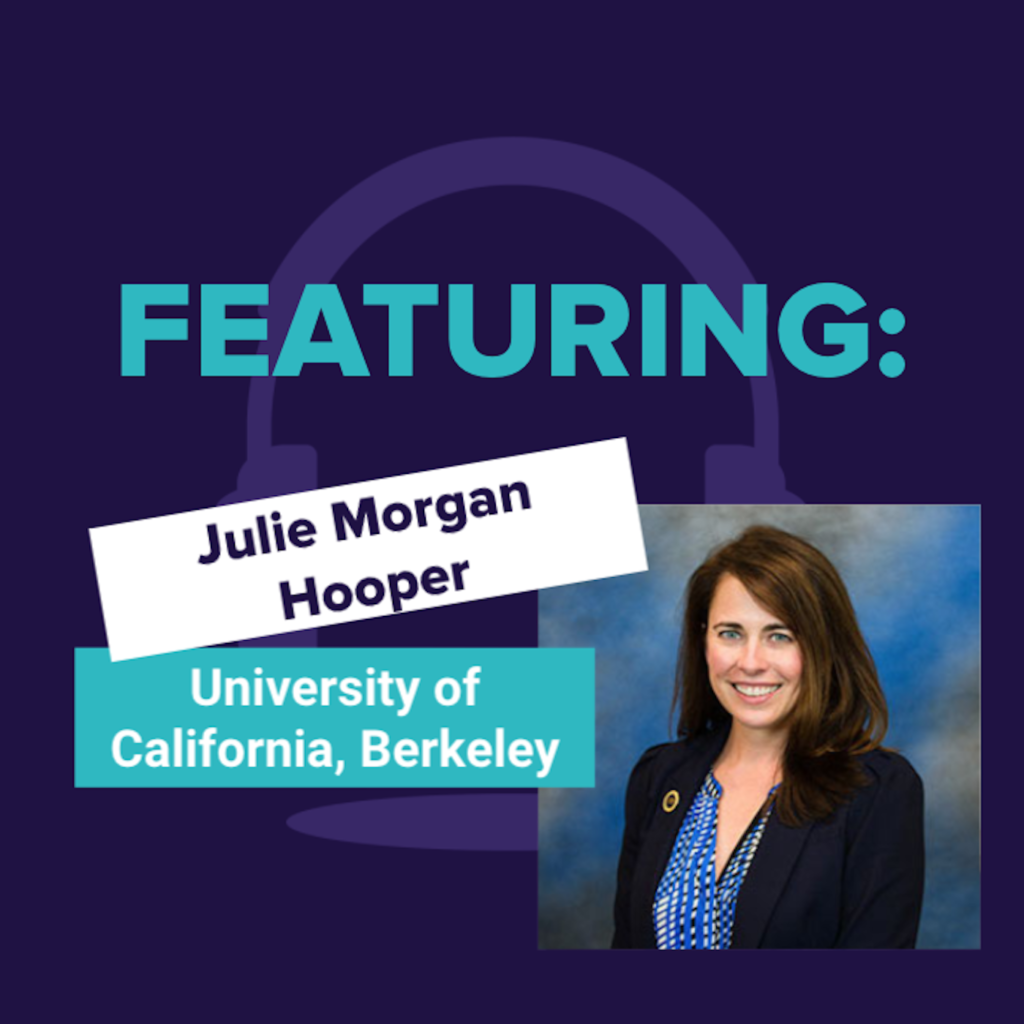
RAISE Podcast: Julie Morgan Hooper, University of California, Berkeley

On this episode of the RAISE podcast, Brent catches up with Julie Morgan Hooper, Vice Chancellor for University Development and Alumni Relations at the University of California, Berkeley. Julie explains to our audience how the debate team at her Dallas, Texas highschool led her to consider Boston University for College. She reflects on the scholarship funds that made her BU undergraduate degree possible, and how at the time, she thought of the Scholarship as not much more than a helpful line item on her semester bill. Julie and Brent talk about the importance of imparting a culture of philanthropy while students are still students; how she began her career working for a family-owned textile company that often landed her brokering new vendor relationships in India; her decision to complete a Master’s in Historic Preservation at the University of Georgia; and her experience running small nonprofits in Texas before she transitioned to working in higher ed. At UC Berkeley, Julie currently manages a team of over 250 and a budget of over $60MM. It’s a big role with lots of responsibility, and she’s thriving in it thanks to the varied experiences she collected in her life and career along the way.


Here are some highlights from the episode…

Reflecting on her own experience as a scholarship recipient at BU, Julie asks herself and the podcast audience, “How can we make a Scholarship more than just a line item to an 18-year-old college student?”

Julie began her career working at Crowe Resources International, a Texas-based, family-owned textile company. She worked her way up in the company and spent a lot of time developing the company’s international partnerships in India. During her time in India, she witnessed the deep history and spirituality of the country, some of its extreme poverty, the beginning of the tech boom in Bangalore, and the women who were paving their own ways in the textile industry and essentially forming the middle class.

Julie met her husband after she had just quit her job, moved to Austin, and didn’t yet have any set plans about her future job or course of study. They have been married for 25 years. 

Before making her entrance on the higher ed advancement stage, Julie served as the Executive Director for a number of small non-profits in the Texas area: the Heritage Society of Austin, the Colorado River Foundation, and Safe Place. At these smaller organizations, she taught her teams how to develop the muscle of asking for individual major gifts.

Julie reflects on the continued utility of Zoom and virtual meetings in discovering new prospects, diversifying the “orchestra” of campus partners that we’re able to bring into conversations with donors, and how the approach to “low ROI” donor visits will likely be changed forever. 

Julie acknowledges that the last year’s surge in increasing Diversity, Equity, Inclusion, Justice, and Belonging at our institutions is not just about our advancement teams or about improving the experience of underrepresented students in higher education. It’s about improving our world.

Want to work with Julie? UC Berkeley is hiring! Connect with Julie on LinkedIn or via email at julie.hooper@berkeley.edu.

We dedicate this episode of the RAISE podcast to Julie’s father. We know he would be so proud of the huge amount of respect she has earned from her mentors, mentees, colleagues, friends, and admirers in the advancement world.
Endowment Spending & Growth Calculator

Enter your fund's current value and adjust the return, spending, and inflation sliders to see how its value in today's dollars changes over time.

$
6.0%
0%12%
4.0%
2%7%
3.0%
0%8%
10
5 yrs25 yrs

Value in 10 years

$0

In today's dollars

$0

4. Continue to Steward Donors

Your relationship with the donors who give to your endowment doesn’t end when you secure their gifts. Because your endowment exists to make a difference in the long term, your supporters will want you to keep in touch about its progress. Ongoing stewardship means keeping donors updated about your endowment’s performance and impact. A report that strengthens your relationship with donors should cover:
  • The fund’s balance at the start and end of the year
  • Spending amounts and allocations
  • How the fund’s returns compare to your investment targets
  • A short narrative detailing the specific impacts the endowment achieved
Create a report for each endowment rather than sending an identical document to everyone. A donor who endowed a scholarship wants to hear about the students it supported, while a donor who endowed a building fund wants updates on construction projects.

5. Upgrade Your Endowment Management Tools

Your endowment management tools should make applying your spending policy across every fund easy. Investing in dedicated software is especially useful as your endowment grows. Handling unitization in spreadsheets might work for a few funds, but as you begin to manage dozens or hundreds of gifts, dedicated software can save your team time spent manually calculating gains and losses for each one.

Why Nonprofits Need Dedicated Endowment Management Software

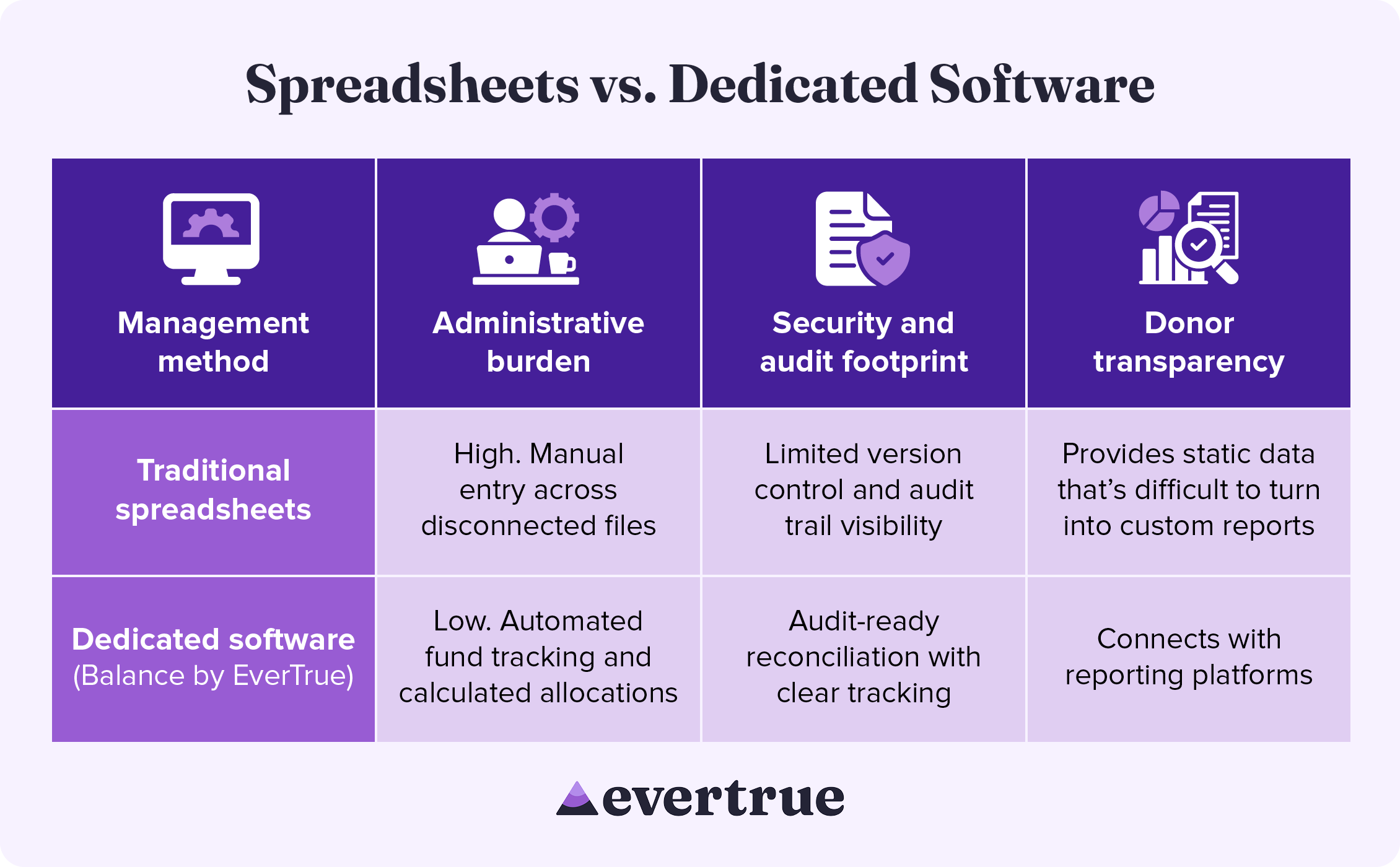
Dedicated endowment software brings accuracy and consistency to every part of the management process, from tracking individual funds to improving security. See how these solutions compare to a spreadsheet-based approach: nfographic table outlining the information below.

How These Methods Compare:

In managing your endowment with traditional spreadsheets, you may see:
  • High administrative burden: Manual entry across disconnected systems
  • Limited security and audit footprints: Reduced version control and audit trail visibility
  • Difficulty with donor transparency: Spreadsheets provide only static data that is difficult to turn into custom results.
By using dedicated software, you are likely to find the following improvements:
  • Lower administrative burden: Automated fund tracking and calculated allocations
  • Enhanced security and audit footprint: Audit-ready reconciliation with clear tracking
  • Greater donor transparency: Connects with reporting platforms
Dedicated endowment management software keeps your organization compliant while freeing up the time your team once spent manually managing spreadsheets.

Secure Your Endowment with Balance by EverTrue

Effective endowment management begins with excellent accounting. Balance by EverTrue handles unitization, applies spending rules, and produces audit-ready reports, so your team can spend more time on the donor relationships that built the fund in the first place.
  • Turn your data into a clear picture of long-term impact. Combine accurate fund accounting with donor reporting that showcases impact.
  • Connect with the tools you already use. Pair Balance with Impact by EverTrue and ODDER by EverTrue to create and deliver compelling digital endowment reports that you can send to donors with ease.
  • Know where every fund stands in real time. Check market values, gift history, and available spending for any fund. Then, share view-only versions with your team, so everyone stays informed.
With Balance, your team can stop spending all your time on manual management and instead add balance to your endowment workflow.

Additional Resources

To learn more about managing your endowment and other ways that technology can help your organization, check out these additional resources: Less stress, higher endowment funds. Discover how Balance provides the organization, security, and accuracy your endowment needs. Request a demo.
0 0 votes
Article Rating
Subscribe
Notify of
guest
0 Comments
Oldest
Newest Most Voted
Inline Feedbacks
View all comments
0
Would love your thoughts, please comment.x
()
x