
















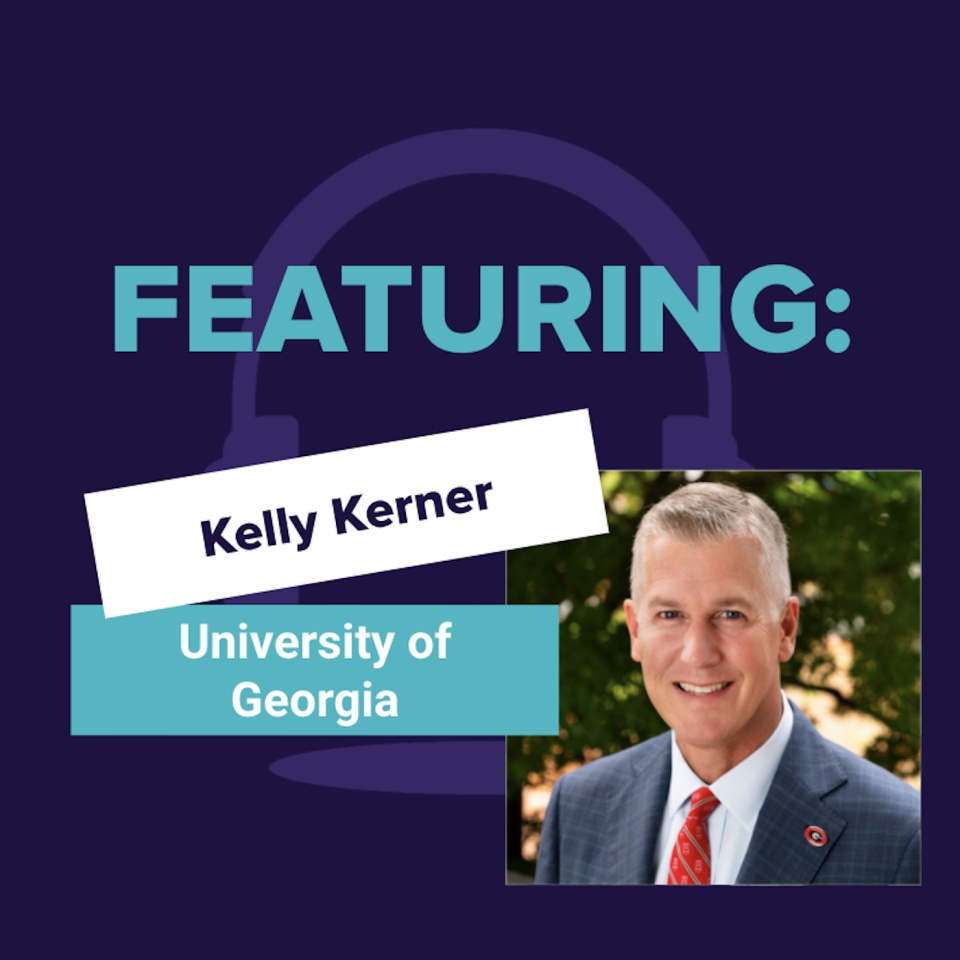
On this episode of the RAISE podcast, Brent chats with Kelly Kerner, Vice President for Development and Alumni Relations and Executive Director of the University of Georgia Foundation.
Kelly’s career has spanned small, private colleges to large, public institutions, which helps him bring a unique perspective to his work.
Listen to the full episode here or read on for the highlights.
Here are some highlights from the episode…
Kelly played tennis at UC Boulder and went pro for a few years. He attained an ATP ranking and played internationally for two years before retiring the racket. He says one of the best things that happened during his tennis career was a match he lost. To console himself, he headed into an ice cream shop and met his future wife. He attributes many life lessons to things he learned on the tennis court.
After a brief experience at a failed startup, Kelly took a job in athletics fundraising. He didn’t expect to stay in fundraising, but the career path fell in his lap. He “loved the mission of what we were trying to accomplish,” so after moving to Vermont, he proactively contacted Middlebury College weekly until they gave him an opportunity as a fundraiser.
Kelly met his mentor, Terry Mayo, at Middlebury College. Terry taught Kelly that “it’s never about you” in the relationship with a donor. He felt that it was the goal of fundraisers to work with philanthropists to understand how they want to change the world, even if your institution isn’t the right place for them.
Kelly moved from an individual fundraiser into a leadership position when he went to Bates College and met another mentor, David Lawrence. The first thing he said was, “as a VP your job is not as much to raise money as it is to cause money to be raised.” This helped Kelly learn to focus on elevating the work of his team above all else.
After moving from Bowdoin to the University of Georgia, the alumni body Kelly managed grew 10x. He believes it’s about juggling complexities on a different scale. “The work is the work,” and “at the end of the day, it’s all about people.” He prioritized hiring incredible people and building on the existing strength of the team to achieve success.
UGA created the Georgia Commitment scholarship to support the needs of students who are food insecure or homeless. They solicited a $30 million dollar gift from a foundation in Atlanta and paired it with a matching program for gifts of $50k, $75k, or $100k. This allowed an immediate scholarship to be available while the endowment grew for future use. It is a fully transformative scholarship that Kelly is proud to have been a part of.
More about Kelly…
Vice President Kerner has been at the helm, serving as the University of Georgia’s vice president for development and alumni relations, since July 2014. In this role, he guides the entire fundraising operation, alumni relations, career counseling; he also serves as the executive director of the UGA Foundation. Under his leadership, overall giving has increased from a three-year-rolling average of $115 million annually in 2014 to more than $200 million last year. He also directed the most successful comprehensive campaign in UGA’s history, which raised more than $1.45 billion. With a focus on long-term, sustainable growth, he created an organizational structure built to increase revenue opportunities. During his tenure, the University of Georgia secured its largest single gift of $30 million, which became the catalyst for a matching need-based aid scholarship program, ultimately raising more than $90 million for need-based scholarships. Before joining UGA, Kerner served as Senior Vice President for Development and Alumni Relations and Secretary of the College at Bowdoin College in Brunswick, Maine. In that role, he reorganized the team for better collaboration and more efficiency and also introduced a metrics-driven approach to their fundraising structure. Under his leadership, individual fundraising visits, overall giving, annual giving, total number of alumni fund volunteers and the total number of alumni events all increased. Prior to joining Bowdoin, he served as Vice President for College Advancement at Bates College in Maine. There, he led a reorganization effort and significantly increased the staff. As a result, fundraising visits nearly tripled, annual giving increased by 28% and overall giving increased 46%. Kerner also held various development roles at Middlebury College and the University of Portland prior to joining Bates. He holds a bachelor’s degree from the University of Colorado, Boulder, where he was on the varsity tennis team. He achieved an international ranking in 1987 on the Association of Tennis Professionals tour. He has been married to Rachel Kerner for 33 years, and together they have a son, Colin, 25, (UGA ‘19) and daughter Grace, 21 (UGA ‘22).