




New 1:many cadences with automated emails, reusable templates, and more in Signal

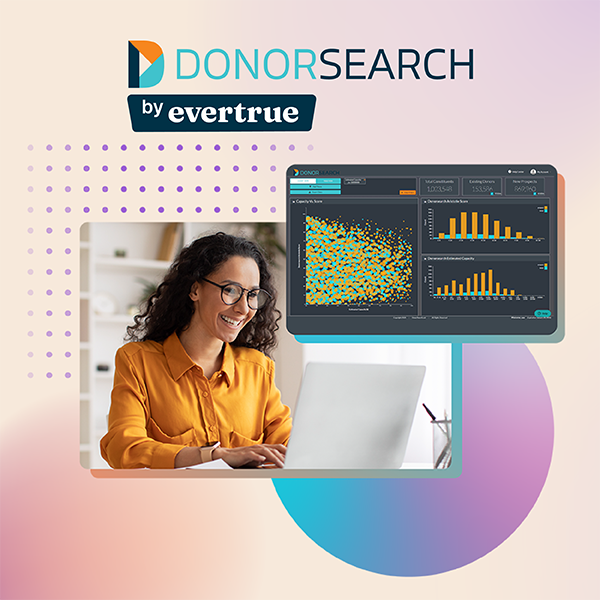
DonorSearch identifies prospects in your database with the capacity and intent to give.

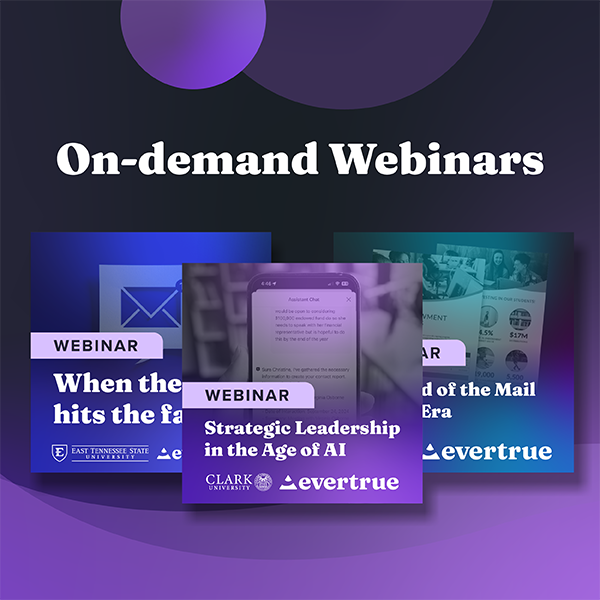
Missed the live session? Watch our on-demand webinars anytime to get guidance from industry experts.

Make Your Constituent Interactions More Personal with Social Media

Social media offers nonprofits of all sizes the same rewards it offers the millions of us who use it personally: an immediacy of attentiveness, engagement and interaction, and ever-growing networks of new colleagues and friends. Those rewards are impossible to achieve through direct mail and even email.

Many of us in prospect research didn’t have the advantages of social media when we first began our careers.  When I started working as a prospect researcher in a local social service agency in 2000, I envied the researchers from higher education institutions whom I met at APRA conferences. After all, how hard could it be when you had a built-in constituency already loyal to your mission?

At my organization, I searched for hidden millionaires among our direct mail donors and the people who filled the corporate tables at our annual awards dinner. I examined corporate and nonprofit board lists for people our trustees might know and would be willing to solicit. One summer I even combed through 40 years of scrapbooks to see if any of the members pictured in old newspaper clippings had gone on to greatness or were even in our database. And on those rare occasions when I did find a wealthy prospect, all too often I was only guessing at whether they would have any interest in supporting programs, much less any passion for it.

So, yes, I was jealous of those colleges and universities who created hundreds if not thousands of loyal alumni prospects year after year after year.

In 2009, I left the social service agency and joined the research team at a major university, where I found out the grass wasn’t necessarily any greener. True, we had large internal lists we could comb through for prospects. But I discovered that a degree did not necessarily a donor make, attendance did not equal affinity, and wealth and passion weren’t always aligned.

As it turns out, 2009 was also the year my former employer (the social service agency) first created its Facebook page. Today, the page has over 3,000 likers—roughly the number of annual donors the organization had in my days there. As for the university, it waited until 2010 to join Facebook, but it now has over 38,000 likers. That’s many times the current enrollment. I know who I’d be taking a closer look at if I were still a researcher at either of those organizations…

Facebook likers—and similarly organizations’ followers on LinkedIn, Instagram, Twitter, and other social platforms—have joined a community. They’ve created multi-lateral relationships and space for conversation, not just transactions. Unlike recipients on direct mail acquisition lists, these likers and followers haven’t simply opted-in; they’ve each sought out the organizations they have chosen to follow. They’ve all expressed true interest and offered real interaction. More importantly for me as a prospect researcher, the likers and followers have created a community, a network, a constituency with built-in affinity and engagement.

While adhering to the APRA Social Media Ethics Statement, my next step as a researcher is to look for the wealth within that community. Those ethics require me to locate and analyze asset and affinity data found and verified in publicly available resources not within any constituent’s social media posts on his/her private page.

Social media gives all nonprofits, whether or not they already have natural constituencies, stronger measures of interest and passion to help organically build a constituency of prospects, donors, and friends from the bottom up.

For more information on how social media has proven itself to be a significant source of new major gift donors and an excellent stewardship tool for your biggest current donors, read this blog by BWF_social’s Justin Ware.


Sarah Bernstein is an independent consultant in Milwaukee, WI, supporting nonprofit organizations with prospect research and database analysis. She earlier worked in both the social service and higher education sectors. Sarah is an active member of APRA International and past president of the APRA Wisconsin Chapter. She blogs at The Fundraising Back-Office and can also be found on LinkedIn and Twitter.
Endowment Spending & Growth Calculator

Enter your fund's current value and adjust the return, spending, and inflation sliders to see how its value in today's dollars changes over time.

$
6.0%
0%12%
4.0%
2%7%
3.0%
0%8%
10
5 yrs25 yrs

Value in 10 years

$0

In today's dollars

$0

4. Continue to Steward Donors

Your relationship with the donors who give to your endowment doesn’t end when you secure their gifts. Because your endowment exists to make a difference in the long term, your supporters will want you to keep in touch about its progress. Ongoing stewardship means keeping donors updated about your endowment’s performance and impact. A report that strengthens your relationship with donors should cover:
  • The fund’s balance at the start and end of the year
  • Spending amounts and allocations
  • How the fund’s returns compare to your investment targets
  • A short narrative detailing the specific impacts the endowment achieved
Create a report for each endowment rather than sending an identical document to everyone. A donor who endowed a scholarship wants to hear about the students it supported, while a donor who endowed a building fund wants updates on construction projects.

5. Upgrade Your Endowment Management Tools

Your endowment management tools should make applying your spending policy across every fund easy. Investing in dedicated software is especially useful as your endowment grows. Handling unitization in spreadsheets might work for a few funds, but as you begin to manage dozens or hundreds of gifts, dedicated software can save your team time spent manually calculating gains and losses for each one.

Why Nonprofits Need Dedicated Endowment Management Software

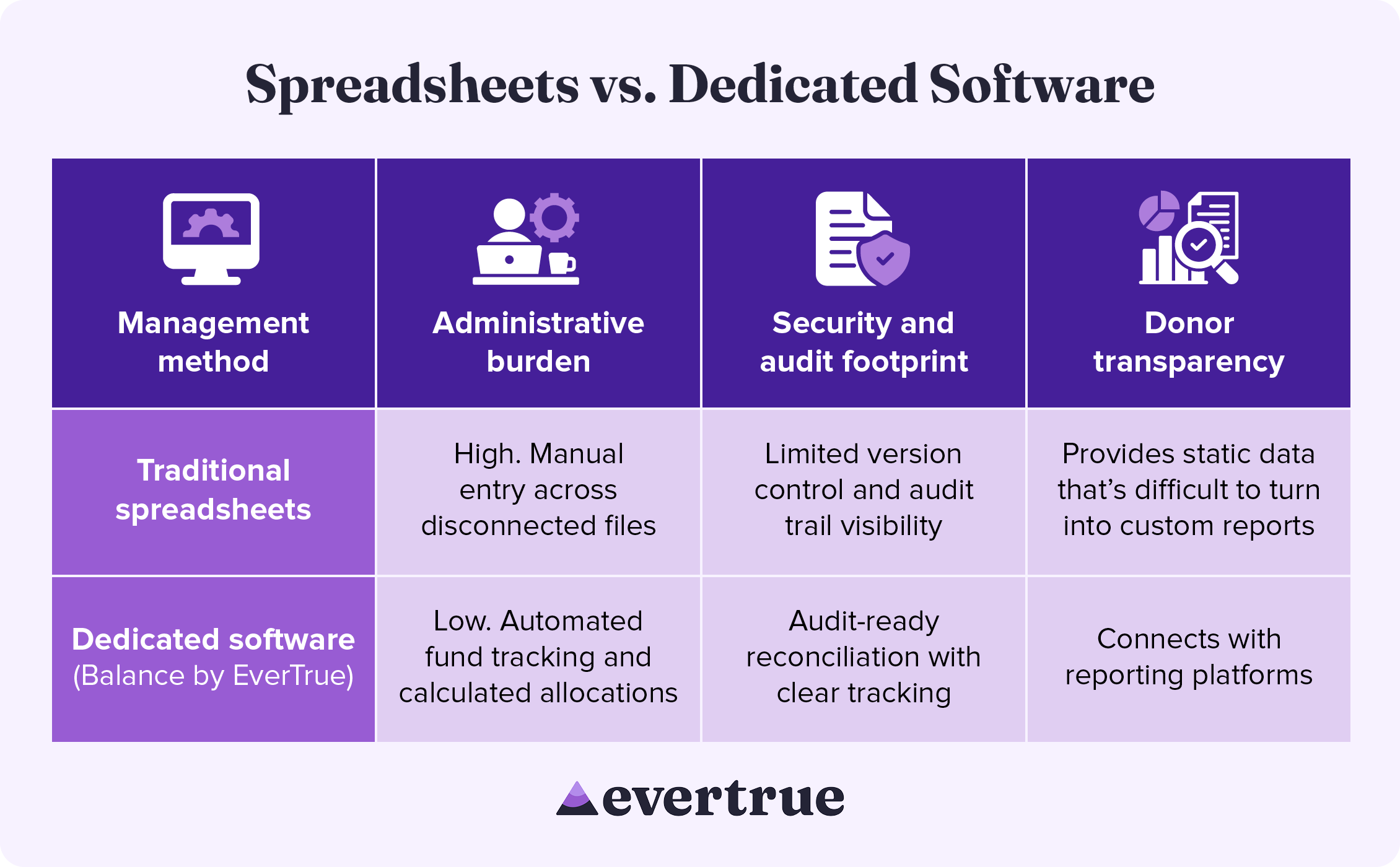
Dedicated endowment software brings accuracy and consistency to every part of the management process, from tracking individual funds to improving security. See how these solutions compare to a spreadsheet-based approach: nfographic table outlining the information below.

How These Methods Compare:

In managing your endowment with traditional spreadsheets, you may see:
  • High administrative burden: Manual entry across disconnected systems
  • Limited security and audit footprints: Reduced version control and audit trail visibility
  • Difficulty with donor transparency: Spreadsheets provide only static data that is difficult to turn into custom results.
By using dedicated software, you are likely to find the following improvements:
  • Lower administrative burden: Automated fund tracking and calculated allocations
  • Enhanced security and audit footprint: Audit-ready reconciliation with clear tracking
  • Greater donor transparency: Connects with reporting platforms
Dedicated endowment management software keeps your organization compliant while freeing up the time your team once spent manually managing spreadsheets.

Secure Your Endowment with Balance by EverTrue

Effective endowment management begins with excellent accounting. Balance by EverTrue handles unitization, applies spending rules, and produces audit-ready reports, so your team can spend more time on the donor relationships that built the fund in the first place.
  • Turn your data into a clear picture of long-term impact. Combine accurate fund accounting with donor reporting that showcases impact.
  • Connect with the tools you already use. Pair Balance with Impact by EverTrue and ODDER by EverTrue to create and deliver compelling digital endowment reports that you can send to donors with ease.
  • Know where every fund stands in real time. Check market values, gift history, and available spending for any fund. Then, share view-only versions with your team, so everyone stays informed.
With Balance, your team can stop spending all your time on manual management and instead add balance to your endowment workflow.

Additional Resources

To learn more about managing your endowment and other ways that technology can help your organization, check out these additional resources: Less stress, higher endowment funds. Discover how Balance provides the organization, security, and accuracy your endowment needs. Request a demo.
0 0 votes
Article Rating
Subscribe
Notify of
guest
0 Comments
Oldest
Newest Most Voted
Inline Feedbacks
View all comments
0
Would love your thoughts, please comment.x
()
x