






New 1:many cadences with automated emails, reusable templates, and more in Signal

DonorSearch identifies prospects in your database with the capacity and intent to give.

Missed the live session? Watch our on-demand webinars anytime to get guidance from industry experts.

Surveys: Alumni Relations’ Best Friend

Has one (or all) of these reasons kept you from surveying your constituents?

“We shouldn’t ask if we’re not going to change anything.”
“I was there—I could tell people were happy.”
“People get too many surveys.”

They’re all valid. They’re all bunk.

Let me explain.

Those statements are valid, IF you send out surveys solely to get feedback about the logistics of a transaction—an event, a website visit, or a volunteer experience. But they’re bunk if you consider surveys as a way to continue and/or fix the relationships you started when you invited people to engage.

For example, let’s say you get a standing ovation at your event. You get the impression that the event went really well. Bob is the only person who fills out the survey and says he hated the venue. If you only care about event logistics, then go ahead and ignore lone-respondent Bob.

But if you care about your relationship with Bob, and you care about the influence he may have on other constituents, then Bob just gave you a precious gift: a second chance. It doesn’t matter that nobody else answered the survey. Doesn’t matter that everyone else was happy. Doesn’t matter that you’re not going to change the venue. What matters is Bob.

Research shows that 70% of people who had a bad experience are willing to give the organization another chance if they get great customer service, whereas 89% of people stop engaging with organizations because of bad customer service. People are twice as likely to talk about bad customer service rather than good customer service, and 26% of people post negative comments on social media after poor service. So the people who are least happy seem to have the loudest voices.

In our experience here at Cornell, alumni who gave us poor evaluations are blown away when we phone or email them to learn more about their experiences. Yes, it can be hard to find the time and tough to face criticism. But you spent dozens of hours planning that experience for Bob—what’s another 5-10 minutes on the phone to ensure that he remains engaged?

Surveys—and the subsequent alumni interactions they necessitate—should be valued not only by alumni relations professionals on your team but by prospect researchers and fundraisers too! To learn more about the direct correlation between alumni engagement and dollars raised, read our blog post that details how University of Cincinnati President Santa Ono has turned Twitter interactions into more than $1 million.


Jennifer Cunninghams job is to find stories in Cornell’s alumni data, then use the findings to help her team turn attendance into engagement. Beyond her day job, you’ll find her speaking at industry conferences, writing articles about engagement, and consulting with other alumni offices and nonprofits on survey design, engagement metrics, and use of Net Promoter. You can connect with Jennifer on Twitter, on her blog, or via email at Jennifer.Cunningham@cornell.edu.
Endowment Spending & Growth Calculator

Enter your fund's current value and adjust the return, spending, and inflation sliders to see how its value in today's dollars changes over time.

$
6.0%
0%12%
4.0%
2%7%
3.0%
0%8%
10
5 yrs25 yrs

Value in 10 years

$0

In today's dollars

$0

4. Continue to Steward Donors

Your relationship with the donors who give to your endowment doesn’t end when you secure their gifts. Because your endowment exists to make a difference in the long term, your supporters will want you to keep in touch about its progress. Ongoing stewardship means keeping donors updated about your endowment’s performance and impact. A report that strengthens your relationship with donors should cover:
  • The fund’s balance at the start and end of the year
  • Spending amounts and allocations
  • How the fund’s returns compare to your investment targets
  • A short narrative detailing the specific impacts the endowment achieved
Create a report for each endowment rather than sending an identical document to everyone. A donor who endowed a scholarship wants to hear about the students it supported, while a donor who endowed a building fund wants updates on construction projects.

5. Upgrade Your Endowment Management Tools

Your endowment management tools should make applying your spending policy across every fund easy. Investing in dedicated software is especially useful as your endowment grows. Handling unitization in spreadsheets might work for a few funds, but as you begin to manage dozens or hundreds of gifts, dedicated software can save your team time spent manually calculating gains and losses for each one.

Why Nonprofits Need Dedicated Endowment Management Software

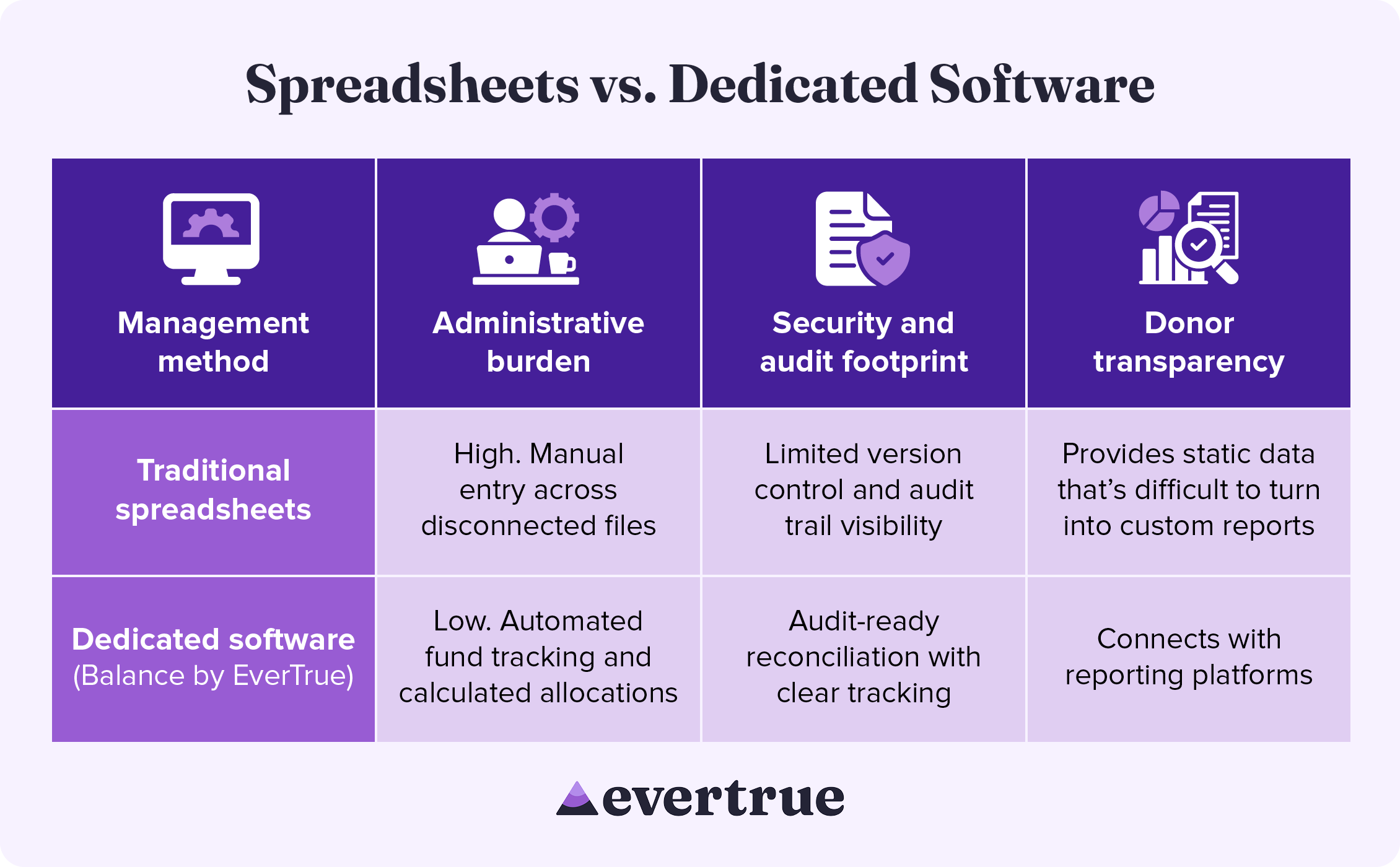
Dedicated endowment software brings accuracy and consistency to every part of the management process, from tracking individual funds to improving security. See how these solutions compare to a spreadsheet-based approach: nfographic table outlining the information below.

How These Methods Compare:

In managing your endowment with traditional spreadsheets, you may see:
  • High administrative burden: Manual entry across disconnected systems
  • Limited security and audit footprints: Reduced version control and audit trail visibility
  • Difficulty with donor transparency: Spreadsheets provide only static data that is difficult to turn into custom results.
By using dedicated software, you are likely to find the following improvements:
  • Lower administrative burden: Automated fund tracking and calculated allocations
  • Enhanced security and audit footprint: Audit-ready reconciliation with clear tracking
  • Greater donor transparency: Connects with reporting platforms
Dedicated endowment management software keeps your organization compliant while freeing up the time your team once spent manually managing spreadsheets.

Secure Your Endowment with Balance by EverTrue

Effective endowment management begins with excellent accounting. Balance by EverTrue handles unitization, applies spending rules, and produces audit-ready reports, so your team can spend more time on the donor relationships that built the fund in the first place.
  • Turn your data into a clear picture of long-term impact. Combine accurate fund accounting with donor reporting that showcases impact.
  • Connect with the tools you already use. Pair Balance with Impact by EverTrue and ODDER by EverTrue to create and deliver compelling digital endowment reports that you can send to donors with ease.
  • Know where every fund stands in real time. Check market values, gift history, and available spending for any fund. Then, share view-only versions with your team, so everyone stays informed.
With Balance, your team can stop spending all your time on manual management and instead add balance to your endowment workflow.

Additional Resources

To learn more about managing your endowment and other ways that technology can help your organization, check out these additional resources: Less stress, higher endowment funds. Discover how Balance provides the organization, security, and accuracy your endowment needs. Request a demo.
0 0 votes
Article Rating
Subscribe
Notify of
guest
0 Comments
Oldest
Newest Most Voted
Inline Feedbacks
View all comments
0
Would love your thoughts, please comment.x
()
x