















We talk to fundraisers across the country every day. We talk about what’s working. What tools, methods and approaches are critical to their day to day. What projects they dream about getting off the ground.
We also hear about what’s not working. What walls they continually feel like they’re banging their heads against. What limitations they face in various aspects of their work.
Since we’re not tied to dollar and donor goals at EverTrue, and don’t hear the clock ticking quickly and loudly toward the fiscal year end, it gives us the ability to step back and look at the full picture of where the industry is and where we believe it can go.
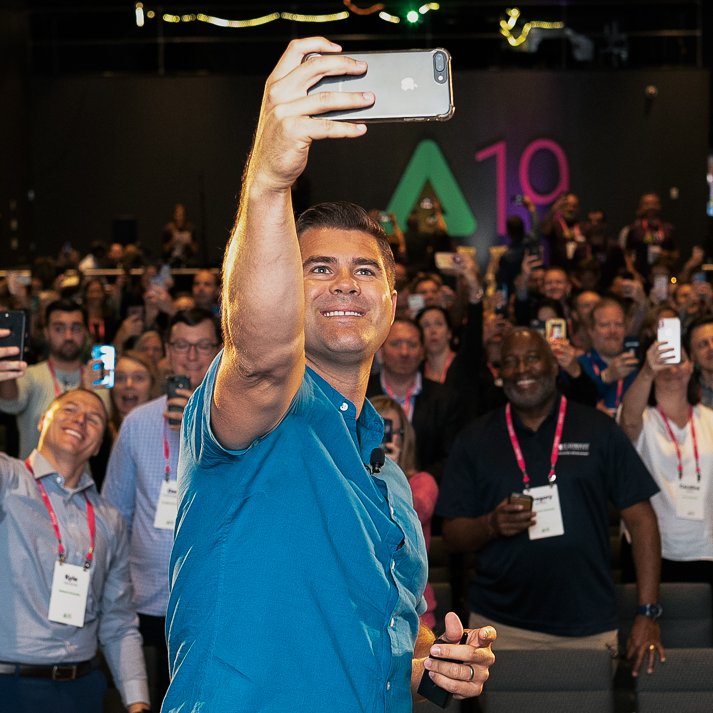
Which is why, to kick off RAISE 2019, EverTrue founder and CEO Brent Grinna reflected on what we’ve seen over the past year and what we believe are the next steps forward for advancement. We’re not talking about big, lofty steps you should build into your institutional goals for 2030. These are right there for the taking. All you have to do is put one foot in front of the other and take it one pace at a time.
After hundreds (thousands?) of conversations this past year, a ton of observation and lots of friendly debate, this is what we see as the path forward.
A truly personalized approach
Have you ever flown JetBlue? Brent sure has. And, despite what you might think of the startup lifestyle, he’s not some jet setting CEO, on the road 80% of the time. Most days you’ll find him at the office, in the trenches with the rest of the team.
But he does get around a decent amount. No one at JetBlue would think of him as one of their top-tier customers, but he’s a frequent enough flyer to catch their attention.
Which is exactly the point.
He’s frequent enough. He shows clear loyalty to JetBlue. But he’s not a major flyer. He’s not in their top 5% of customers.
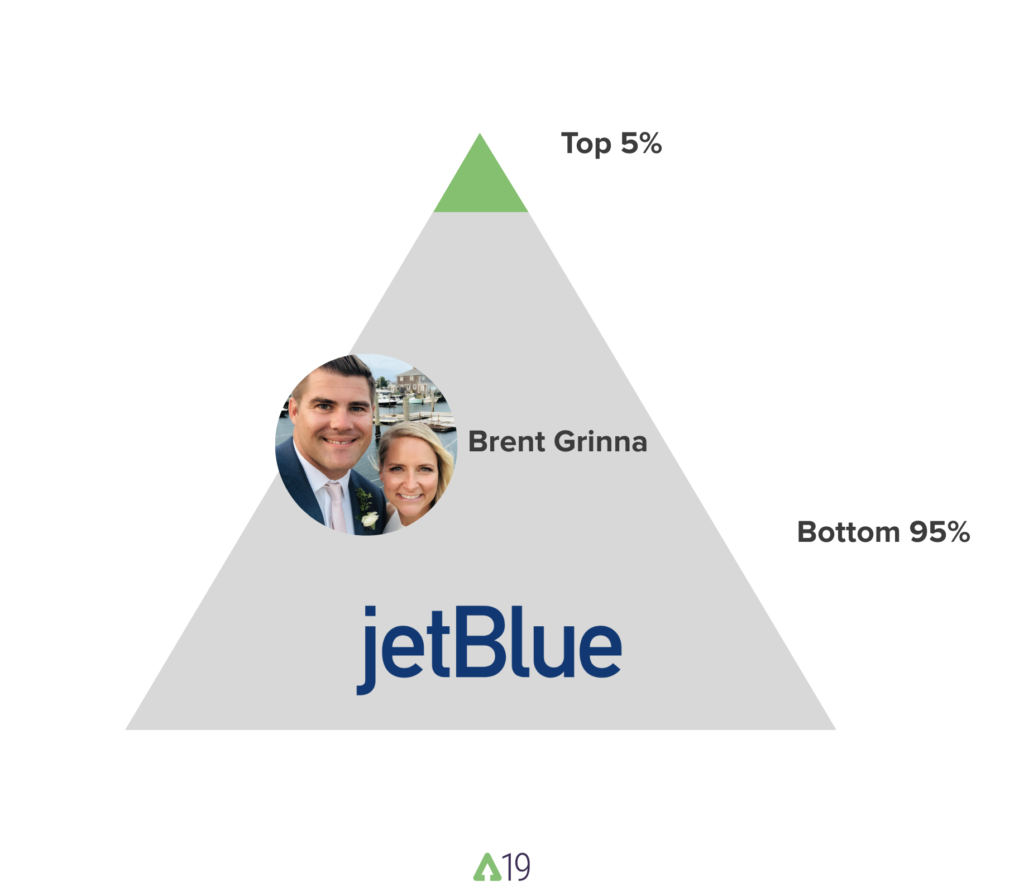
But his experience flying with them is always remarkable. They offer him priority boarding and discounts to the destinations he flies most often.
And every time he boards, they know exactly where he’s sitting on each flight and even leave him a personalized note more often than not. Just a little touch to let him know they appreciate and value his business. It’s not a huge effort on their part, but he notices it every time, and it deepens his connection to their airline.
That’s the sort of personalized approach that all of today’s most successful companies are taking. JetBlue, and other companies like them, offer advantages for being a loyal customer. They bring value to our lives.
Of course, JetBlue isn’t doing this out of the goodness of its heart. They know they have to earn Brent’s loyalty and then maintain it, or he’ll take his business elsewhere.
Make sure everything you do is donor centric
There’s a lot of overlap between being donor centric and taking a personalized approach to communication. But they’re not the same, and the difference is important to call out.
Brent had recent interaction with another institution. This time it was his alma mater. And it stood in stark contrast to his experience with JetBlue.
One evening, just before 7PM, he got a call from a familiar area code: Providence, Rhode Island, where his alma mater is located. Shortly after, another member of the EverCrew and alum of the same school, got the exact same call.
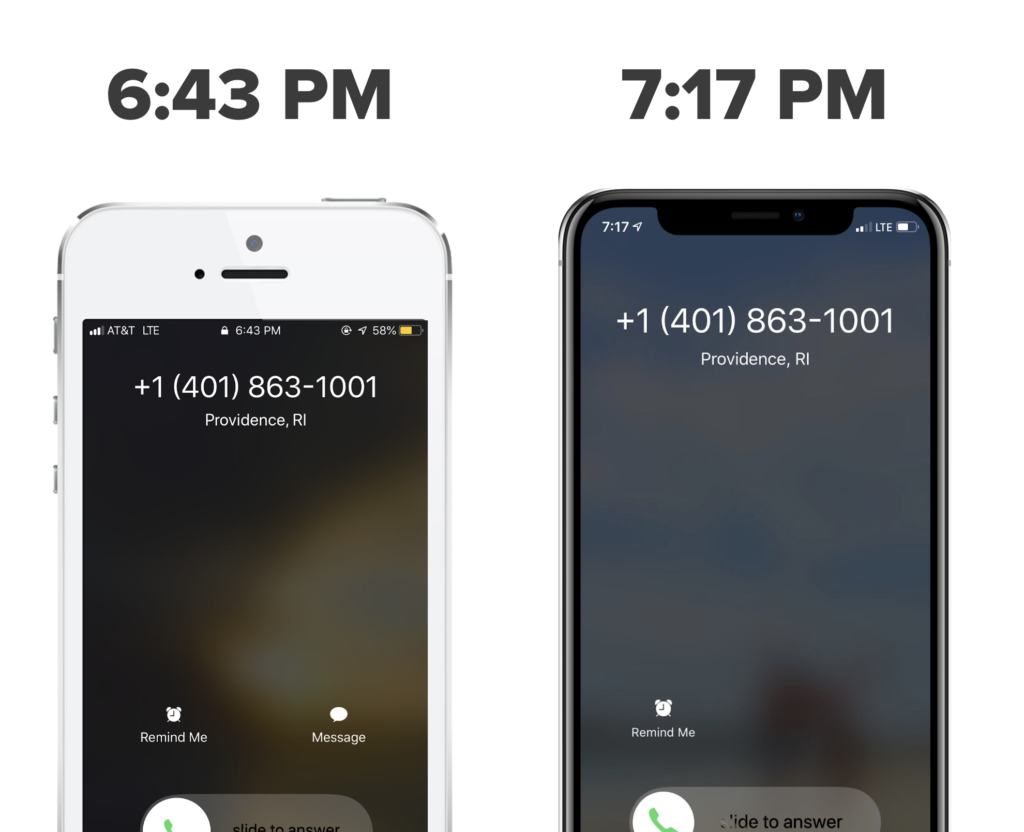
The biggest problem? Brent was smack in the middle of putting his three kids to bed when the phone rang. Not exactly a convenient time for him to talk about making a gift.
Even if he had answered (which he’s done in the past), it would have been a student caller reading off a script. He wouldn’t establish any relationship with that student and the next time he got a call, it’d be like starting all over again with a brand new student.
In the grand scheme of things, his alma mater likely views him about the same as JetBlue does. He’s loyal. He donates. He’s shown a clear affinity. But he’s not at the top of the either pyramid and isn’t going to substantially move the needle on his own.
But while JetBlue provides him with all sorts of perks, his alma mater didn’t put much, if any, thought into what matters to Brent when making that call. They didn’t really consider him, his behavior or his needs.
It wasn’t a donor centric approach. If they were to take an approach with Brent in mind, they’d call at a more appropriate time. Or realize that a personalized email or LinkedIn message would better fit his communication habits. Instead, they chose to fall back on what they know and what’s easy for them.
Even though he occupies a similar status at both JetBlue and his alma mater, he couldn’t be treated more differently by the two organizations. One goes out of their way to earn his loyalty. The other dashes off purely transactional and nondescript calls.
Every university has a ton of people just like Brent, who aren’t at the tippity top but reside firmly in the middle of the pyramid. And within that group, there’s a huge opportunity. But to instill that same sense of excitement and loyalty that JetBlue has, advancement teams must embrace a personalized and donor centric approach.
To instill the same sense of excitement and loyalty in Brent that JetBlue has, his alma mater should embrace a personalized and donor centric approach. Alums who aren’t in the top 5%, but who are, or have the potential to be, valuable and loyal donors.
How do we shift to the Giving Funnel approach?
As donation numbers indicate, there’s nothing wrong with the top of the pyramid. And we understand that’s exactly why an inordinate amount of resources are focused around major gifts.
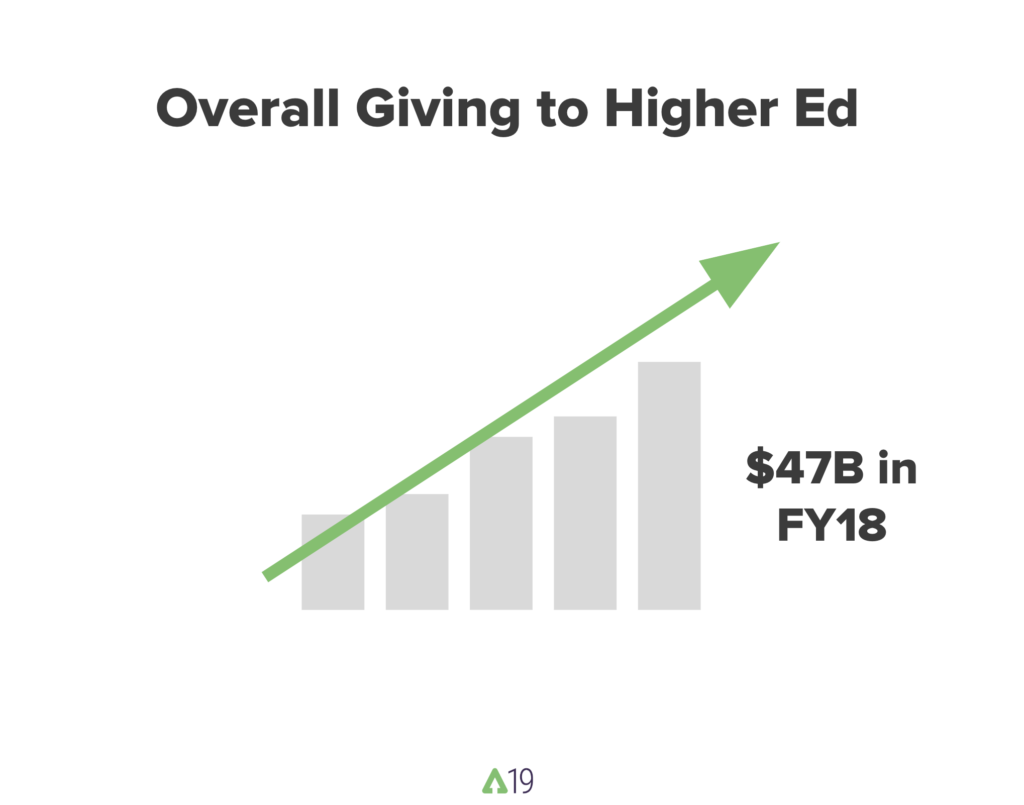
But there’s a huge opportunity at the middle and lower middle parts of the pyramid. Which is why the next step is to take the approach you’re already using for your most valuable donors and scale further down the pyramid.
Not only will adopting a Giving Funnel approach have a near-term revenue impact and near-term donor impact, it will have a long-term major gift impact as well.
How do personalization and donor centricity look throughout the stages of the Giving Funnel?
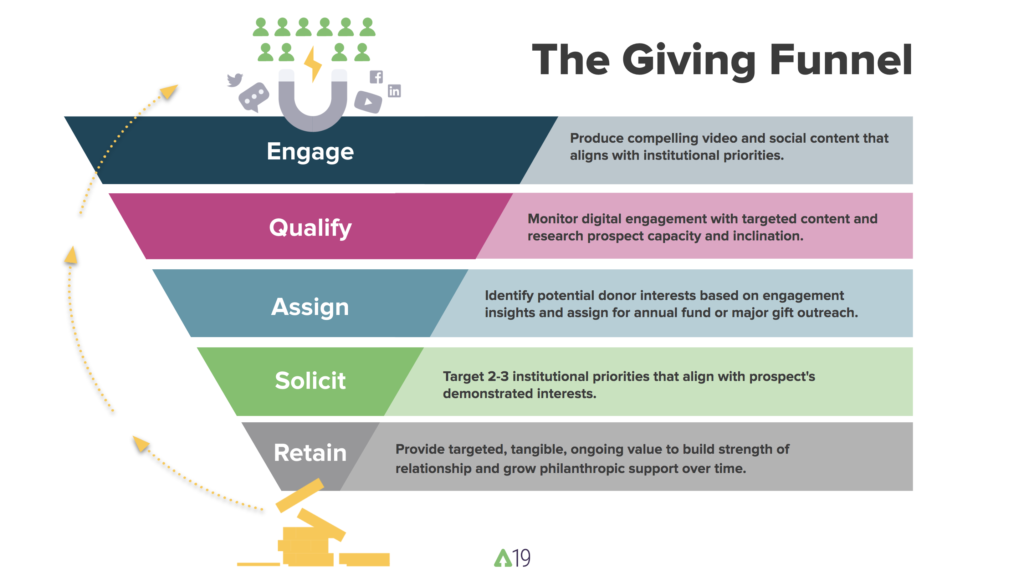
Engage:
It has never been easier to provide people with the right message, at the right time or seamlessly marry offline and online communications. It requires some experimentation and testing, but by creating compelling video and social content (and breaking free from phonathons and mass mailings), you can create content that gets your donor base excited and talking.
Qualify:
Once you see potential arise from engagement, it’s time to dive deep on that group and see what sort of capacity you’re working with. With just a little bit of time dedicated each week to diving into qualification, you can uncover huge chunks of new prospects you’d never before addressed.
Assign:
Some prospects you qualify will be best suited for an annual fund ask. Some might be ready for a leadership level gift. Others might be fast tracked to the discovery portfolio of a major gift officer. Making sure more donors are properly assigned to the right track ensures that they’ll receive the communication and attention that suits them.
Solicit:
No matter what level your newly qualified donors are at, make sure solicitations are geared specifically towards them. From the Engagement and Qualification work, you should know what interests speak specifically to them. The solicitation is not the time to deviate from them. Make sure your ask follows in the footsteps of the previous phases.
Retain:
For-profit companies aim for a 90% retention rate. The average donor retention rate for advancement shops falls between 60% and 70%. Once a gift is closed, regardless of at what level, that doesn’t signal the end of a donor’s life cycle. Instead, they simply travel back to the top of the funnel. But this time your focus should be on reengagement.
The Giving Funnell isn’t new. We’ve been championing it for a few years. But if this past year of talking to people in the industry and hearing their stories of success and struggles have taught us anything, it’s that we’re doubling down on our commitment that this approach will pay huge dividends for any team that adopts it.
Change won’t happen overnight. It also won’t happen at all until we take the first step.