












New 1:many cadences with automated emails, reusable templates, and more in Signal

DonorSearch identifies prospects in your database with the capacity and intent to give.

Missed the live session? Watch our on-demand webinars anytime to get guidance from industry experts.

Take Your Events to the Next Level with Contextual Metrics

Throwing an event is hard work. Ask anyone who’s done it before. There are seventeen different layers of logistics (at least) that somehow never come to mind when you get swept up in the excitement of the initial idea.

Since pulling off even one event is a huge effort, stands to reason you should do everything you can to make sure you learn as much as possible from it so you can build on its success.

Which is why this recent article from Ryan Bersani, Director of Engagement Analytics at Massachusetts Institute of Technology, caught our eye.

How can you know if your event played out exactly as you intended or if something weird happened? Now, if something weird did happen, that’s not a bad thing. You can build from it and use that weirdness to your advantage in the future.

But you can’t know one way or the other unless you have some contextual analytics to compare your even to. Which is why Ryan says in order to gauge the success of an event (or appeal or, really, any engagement initiative), you first need to know how your population breaks down.

So what exactly contextual metrics anyway? Let’s put it this way. When you throw an event, you’ll collect all sorts of data about people who attended (or even just engaged with it but didn’t show up). But there’s only one way for those numbers to make even a lick of sense. You need to know how they stack up against your population as a whole. And those right there are your contextual metrics.

So if 40% of your attendees graduated in the last 10 years AND 40% of all your alumni graduated in the last 10 years, then those attendance numbers could be expected. But if only 20% of your alumni graduated in the last 10 years, then you might be onto something that resonates with your young alums.

That’s something you can build off. (And be sure to check out Ryan’s article for a bunch more examples.)

Which brings us to the thing about Ryan’s approach that we really liked: Anyone can adopt it! If you’ve got all the resources in the world, you can go super deep and take an incredibly nuanced approach to your next event.

On the other hand, plenty of us have, well, the opposite of all the resources in the world. In this case, that’s no big deal. As Ryan points out, even a baseline set of contextual metrics to work off will let you make some pretty smart guesses. Will the correlations you notice always equal causation? Nope. However, even without in-depth analysis, you can take those macro-level observations into your next event with a hypothesis and see if it works out. If so, great; you can continue to sharpen that strategy. And if not, well, that’s still another data point to help you take a smarter approach moving forward.

With contextual metrics in hand, you can not only optimize your events, but you can optimize your marketing efforts around them to make sure you’re creating occasions that people are interested in and getting invitations in front of the right people. That results in better engagement and, in turn, better prospects.

See how Oklahoma State University sifted through their enormous database to rethink their approach to alumni engagement.
Endowment Spending & Growth Calculator

Enter your fund's current value and adjust the return, spending, and inflation sliders to see how its value in today's dollars changes over time.

$
6.0%
0%12%
4.0%
2%7%
3.0%
0%8%
10
5 yrs25 yrs

Value in 10 years

$0

In today's dollars

$0

4. Continue to Steward Donors

Your relationship with the donors who give to your endowment doesn’t end when you secure their gifts. Because your endowment exists to make a difference in the long term, your supporters will want you to keep in touch about its progress. Ongoing stewardship means keeping donors updated about your endowment’s performance and impact. A report that strengthens your relationship with donors should cover:
  • The fund’s balance at the start and end of the year
  • Spending amounts and allocations
  • How the fund’s returns compare to your investment targets
  • A short narrative detailing the specific impacts the endowment achieved
Create a report for each endowment rather than sending an identical document to everyone. A donor who endowed a scholarship wants to hear about the students it supported, while a donor who endowed a building fund wants updates on construction projects.

5. Upgrade Your Endowment Management Tools

Your endowment management tools should make applying your spending policy across every fund easy. Investing in dedicated software is especially useful as your endowment grows. Handling unitization in spreadsheets might work for a few funds, but as you begin to manage dozens or hundreds of gifts, dedicated software can save your team time spent manually calculating gains and losses for each one.

Why Nonprofits Need Dedicated Endowment Management Software

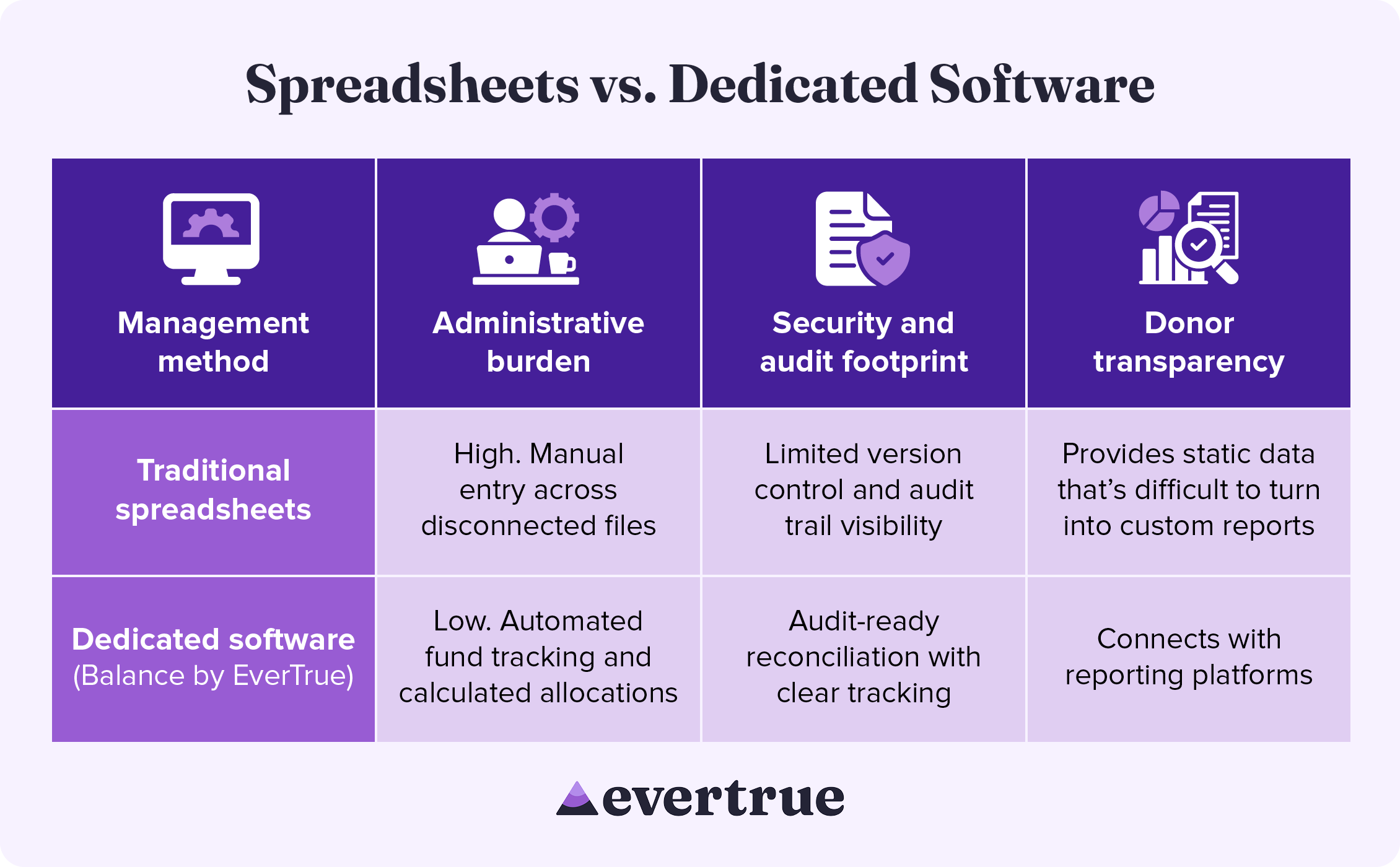
Dedicated endowment software brings accuracy and consistency to every part of the management process, from tracking individual funds to improving security. See how these solutions compare to a spreadsheet-based approach: nfographic table outlining the information below.

How These Methods Compare:

In managing your endowment with traditional spreadsheets, you may see:
  • High administrative burden: Manual entry across disconnected systems
  • Limited security and audit footprints: Reduced version control and audit trail visibility
  • Difficulty with donor transparency: Spreadsheets provide only static data that is difficult to turn into custom results.
By using dedicated software, you are likely to find the following improvements:
  • Lower administrative burden: Automated fund tracking and calculated allocations
  • Enhanced security and audit footprint: Audit-ready reconciliation with clear tracking
  • Greater donor transparency: Connects with reporting platforms
Dedicated endowment management software keeps your organization compliant while freeing up the time your team once spent manually managing spreadsheets.

Secure Your Endowment with Balance by EverTrue

Effective endowment management begins with excellent accounting. Balance by EverTrue handles unitization, applies spending rules, and produces audit-ready reports, so your team can spend more time on the donor relationships that built the fund in the first place.
  • Turn your data into a clear picture of long-term impact. Combine accurate fund accounting with donor reporting that showcases impact.
  • Connect with the tools you already use. Pair Balance with Impact by EverTrue and ODDER by EverTrue to create and deliver compelling digital endowment reports that you can send to donors with ease.
  • Know where every fund stands in real time. Check market values, gift history, and available spending for any fund. Then, share view-only versions with your team, so everyone stays informed.
With Balance, your team can stop spending all your time on manual management and instead add balance to your endowment workflow.

Additional Resources

To learn more about managing your endowment and other ways that technology can help your organization, check out these additional resources: Less stress, higher endowment funds. Discover how Balance provides the organization, security, and accuracy your endowment needs. Request a demo.
0 0 votes
Article Rating
Subscribe
Notify of
guest
0 Comments
Oldest
Newest Most Voted
Inline Feedbacks
View all comments
0
Would love your thoughts, please comment.x
()
x