
















While the term “AI” gets thrown around a lot these days, many nonprofit leaders feel stuck between the hype and the implementation. It’s one thing to know that AI fundraising exists and another to turn it into a reliable tool for donor retention and gift acquisition.
AI fundraising technology has already fundamentally reshaped the nonprofit sector. Recent data suggests that 92% of nonprofits report adopting AI in some capacity, using it to bridge the gap between limited staff time and their organization’s ambitious goals. To help you join these modern nonprofits, we’ll explore these topics:
- AI Fundraising FAQ
- Benefits of AI Fundraising
- 7 AI Fundraising Use Cases
- How to Get Started With AI Fundraising
- The Top AI Fundraising Tool: DonorSearch by EverTrue
Keep in mind that while AI is a powerful productivity tool, getting started isn’t always a breeze. The goal isn’t just to use AI to “do more,” but to do more of what works. Let’s dive into the background and strategies your nonprofit needs to start using AI to improve workflows and donor relationships.

AI Fundraising FAQ
What is AI fundraising?
AI fundraising is the application of machine learning, natural language processing, and predictive modeling to help fundraising teams. For example, these predictive and generative technologies can analyze donor data and craft personalized appeals at a scale and speed impossible to achieve manually. In addition to saving time, AI helps identify donors who are most likely to give, messages that will resonate, and the best moment to reach out.
What are the types of AI fundraising tools?
To start reviewing AI solutions, you should get to know the different types of AI. These include:
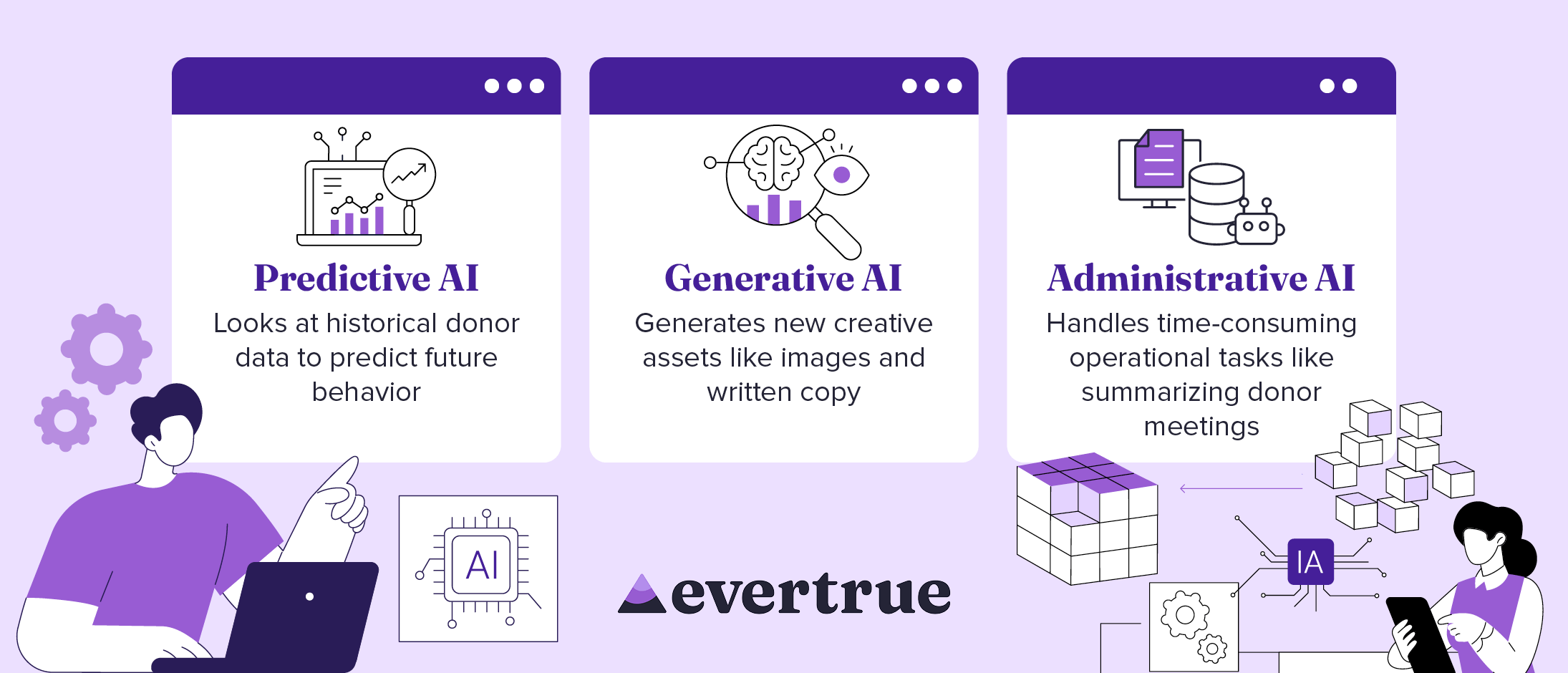
- Predictive AI: This is the brain of your prospect research. It looks at historical donor data to forecast future behavior. Tools like DonorSearch Ai (DSAi) use machine learning to score prospects based on their likelihood to give, helping your team shift from reviewing past actions to predicting—and securing—the next big gift.
- Generative AI: These creative tools aggregate information to produce content, from appeal letters to donor profile summaries to prospect reports. Look for nonprofit-specific solutions like ProspectView Online 2 (PVO2), which can safely transform complex philanthropic data into concise, actionable reports.
- Agentic AI: Think of these as assistants. They automate repetitive tasks like summarizing donor meetings, syncing CRM data, and managing complex schedules. By removing this administrative burden, your team can spend less time on manual data entry and more time building high-value human relationships.
What are the drawbacks of using AI for fundraising?
While AI fundraising is powerful, over-reliance on these tools without human oversight comes with risks, such as:
- Donor communications that feel robotic or impersonal
- Privacy and security issues when working with sensitive donor and organizational data, especially when using public AI tools
- Potential inaccuracies due to “AI hallucinations,” where the software confidently states a fact that is entirely made up
- Donor and staff resistance to AI usage
Pro Tip: You can overcome these hurdles by treating AI as a co-pilot. Always have your human team members review any donor-facing content and use secure, nonprofit-specific platforms like DonorSearch to ensure data privacy. Also, never enter sensitive data into public AI tools like ChatGPT or Gemini.
Benefits of AI Fundraising
Transitioning to AI allows your organization to move away from reactive fundraising, where you’re always playing catch-up with your data. Instead, with a more proactive approach, you can better anticipate and meet donors’ needs.
Some of the most enticing benefits of AI fundraising include:
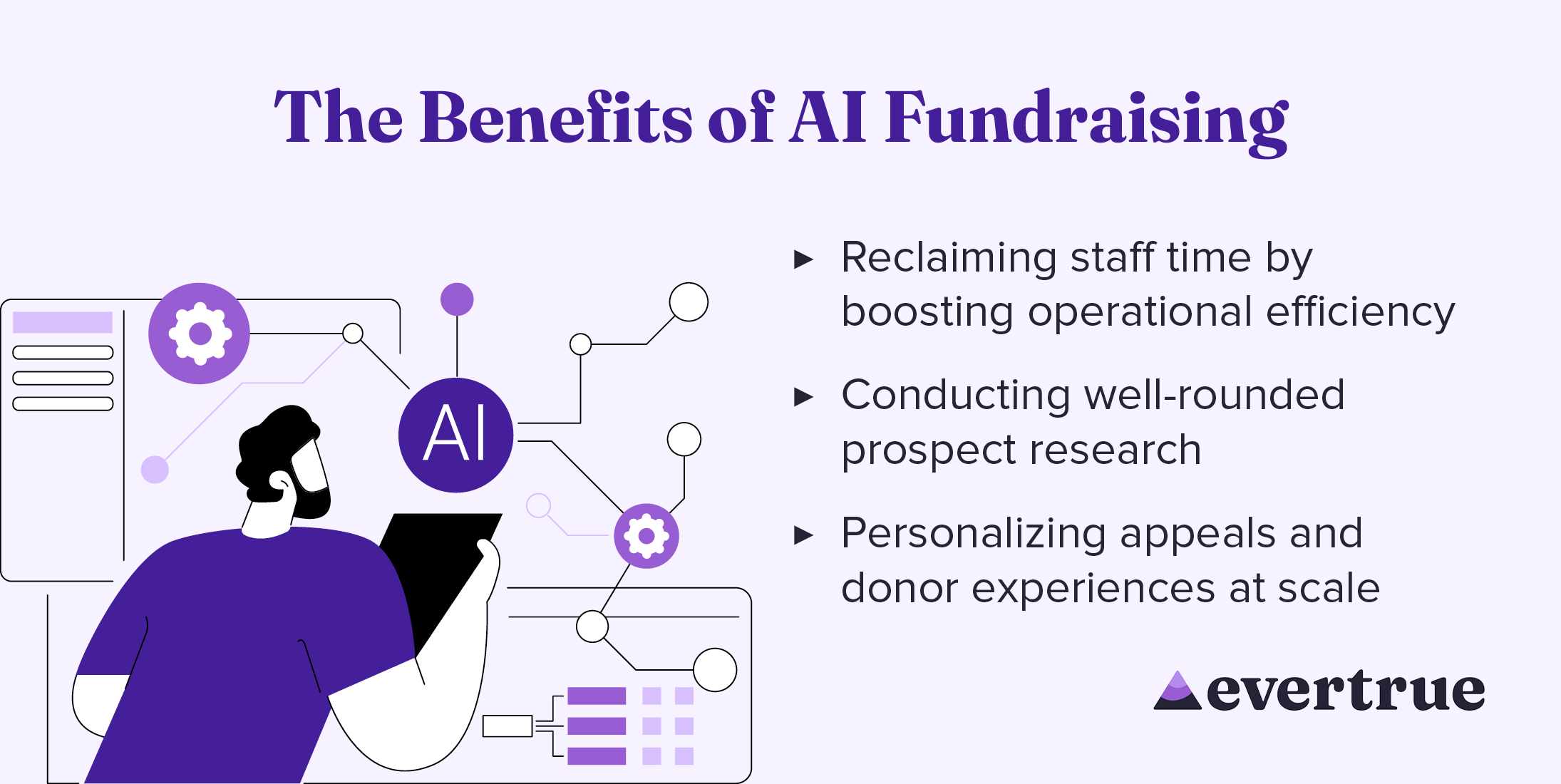
- Reclaimed staff time: 70% of nonprofit leaders cited operational efficiency as AI’s top benefit. By automating time-intensive tasks like prospect research and drafting communications, your team can focus on the high-touch, face-to-face donor interactions that actually move the needle.
- Holistic prospect research: While traditional wealth screening only identifies if a person can give, AI fundraising analyzes additional data to determine whether they actually want to. You can stop guessing and start prioritizing donors and non-donors based on real-time engagement signals and philanthropic history.
- Hyper-personalization at scale: Generative AI allows you to move beyond generic mass appeals by tailoring outreach to each donor’s specific interests and giving history.
When used strategically, AI fundraising can be a powerful addition to your workflow and development strategies. Basically, these tools empower your team to work smarter, foster deeper donor loyalty, and secure more funding.
7 AI Fundraising Use Cases
By integrating AI into your fundraising strategy, you can enhance every stage of the donor journey. Below are high-impact use cases where this technology can immediately improve your team’s fundraising outcomes.
1. Donor analysis
AI fundraising transforms static donor profiles into a dynamic view of your supporter base by analyzing real-time engagement signals like internal and external giving history, email click-throughs, fundraising event attendance, and social media interactions. This allows you to segment your audience with precision and get suggestions for how to move a donor from a one-time supporter to a recurring one.
2. Workflow and schedule management
For major gift officers, manual data entry and calendar Tetris often limit actual time spent with donors. AI-powered workflows solve this by automating note summarization and suggesting follow-up tasks directly within your CRM.
For example, Signal by EverTrue simplifies daily outreach. It uses AI to help fundraisers:
- Prepare for donor conversations with donor summaries that highlight giving history, past interactions, and career updates.
- Quickly decide next steps with AI-suggested follow-up tasks and outreach cadences based on real-time engagement.
- Follow up at the right time with prioritized outreach lists that surface supporters with recent activity, like donations or other engagement signals.

3. Marketing content generation
Writer’s block is a common bottleneck in fundraising. AI acts as a high-powered brainstorming partner that can do things like generate campaign outlines, draft multiple versions of a social media post, and create engaging email subject lines.
By providing AI tools with your mission statement and project details, you can generate ideas and first drafts that will jumpstart your creative team.
4. Communication personalization
Modern donors expect every communication to feel tailored specifically to them. AI fundraising makes this possible by automatically personalizing messages based on donors’ past behavior, interests, and giving history.
For example, you can use AI to build dynamic donor communications templates that automatically insert references to a specific program a donor has supported or send a personalized thank-you email right when a gift is processed. This makes every supporter feel valued without your staff writing every message from scratch.
5. Major giving prospect identification
AI fundraising can analyze your entire database to identify major gift prospects. For example, DonorSearch Ai uses custom machine learning models to quantify the connection a constituent has with your organization, pinpointing the donors most likely to respond to fundraising appeals, donate, become repeat contributors, and make a commitment to your nonprofit’s cause long-term.
Nonprofits that leverage DSAi can experience pretty incredible results. For example, they see 5x-10x higher average gift amounts, identify donors with up to 20x higher lifetime value (LTV), and move major donors through the donor journey 17% faster.
6. Campaign forecasting
Before launching a campaign, nonprofits can use predictive analytics to simulate various strategies and outcomes. AI can analyze your current donor pipeline and previous campaign data to determine the viability of your fundraising goals before investing time and resources.
By running these simulations, leadership can identify potential gaps in the pipeline and proactively adjust their strategy. This data-driven approach reduces the risk of underperforming and helps set realistic benchmarks.
7. Donor support
Donors often have routine questions—such as how to update credit card information or where to find a tax receipt—that don’t require human intervention. AI-powered chatbots can provide 24/7 support, answering these questions instantly. Consider adding this tool to your nonprofit website to make it easy for donors to get answers.
How to Get Started With AI Fundraising
Transitioning to an AI fundraising model isn’t a “flip of the switch” process. Rather, it requires a strategic approach that balances new technology with your organization’s unique culture. Here’s how to move from curiosity to implementation:
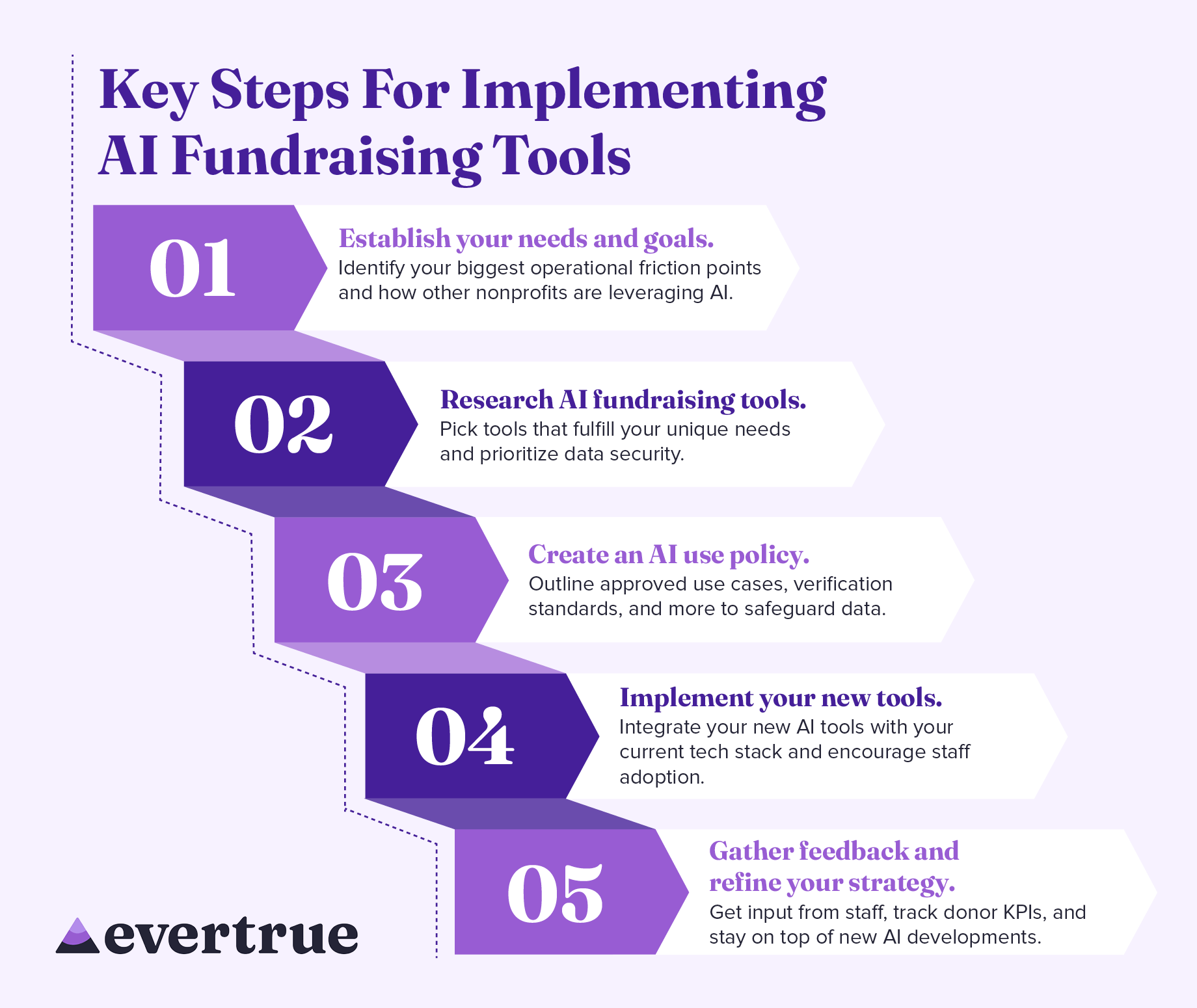
Establish your needs and goals.
Start by identifying your biggest operational friction points. Before investing in any AI software, survey your team or host a roundtable discussion to identify the most significant productivity gaps. By uncovering specific bottlenecks, you can choose AI tools that will solve problems instead of ones that just complicate your daily processes.
You might pinpoint friction points like:
- Gaps in research: Gift officers spend hours manually scouring LinkedIn and Google for donor career updates instead of meeting with prospects.
- The “blank page” bottleneck: Your marketing and development teams struggle to keep up with the volume of personalized content required for multi-channel campaigns.
- Data silos: Important donor interactions get siloed (like email or personal notes) and never make it into the CRM, leading to poorly informed outreach.
- Pipeline stagnation: The major gift team isn’t sure who to prioritize next, leading to reduced prospects.
Take a look at how similar nonprofits use AI, too. Whether they’re using it for automated donor stewardship or predictive prospect scoring, understanding the competitive landscape helps you benchmark your own goals and identify which use cases will offer the highest return on investment.
Research AI fundraising tools.
When vetting technology, ask critical questions about each solution’s data sources and security. Learn what data the AI was trained on and whether your organization’s data will be kept private or used to train public models.
Important Note: Avoid public AI tools for any task involving sensitive donor data. Freesolutions often use your data as “payment” to improve their models, which can lead to privacy breaches. Stick to enterprise-grade, nonprofit-specific solutions that offer SOC 2 compliance.
Create an AI use policy.
60% of nonprofit leaders cite security as an AI concern. However, only a third of organizations have AI policies. Using nonprofit AI responsibly requires establishing clear guardrails that help avoid security lapses, produce high-quality content, and prevent AI abuses or mistakes.
Craft an effective nonprofit AI use policy that outlines:
- Approved use cases: When it is appropriate to use generative AI (e.g., drafting outlines for grant proposals) versus when a human must take the lead (e.g., final proposal review)
- Verification standards: A “human-in-the-loop” requirement to check AI-generated facts and figures for accuracy
- Donor transparency: A statement regarding your nonprofit’s AI usage and guidelines for how staff should discuss AI with donors if asked, ensuring you maintain supporter trust
By formalizing your standards, AI fundraising goes from a potential risk to a structured asset that empowers your staff. This proactive governance ensures that as your technology evolves, your commitment to ethical fundraising and donor stewardship remains unshakeable.
Implement your software.
Successful implementation is where your strategy meets reality. While some specialized AI tools require extensive developer support and custom API integrations to function, out-of-the-box solutions can work almost immediately.
Regardless of the tool’s complexity, ensure it syncs with your existing tech stack so that data flows seamlessly. Remember that AI is only as effective as the information it processes, so dedicate time to training the software on your nonprofit’s data to ensure the insights it generates are relevant to your unique donor base.
Beyond the technical hurdles, you’ll need to prepare your team. To encourage employee buy-in, provide thorough staff training. Documenting processes upfront empowers your current team and creates onboarding resources for future hires, ensuring your AI tools become a long-term asset.
Gather feedback and refine your strategy.
To keep your technology aligned with your mission, establish a loop for gathering staff feedback on which AI processes are truly saving time. At the same time, track key performance indicators such as donor engagement, retention, and acquisition. This will give you insight into the actual ROI of your AI fundraising stack.
Because the landscape of nonprofit AI is advancing rapidly, your leadership team should stay vigilant for new feature releases or entirely new tools. By treating your AI strategy as a living document, your organization will be ready to capitalize on the next wave of philanthropic innovation.
The Top AI Fundraising Tool: DonorSearch by EverTrue
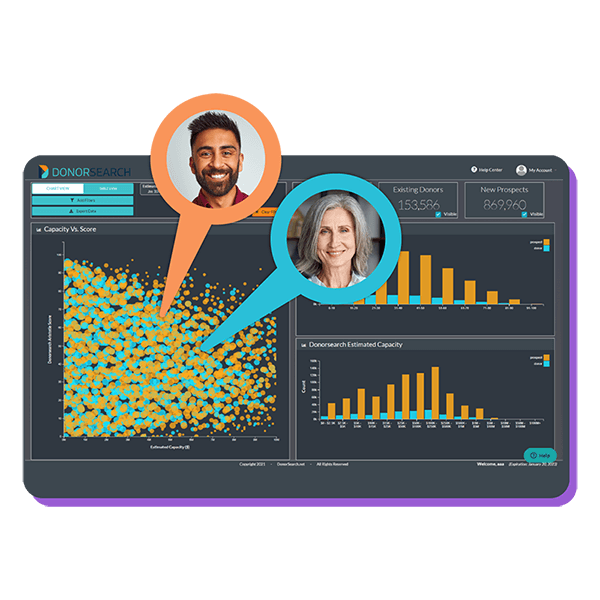
Selecting the right tools is the most important decision in your nonprofit’s AI journey. DonorSearch by EverTrue stands out as the most robust prospect research database available, offering a depth of data that traditional screening services can’t match.
By integrating DonorSearch’s massive databases directly into EverTrue’s fundraising technology, we provide your nonprofit with a 360-degree view of your donors. In other words, you’ll turn raw information into an immediate, actionable strategy.
To help development teams work more effectively, check out how DonorSearch’s AI tools are designed for every stage of the donor pipeline.
Predictive Insights: Identifying Opportunities
These tools analyze your donor data to forecast behavior, helping you prioritize your portfolio:
- DonorSearch Ai: This flagship predictive tool uses custom machine learning models to identify the donors with the highest propensity to make a repeat gift and the non-donors with the highest propensity to make their first gift. It moves beyond basic wealth metrics to measure true engagement indicators and past philanthropic activity, pinpointing supporters who are likely to respond to outreach, give major gifts, become repeat donors, and more. It’s built exclusively for your organization, using your data and leveraging the world’s largest philanthropic database, making it the most advanced machine learning tool for nonprofits.
- Enhanced CORE: Think of Enhanced CORE as your organization’s gateway to predictive AI. This standardized predictive modeling approach is designed for quick implementation. It analyzes donor data to predict who’s most likely to respond, give for the first time, keep giving, donate frequently, upgrade their support, and be a top lifetime supporter. It’s an ideal entry point for smaller teams that need actionable insights without a complex setup.
Generative Action: Executing Strategy
Once the predictive models identify your targets, these tools help you automate the research and communication processes:
- ProspectView Online 2: This high-speed research assistant uses embedded generative AI to instantly transform donor data into custom narrative reports. By combining engagement metrics like the Most Likely to Respond Score with a centralized Hero Dashboard, it allows fundraisers to quickly assess and prioritize their top prospects.
Check out how Taylor University has used DonorSearch and EverTrue to fuel smarter donor identification and cultivation:

Additional AI Fundraising Resources
The era of gut-feeling fundraising is over. For nonprofits, the new standard is using data-driven insights paired with human empathy to drive meaningful impact. By integrating AI fundraising into your workflow, you’ll save time and ensure every appeal is backed by sophisticated data analysis.
While the technology is complex, the goal remains simple: to build deeper, more authentic relationships with the people who make your mission possible.
As you create your nonprofit’s AI strategy, explore these resources from the EverTrue team:
- Using AI to Make Giving Day Easier (Without Losing the Human Touch)
- Donor Ghosting Prevention Kit: How to Bring Supporters Back From the Beyond
- Beyond the CRM: Building a Connected Fundraising Data Strategy