














Volunteers care more about your institution than anyone else.
And you have more volunteers out there than you think.
Research into alumni identity has confirmed what is already well established in the literature (seminal work by Weerts & Ronca, 2007, 2008) and in the day-to-day work of advancement shops across the country: alumni volunteers are the best and most loyal donors.
But there’s a problem.
Colleges and universities offer limited volunteer opportunities for graduates and, at least in databases, count alumni as volunteers only if they participate in an institutionally-sanctioned volunteer opportunity.
This practice severely underestimates the number of highly engaged alumni who volunteer in support of their school. Beyond the board service, mentoring, recruiting, fundraising, and speaking opportunities that institutions tally as volunteering, there is a plethora of other activities that alumni undertake and perceive as volunteering for their alma mater.
In a survey of undergraduate alumni at a mid-size, Jesuit university on the West coast, several participants who were not coded as volunteers in the institutional database self-reported as an active volunteer for their alma mater (Dillon, 2017). What makes a graduate feel like a volunteer?
One alumna put it this way:
I’m still teaching and coaching and talk about [school name] to my students all the time. I wore my sweatshirt to school yesterday!
Similarly, an alumnus reported:
My family is very big on volunteering and we do this heavily in our community. Since I moved away from campus, it is almost impossible for me to volunteer unless there is something hosted near my area, but I do what I can for [school name].
These responses reveal a gaping hole in high education fundraising strategy.
Colleges and universities lack mechanisms to track alumni who think of themselves as volunteers and to recognize volunteering outside of established institutional programs.
Advancement organizations are missing the chance to cultivate, solicit, and steward a large population of graduates who demonstrate the highest levels of connection and engagement with the school.
The opportunity cost (to borrow a for-profit phrase) is staggering.
When it comes to influencing alumni identity—which is both a measure of engagement and a predictor of giving—nothing is more influential than volunteering (see the third post in this series).
Study participants who volunteered for their alma mater reported an average alumni identity score of 58.67, far greater than the average score of all participants, which was 50.18 (Dillon, 2017). And with every additional volunteer opportunity completed, a participant’s average alumni identity scored increased steadily (see figure).
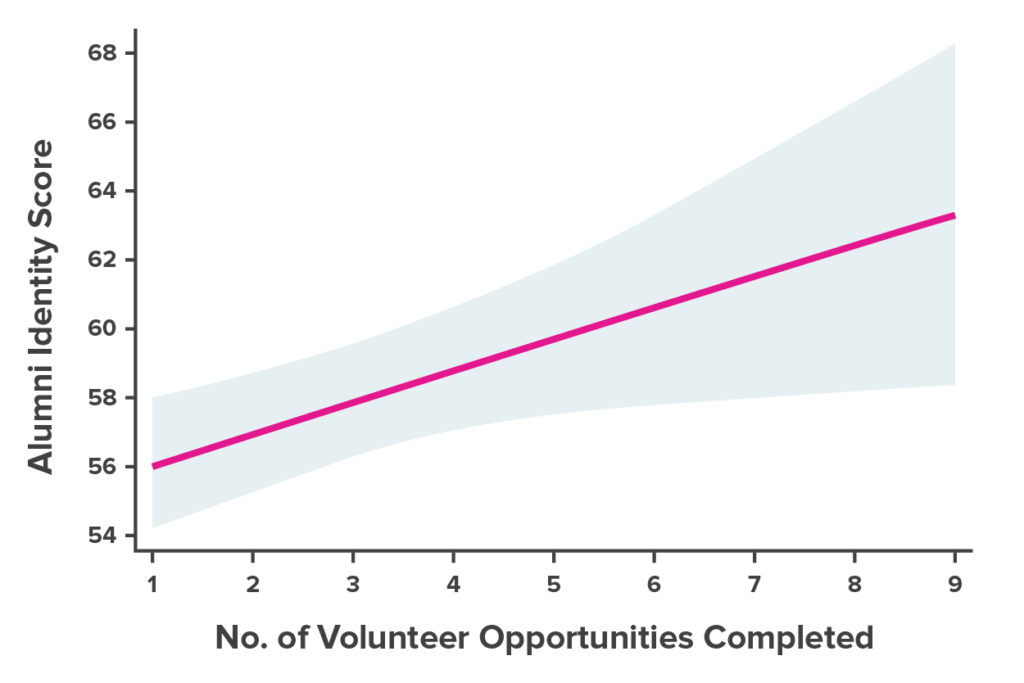
Put this all together and the implication is clear. If increased alumni identity is associated positively with an inclination to give, and volunteering and number of volunteer opportunities completed are the factors that influence alumni identity most, it follows that…
Advancement shops could increase return on investment of annual and major gift fundraising efforts by identifying and appealing to all alumni volunteers, including those that serve in informal ways.
But aren’t some volunteer activities more valuable than others?
Sure, maybe from an institutional perspective, but not in the eyes of graduates themselves.
From the board member to the teacher who fills her classroom with pennants from her alma mater, both alumni think of themselves as volunteers, and that’s what matters because volunteering is a great indicator of increased alumni identity and inclination to give.
Of course, not all alumni will feel like volunteers, so what are some other ways that a graduate’s feelings of connection can be leveraged to increase annual and major giving? How can the social psychology behind alumni identity be used to fill the donor pipeline when wealth screening and predictive models fall short?
Here’s a hint at the next post in this series: alumni identity scores are far better at predicting giving than recency, frequency, and monetary (RFM) models.
Join me as we explore these and other questions. Subscribe to the EverTrue blog and we’ll continue to post updates on this series.
Click here to go to part 5 of our alumni identity series.
Click here to see how EverTrue empowers your fundraising volunteer program with better access to data and powerful mobile tools.
Read Dr. Jay Le Roux Dillon’s entire series on alumni identity.
Part 1: Are You Missing Advancement’s Most Important Metric?
Part 2: The Story Behind Giving Has Little to Do With 1s and 0s
Part 3: Digital Engagement ≥ Event Engagement? Yes.
Part 4: Meaningful Volunteer Experiences Are Best, But Far Too Few
Part 5: Data-driven Prospect Discovery Needs to Include Graduate Feelings of Connection
Part 6: Raising Alumni Identity Raises Dollars
Need more? Connect with the author:
LinkedIn
Twitter @jayldillon
www.alumniidentity.com
Dr. Jay Le Roux Dillon is a social scientist and higher education advancement executive whose research focuses on broadening and measuring institutional value and impact among college and university alumni. He has served as Director of Alumni Engagement at the University of San Francisco and as Executive Director of Alumni Strategic Initiatives at UCLA. Jay is dedicated to improving philanthropy through data science in order to bring social justice and equity to education. He holds a doctorate in organization and leadership from USF and a master’s and bachelor’s degree in music from UCLA. Jay is a native of Riverside, California.