


New 1:many cadences with automated emails, reusable templates, and more in Signal

DonorSearch identifies prospects in your database with the capacity and intent to give.

Missed the live session? Watch our on-demand webinars anytime to get guidance from industry experts.

Customer Stories:

How the University of Delaware Turned Donor Preferences into a Scalable, High ROI Giving Strategy

WHO:

Giving is personal. Your outreach should be too. The University of Delaware is a public research university where annual giving spans direct mail, email, and giving day campaigns supported by teams across marketing, advancement, and data operations. Donor preferences vary widely across timing and communication style, requiring a more intentional way to align outreach with how supporters want to be engaged.

THE CHALLENGE:

The team was regularly hearing from donors about communication fatigue and timing preferences that were not being met.

Donors shared that they were receiving too many solicitations and, in some cases, only wanted to be contacted during specific times of the year that aligned with their personal giving patterns. This feedback made it clear that the university needed a way to reduce unnecessary outreach while still honoring donor preferences.

WHY EVERTRUE:

To support the operational side of the program, the University of Delaware uses Pledgemine by EverTrue to streamline and automate direct mail execution.

With Pledgemine, the team is able to:

-Pull monthly CRM reports into ready-to-send direct mail audiences

-Eliminate manual list building and small batch processing

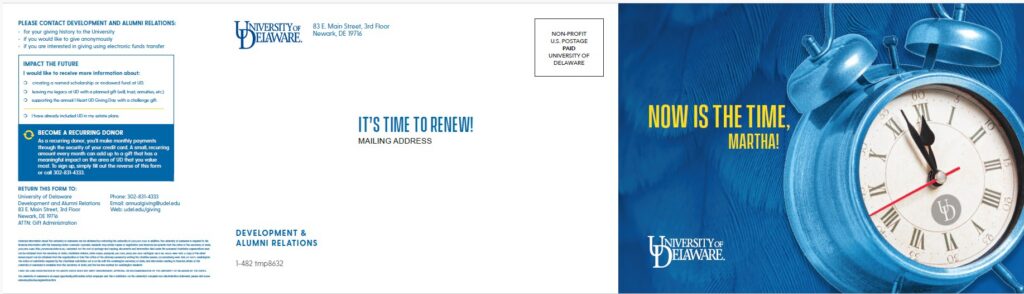
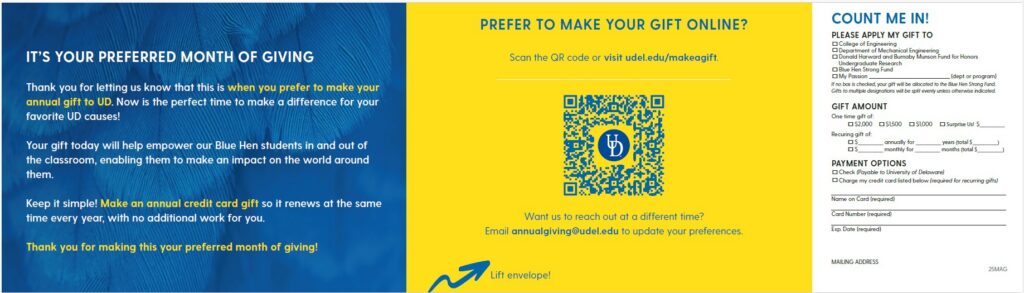
-Execute targeted mailings aligned to each donor’s preferred giving month

-Maintain a highly personalized mail strategy without added operational burden

What was once a manual process involving individual letter creation and small batch mailings is now a streamlined, report-driven workflow. Pledgemine helps the team efficiently execute highly segmented direct mail while honoring donor preferences at scale.

The Results:

The University of Delaware implemented a Preferred Month of Giving program that allows donors to select when they would like to be contacted.

When a donor shares their preference, the team confirms it through follow-up communication, codes it in the CRM, and assigns it to a monthly giving segment.

As a result:

-Donors are segmented in the CRM by preferred giving month

-Monthly audiences are generated through reporting

-Email outreach runs through Marketing Cloud journeys with follow-up reminders if needed

-Donors are only contacted during their selected timeframe

The program has reduced communication fatigue while maintaining consistent, targeted engagement. It has also supported steady, predictable giving from a small but highly engaged donor group.

The result was a more intentional communication strategy that aligned outreach with donor preferences instead of institutional cadence.

The Full Story:

The Preferred Month of Giving program began in 2015 in response to direct donor feedback about communication overload and timing preferences.


Donors were asking to reduce the number of solicitations they received or to be contacted only during specific times of year that aligned with their giving habits.


In response, the team built a system that allows donors to select their preferred month of giving. Those preferences are confirmed through follow-up communication, then coded in the CRM and organized into monthly segments such as January, February, and beyond.


Initially, the process was entirely manual, with small donor batches handled individually for outreach. Over time, the team introduced more scalable workflows using reporting tools, automated email journeys, and Pledgemine to streamline direct mail execution.


Today, the program enables the University of Delaware to honor donor preferences at scale, reducing communication fatigue while ensuring supporters are contacted only when they have indicated they want to hear from the university.


Together, these tools allow the University of Delaware to reduce manual effort, improve targeting precision, and honor donor preferences at scale. The result is a more efficient fundraising operation that lowers communication fatigue while ensuring donors are only contacted when they have explicitly asked to hear from the university.