









How to Get Started With AI for Fundraising Teams: An EverTrue Guide
Every fundraising team we talk to is somewhere on the same spectrum right now. Some have already brought AI into their daily workflow. Some are still watching from the sidelines, waiting to see if it’s worth the risk. Most are somewhere in between, curious, a little overwhelmed, not sure where to start.
Here’s what we believe: AI doesn’t replace the fundraiser. It doesn’t replace the relationship, the phone call, the handwritten note, or the years of trust a gift officer builds with a donor. What it does is close the gap between the data your team already has and the action your team needs to take. That gap is where generosity gets lost, where the right donor goes uncontacted, where the causes that matter most end up underfunded simply because nobody had the bandwidth to notice who was ready to give.
This guide walks through what AI actually is, how fundraising teams are using it today, and how to bring it into your organization responsibly, without losing the human part of this work that made you want to do it in the first place, and that make donors want to give.
What AI Actually Means for Fundraising
Artificial intelligence, at its core, is a system that learns from data and uses what it learns to recognize patterns, make predictions, or generate something new. That’s the whole idea. It’s not magic, and it’s not a replacement for judgment. It’s a tool that gets smarter the more relevant information it has to work with.
In fundraising, there are two types of AI worth understanding before you invest in anything:
Predictive AI looks at historical data, giving history, philanthropic patterns, engagement, wealth indicators, and uses it to forecast what’s likely to happen next. Who’s likely to give. Who’s likely to lapse. Who’s quietly become a much stronger prospect than their file suggests. This is the kind of AI that answers the question every fundraiser needs answered before a conversation starts: not just who can give, but who’s actually ready to.
Generative and workflow AI takes that intelligence and turns it into something a fundraiser can use right now, a donor briefing, a suggested next step, a prioritized list for the week. It doesn’t just tell you something. It tells you what to do with it.
| Predictive AI | Generative AI | |
| What it does | Forecasts what's likely to happen based on historical and behavioral data | Turns intelligence into something a fundraiser can act on today |
| Question it answers | "Who's actually ready to give?" | "What should I do about it, and when?" |
| Where you'll see it | Scores, rankings, capacity and giving predictions | Briefings, cadences, prioritized task lists |
| EverTrue product | DonorSearch (all tiers include at least one predictive model) | Signal |
The best fundraising strategies don’t pick one over the other. They use predictive AI to know who to focus on, and generative AI to know what to do next. Knowing without acting is just more data sitting in a dashboard. Acting without knowing is just guessing faster.
Where AI Actually Helps a Fundraising Team
AI shows up in nonprofit and advancement work in more places than most teams realize.
| Where AI helps | What that means day to day |
| Prospect discovery | Surfaces prospects who look ordinary on paper but have real philanthropic history |
| Lapse and upgrade prediction | Flags who's likely to lapse, upgrade, or become a sustainer, before it happens |
| Portfolio prioritization | Tells gift officers who to call first, out of hundreds or thousands of names |
| Meeting prep | Briefs a fundraiser before a meeting so they walk in already knowing what matters to that donor |
| Personalization at scale | Personalizes outreach at a volume no team could manage by hand |
None of this replaces the fundraiser. It replaces the hours spent digging for the thing a fundraiser needed to know in order to be effective. That’s an important distinction, and it’s the one we’d encourage every team to hold onto as AI adoption grows across the sector.
As you evaluate these metrics, set realistic benchmarks. If your major gift request success rate was 50% last year, a reasonable target this year might be 60%, a number that pushes your team without setting them up to fail.
A Note on Using AI Responsibly
Skepticism around AI in this sector is fair. Donor data is sensitive. Predictions can be wrong. And a tool that’s only as good as the data behind it can just as easily reinforce bad assumptions as surface good ones.
We think about it this way: AI should never be the thing making the decision. It should be the thing that gives a fundraiser better information to make their own decision with. That means:
- Being transparent with your team and your donors about how data informs your outreach
- Keeping a human in the loop on every prediction, score, or suggested action before it reaches a donor
- Choosing partners who are clear about where their data comes from and how their models work
- Treating AI as an accelerant for relationship-building, not a substitute for it
Wealth is a starting point. It has never been the whole story, and no predictive model changes that. The organizations that get AI right are the ones that use it to see donors more clearly, not to reduce them to a score.
A Closer Look at EverTrue's AI
EverTrue is a philanthropy-first intelligence platform built to help fundraising teams turn data into action and build real donor relationships. Our founding story is rooted in the power of generosity, and seeing firsthand what was broken in the technology to support it. This is why our approach to AI looks a little different than most. Instead of leading with wealth alone, we built our intelligence on giving history, philanthropic behavior, and engagement signals, the things that actually predict whether someone is ready to give, not just whether they could.
DonorSearch and Signal carry that intelligence into a fundraising team’s daily work.
DonorSearch: One Product, Three Levels of Predictive Intelligence
Every tier includes the same foundation: complete constituent profiles, 200M+ charitable gift records, wealth and capacity data, and direct CRM integration.
The difference is in the models: how many you get, and whether they’re built on national data or your own.
| DonorSearch Core | One national predictive model—the Most Likely to Raise (MLR) score, built on 800+ data points—ranks your current donors which are most likely to make the highest-value gifts in the next 12 months |
| DonorSearch Enhanced Core | Allows you to build your own scoring package based on your organization’s fundraising strategies, choosing from five national predictive models: Acquisition, Retention, Sustainer, Upgrade, and Major Gift Potential. Includes MLR and visualization tools. goals. |
| DonorSearch Ai | Custom models built entirely on your organization’s own data— giving history, clinical data for healthcare—layered on top of DonorSearch’s 850+ data points. Your scores reflect your donors, not an industry average. No two organizations are the same. Neither are their models. Clients see 81% prediction accuracy in donor retention, 85% increase in response rate, and a 25% average gain in team efficiency. |
Signal: Intelligence in Motion
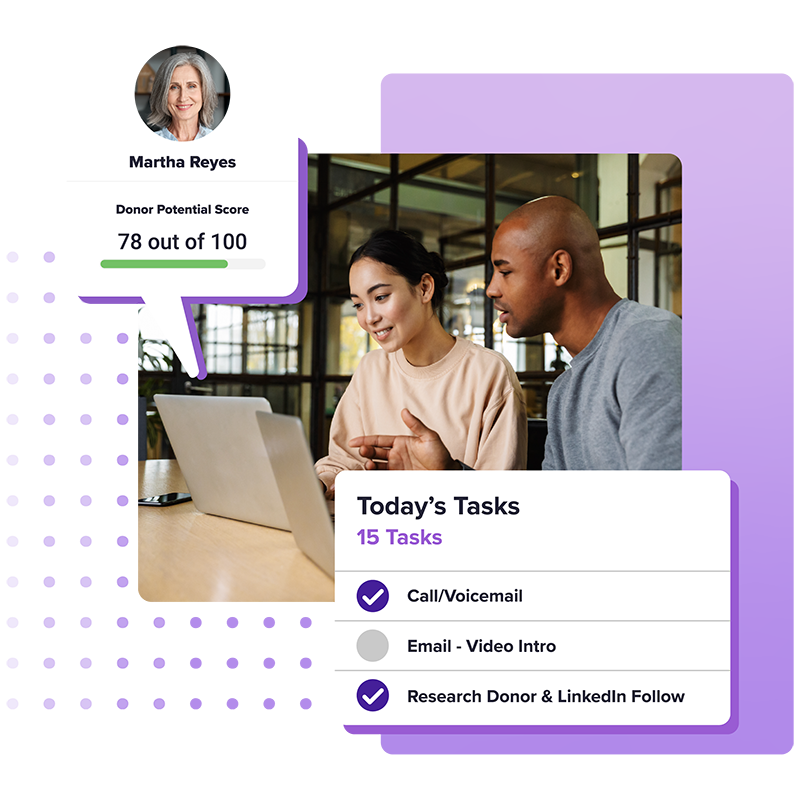
If DonorSearch is how a team knows, Signal is how a team acts. Signal picks up on the behavioral signals a CRM can’t see, social engagement, career moves, digital activity, and turns that intelligence into a daily workflow: who to prioritize, what cadence to follow, and a briefing that means a gift officer shows up already knowing what matters to that donor.
Your CRM tells you what happened. Signal tells you what to do next.
The donors most worth reaching are usually already sitting in a portfolio somewhere, recently promoted, quietly engaged, simply never flagged. Signal exists to make sure that donor doesn’t stay invisible. It gives every fundraiser, whether they’re managing a full team or carrying their own portfolio, the intelligence to make every touchpoint feel personal, without spending hours hunting for it.
Real Teams. Real Results.
These stories come from the 2026 EverTrue Innovators, highlighting the people and teams using AI in thoughtful, practical ways to make fundraising more personal and effective.

U.S. Naval Academy Alumni Association & Foundation (Field Fundraising Innovation Award, Signal):
The Naval Academy Alumni Association and Foundation used Signal to bring portfolio visibility and engagement insight to a growing team of frontline fundraisers. That consistency helped drive the Foundation’s first-ever $100 million fundraising year, including two eight-figure gifts and a $15 million gift built through long-term stewardship. Leadership annual giving officers managed portfolios of roughly 250 donors each while raising about $1 million per officer in their first year.


Boca Raton Regional Hospital Foundation, part of Baptist Health South Florida (Best Healthcare Fundraising Transformation Award, DonorSearch Ai)
Boca Raton used DonorSearch AI, predictive modeling, and HIPAA-compliant patient data to make donor identification and engagement more timely and intentional. That approach helped drive a 407% increase in its Doctor’s Day appeal to $425,000 and nearly tripled year-end giving from $1.2 million to $3.2 million, while uncovering new first-time donors and strengthening its future pipeline.
None of these are stories about AI doing the fundraising. They’re stories about fundraisers finally having the bandwidth and clarity to do the part only they can do.
Final Thoughts
Generosity doesn’t run out. It just doesn’t always find its way to the causes that need it, because somewhere between a donor’s capacity to give and a fundraiser’s ability to reach them, something gets lost. That’s the gap AI can help close, not by replacing the relationship, but by making sure the right relationship gets a chance to happen in the first place.
If your team is exploring AI, start with a plan. Know what problem you’re actually trying to solve before you choose a tool to solve it. And look for partners who treat your data, and your donors, with the same care you do.
Because the causes that matter most can’t afford to go without.
Curious what this looks like for your team? [Request a demo of DonorSearch or Signal.]