












To spread the word about your mission and fundraise effectively, your nonprofit needs to create a variety of marketing content and donor communications, from social media posts to direct mail messages to live meeting notes. Leveraging solutions powered by generative artificial intelligence (AI) is an effective way to streamline these communications, and almost a third of nonprofits already use this technology for marketing purposes.
In this guide, you’ll learn all you need to know about how you can leverage generative AI for fundraising and engagement, including:
 The term predictive AI describes solutions that analyze data to project future trends and make suggestions based on those outcomes. Generative AI and predictive AI are often treated as opposites, but the best nonprofit AI strategies involve using both in collaboration with each other.
For example, you could use a predictive AI solution to prioritize a list of major giving prospects based on how likely they are to contribute to your nonprofit within the next year. Then, you can leverage generative AI to help you create personalized outreach materials for each prospect in order of priority.
Learn More About EverTrue’s GenAI Capabilities
- Generative AI Fundraising FAQ
- Top Generative AI Fundraising Use Cases
- How EverTrue Supports Predictive & Generative AI Fundraising

Generative AI Fundraising: Frequently Asked Questions
What is generative AI?
Generative AI is a type of technology that uses pattern recognition and analysis to develop new, original content like written copy, images, and videos. It falls under the larger umbrella of artificial intelligence, which is the ability of machines to “think” and process information in a way that allows them to draw conclusions from the available data. Generative AI tools are typically trained by inputting large amounts of data, which they translate into cohesive, valuable outputs.What is the difference between generative AI & predictive AI?
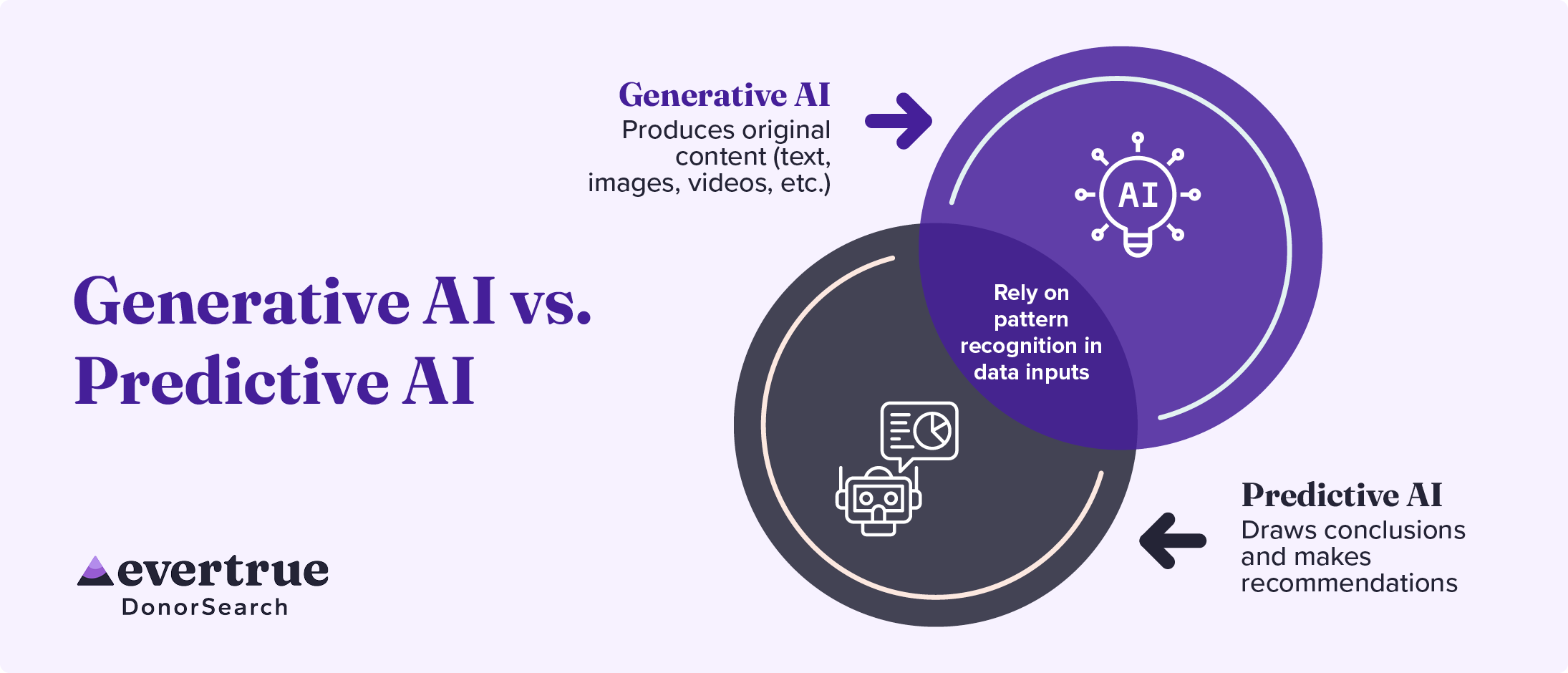 The term predictive AI describes solutions that analyze data to project future trends and make suggestions based on those outcomes. Generative AI and predictive AI are often treated as opposites, but the best nonprofit AI strategies involve using both in collaboration with each other.
For example, you could use a predictive AI solution to prioritize a list of major giving prospects based on how likely they are to contribute to your nonprofit within the next year. Then, you can leverage generative AI to help you create personalized outreach materials for each prospect in order of priority.
What are the benefits of using generative AI for fundraising?
When leveraged strategically, generative AI can provide your nonprofit with various benefits, such as: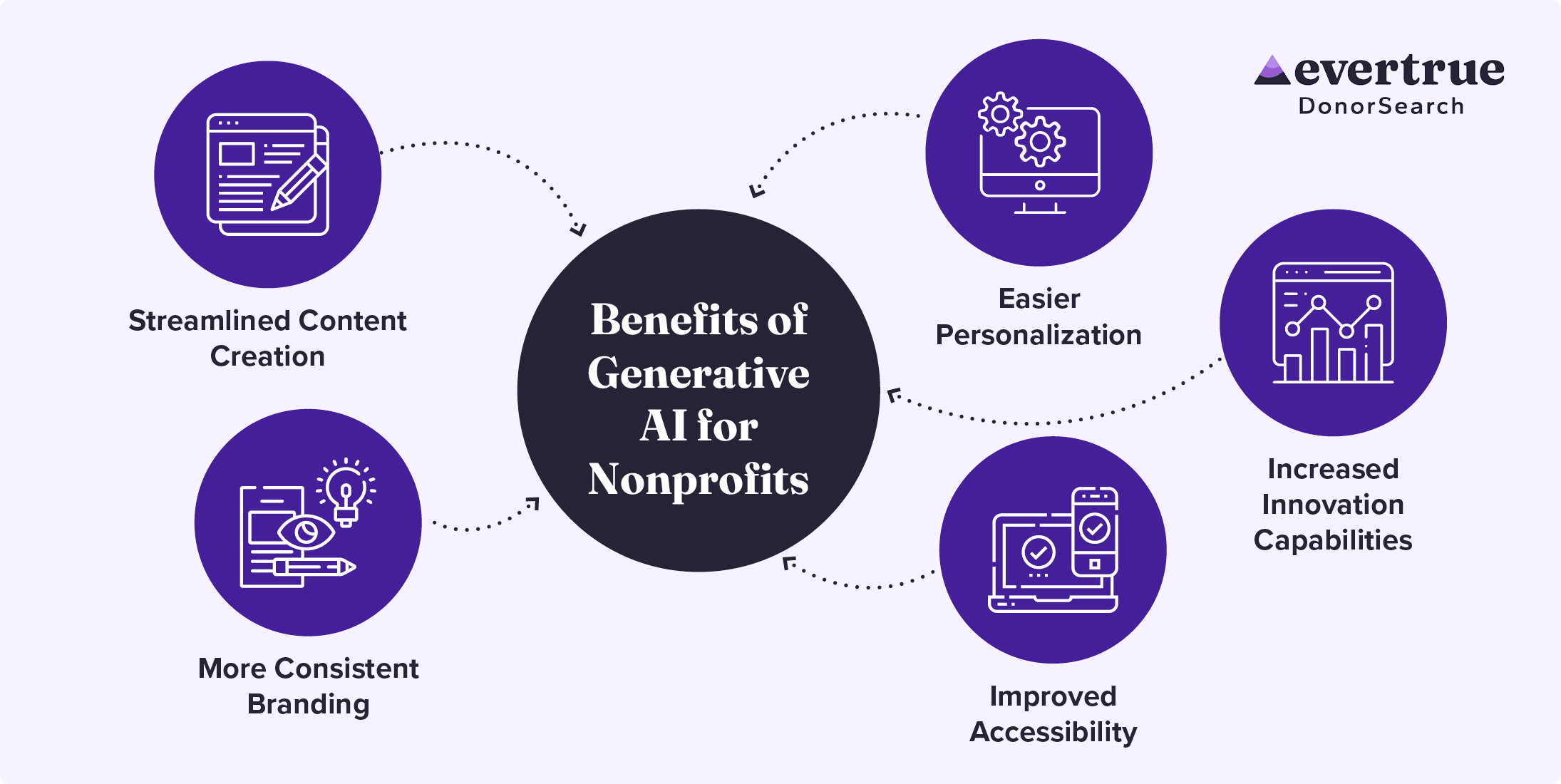
- Streamlined content creation for all of your organization’s communication channels, helping you save time and money while driving better results.
- More consistent branding in both visuals and messaging so your mission is recognizable and memorable to audiences.
- Easier personalization of individual messages to make donors feel valued and more inclined to engage.
- Increased innovation capabilities by exploring new concepts and methods of fundraising and marketing.
- Improved accessibility, since AI can suggest alternative text for images, create closed captions for fundraising videos, and take other steps to ensure all of your nonprofit’s supporters can interact with your content.
What are the top generative AI solutions for nonprofits?
Your organization could incorporate countless generative AI tools into its fundraising work. Some solutions are specifically designed for nonprofits, while others are more general in scope but still useful in a nonprofit context. Here are a few popular generative AI tools for your organization to consider:- ChatGPT, Gemini, Claude, Perplexity, and Microsoft Copilot. Developed by OpenAI, ChatGPT is probably the best-known generative AI solution available, as it can be prompted to create a variety of text-based content. The rest of these tools are also large language models (LLMs) that function similarly to ChatGPT.
- DALL-E. This is also an OpenAI solution, but users can prompt it to generate photos, graphics, and other images.
- Grammarly. Grammarly reviews your writing and provides suggestions to improve elements like mechanics, concision, and word choice.
- Grant writing assistants. These tools are more tailored to nonprofits’ needs than your average LLM, especially when it comes to drafting grant applications. Be advised that nearly a quarter of foundations don’t permit grant applicants to use AI in their proposals, though, so proceed with caution here.
- Signal by EverTrue. Another nonprofit-specific tool, Signal flags recent gifts and engagement worth acting on and uses AI to summarize individual donors’ histories and help draft tailored outreach.

How can my nonprofit use generative AI responsibly?
There are real risks that come with using generative AI improperly, such as unintentional discrimination due to biased outputs, a lack of data privacy, and regulatory challenges. However, the benefits of generative AI fundraising outweigh these risks as long as your nonprofit commits to using AI responsibly. To help you do so, the Fundraising.AI collaborative has established a Responsible AI Framework for nonprofits that consists of the following principles: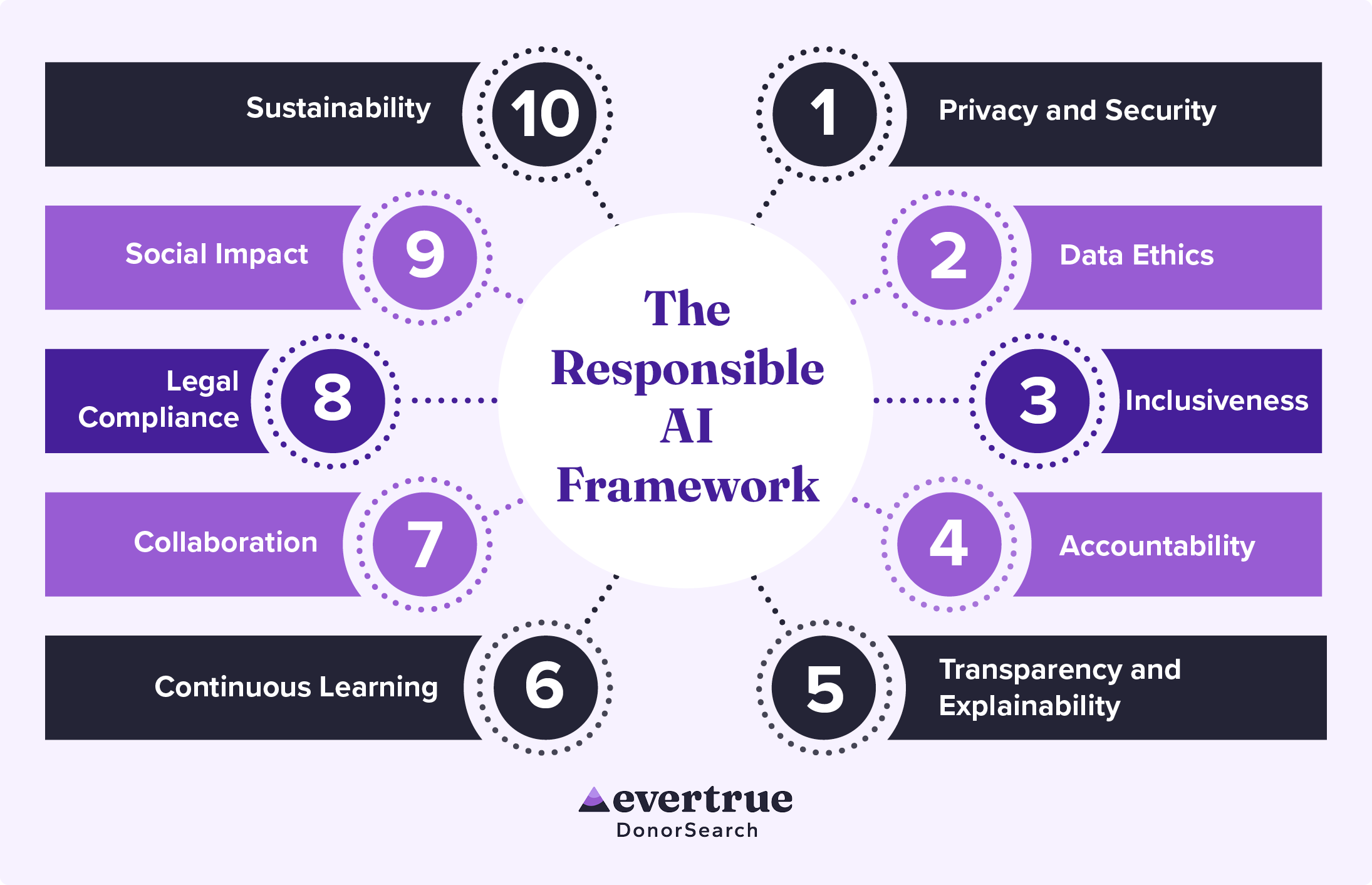
- Privacy and security, especially regarding sensitive information about supporters and beneficiaries
- Data ethics throughout information collection, analysis, and usage
- Inclusiveness by preventing bias and promoting fair representation
- Accountability, or ensuring all results are verifiable and replicable
- Transparency and explainability with community members regarding AI use
- Continuous learning about AI developments and best practices
- Collaboration with other organizations committed to using AI responsibly
- Legal compliance with applicable regulations surrounding AI and data protection
- Social impact—i.e., maximizing positive effects of AI and minimizing negative ones
- Sustainability and an awareness of how AI fundraising may impact the environment
Top Generative AI Fundraising Use Cases
Now that you know what generative AI is and why it’s helpful for fundraising, let’s explore some nonprofit-specific use cases for it. Remember that every organization is unique, so you’ll likely need to adapt these ideas to meet your specific needs.Generative AI Fundraising Use Cases
Multi-Channel Marketing
Draft high-quality, consistently branded content for every channel.
Donor Cultivation
Generate prospect reports, educational materials, follow-up messages, and activity ideas.
Fundraising Appeals
Develop donation requests for various campaigns and communication methods.
Stewardship & Recognition
Appreciate every donor promptly and in a way that resonates with them.
Multi-Channel Marketing
Leveraging multiple marketing channels creates more touchpoints for your community to learn about your nonprofit’s mission and get involved. Generative AI can help you build out your organization’s multi-channel marketing strategy by:- Creating email and direct mail templates that you can tailor to different supporter segments
- Scheduling regular social media posts and drafting captions for each of them
- Developing copy and graphics for key pages on your nonprofit’s website, such as your About page and donation page
- Outlining blog posts and making suggestions to revise them as you write
- Producing videos in the proper formats to share through any of these channels
Donor Cultivation
The actual act of building a relationship with a prospect is something only a person can do because it requires emotional engagement. However, generative AI can assist with the behind-the-scenes elements of donor cultivation so you can focus on engaging current and prospective donors who are able, willing, and likely to give. For instance, you might:- Generate prospect reports that summarize key information about a potential donor that your nonprofit can reference after conducting initial research.
- Develop educational materials, data visualizations, and other portfolio elements so prospects can learn more about your organization’s initiatives and impact.
- Draft messages to introduce prospects to other individuals at your organization who are working on projects they may be interested in contributing to.
- Brainstorm lists of ideas for events and activities that allow prospects to engage with your mission firsthand in ways that will interest them.
Fundraising Appeals
When the time comes to ask a cultivated prospect for a gift, generative AI can help you develop a donation request that will resonate with your audience. These tools are useful for writing a variety of appeals, including:- Major gift solicitations
- Annual fund contribution requests
- Year-end giving campaign asks
- Recurring donation program invites
Stewardship & Recognition
As soon as a donor responds positively to a fundraising appeal, it’s time to begin stewarding them. This process involves thanking the donor promptly and in a way that matches the size of their gift, then following up regularly with the goal of retaining their support over the long term. Generative AI can help not only with drafting stewardship messages but also with deciding which methods would be most effective for each donor. For example, handwritten thank-you notes, personalized videos, and small gifts are all good recognition strategies for mid-level donors. However, if you can’t decide which one a particular mid-level donor would appreciate most, you can input information about that donor into a generative AI tool to help you determine the best idea to make them feel valued.How EverTrue Supports Predictive & Generative AI Fundraising
Since the EverTrue team understands that AI fundraising is most effective when predictive and generative technologies work together, our AI solutions are designed to be used in combination with each other. As previously mentioned, our donor engagement tool Signal works by first predicting which donors are likely to respond well to requests in the near future, then generating tailored communication materials for those individuals. EverTrue also acquired DonorSearch in 2025, a leading prospect research platform that leverages predictive AI to pinpoint and prioritize your best potential donors. DonorSearch also integrates with more than 40 donor databases and fundraising tools so you can easily apply predictive insights to content generation.Final Thoughts
AI is here to stay, in the nonprofit sector and outside of it. Exploring the world of generative AI fundraising now will help your organization stay on top of trends and optimize many aspects of your work. Just make sure to leverage AI responsibly and use tools that allow you to maximize your strategy, such as DonorSearch and Signal by EverTrue. For more information on nonprofit technology, check out these resources:- AI Fundraising: Mastering the Future of the Fundraising Landscape. Dive deeper into fundraising use cases, benefits, and considerations for generative AI.
- Donor Segmentation: How Organizing Donors Boosts Retention. Discover how to group supporters based on shared traits to help you generate more tailored communications.
- 14 Fundraising Software Solutions for Nonprofits in 2026. Explore the best fundraising platforms on the market today, including some that leverage generative AI functionality.