















Endowments give nonprofit organizations the financial stability they need to plan for the long-term. By earning annual income from your endowment investments, your nonprofit is better positioned to weather economic uncertainty and support your mission for years to come.
To ensure your endowment fund lasts indefinitely, your team needs the knowledge and tools necessary to manage it. In this guide, we’ll examine best practices for endowment management to help your nonprofit generate consistent income and honor donor intent. We’ll cover:
- Endowment Management FAQ
- 5 Strategies for Effective Endowment Management
- Why Nonprofits Need Dedicated Endowment Management Software

Endowment Management FAQ
What is endowment management?
Endowment management is the ongoing work of keeping an endowment fund healthy. This includes setting the amount the organization can responsibly spend each year, ensuring the fund’s investments align with its purpose, and reporting its performance to the board and donors.
Is effective management the same for all endowments?
While basic management principles like responsible stewardship, precise accounting, and transparency apply to all endowments, different types of endowments will have different restrictions.
Endowments generally fall into two categories: those with donor restrictions, where the donor dictates how your nonprofit spends investment earnings, and those without donor restrictions, where your organization decides how to allocate generated income. Within these categories, there are three main types of endowments:
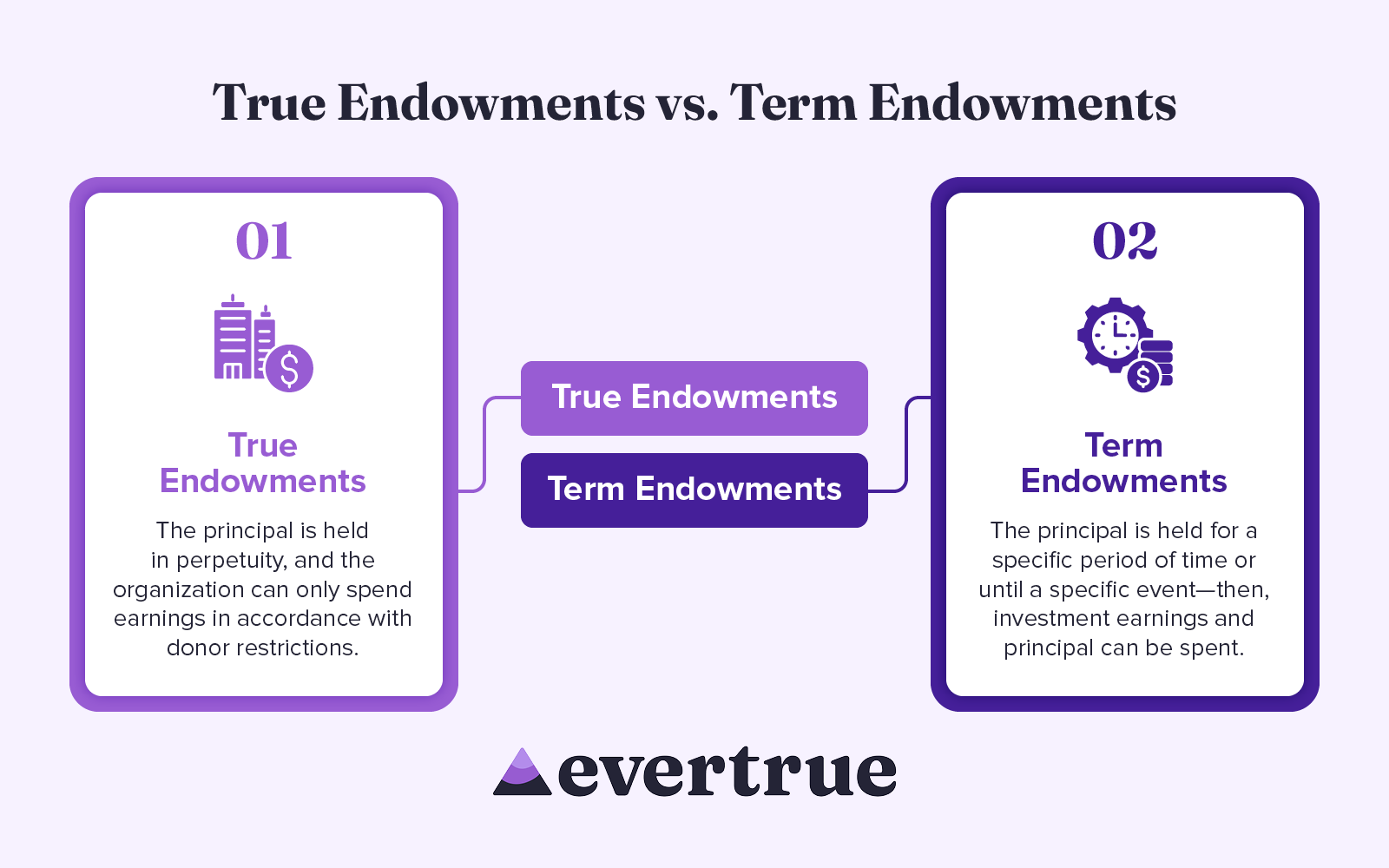
- True endowments are restricted and require your organization to hold the principal in perpetuity.
- Term endowments are restricted and operate like true endowments until a set period or until a specific event, after which your nonprofit can spend the principal.
- Quasi-endowments have no donor restrictions as they are created by your nonprofit’s board, which can also vote to dissolve the endowment at any time.
When it comes to endowment management, be conscious of donor restrictions. Misspending donor-restricted funds can result in a loss of trust with donors or even potential liability. When creating your spending policies, review the endowment type and any associated donor restrictions.
What is a nonprofit endowment management policy?
A nonprofit endowment management policy is the framework that governs how an organization invests its funds. It sets investment allocation targets, risk tolerance, and outlines who is responsible for financial decisions. An effective policy should keep the endowment steady through market swings while preserving the original gift for future use.
Most boards develop an endowment management policy, then delegate day-to-day oversight to an investment committee, who report to the board on a set schedule, often quarterly. Your nonprofit should revisit its policy at least once a year, since a policy your board wrote five years ago may no longer match current markets or priorities.
What is an endowment spending policy?
An endowment spending policy sets the formula for how much money the nonprofit can withdraw from the endowment each year. The goal is to fund specified programs without reducing the value of the original gift.
The 2025 NACUBO-Commonfund Study of Endowments found that U.S. colleges and universities depended upon endowment spending to fund an average of 15.2% of their operating budgets in fiscal year 2025, up from 14% the year before. With reliance on endowment spending on the rise, you’ll need to set a spending policy that accounts for the possibility of needing to increase your percentage in the next couple of years.
When setting your spending percentage, look beyond a single year’s balance. This ensures that an unusually strong year doesn’t trigger an unsustainable increase in spending, and a weak year doesn’t force your organization to suddenly slash program budgets. Instead, apply a fixed spending percentage based on the fund’s average market value over the previous three to five years to account for short market swings.
When setting your spending policy, stress-test it against a few possible market scenarios, including a sustained downturn, to see how it holds up.
What is UPMIFA, and how does it affect endowments?
The Uniform Prudent Management of Institutional Funds Act (UPMIFA) sets the legal standard nonprofits must follow when investing and spending endowment funds. All states, excluding Pennsylvania, have adopted it individually since 2006.
UPMIFA’s core idea is a prudence standard: rather than locking spending to a strict dollar value, it asks your board to make well-documented decisions based on the fund’s overall health and the donor’s intent.
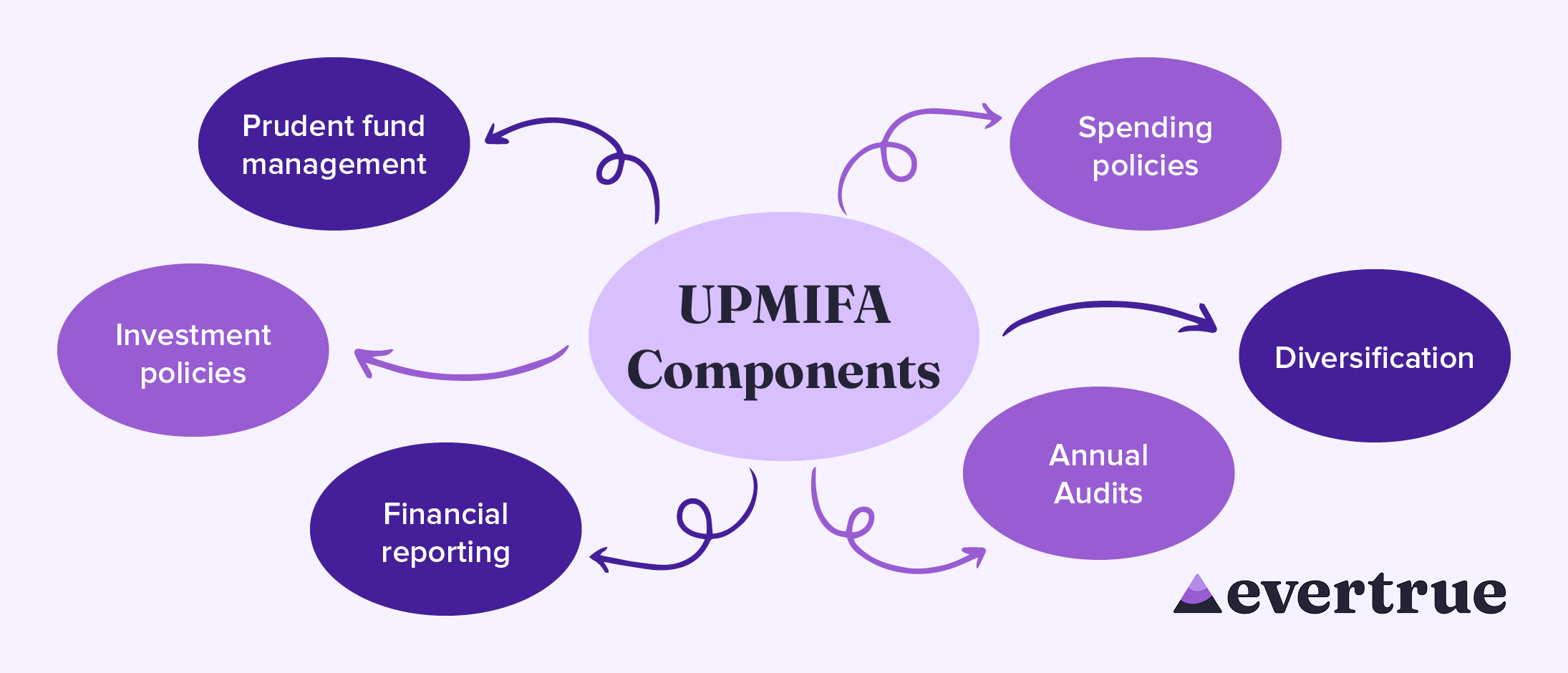
UPMIFA’s key components include:
- Prudent fund management. Under UPMIFA, prudent endowment management means weighing your fund’s purpose, intended duration, broader economic conditions, and potential risks when making investments.
- Investment policies. Maintain a written investment policy that spells out your nonprofit’s investment risk tolerance, how you monitor your investments, and how you evaluate their success.
- Financial reporting. UPMIFA requires your nonprofit to prepare annual financial reports about your endowment. Keep these on hand in case you need to submit them to a governing body or regulatory agency.
- Spending policies. Set endowment spending rules that keep donor intent and the fund’s long-term health in mind.
- Diversification. It is common investment advice not to put all your eggs in one basket. UPMIFA strongly suggests that nonprofits diversify their investments.
- Annual audits. Your nonprofit must undergo an independent audit each year.
Ensure the team overseeing your endowment stays up to date with UPMIFA and any state-specific rules.
What tools should nonprofits use to manage their endowments?
Rather than relying on traditional spreadsheets to manage complex funds, look for a designated endowment management software solution, such as Balance by EverTrue. The right platform can help your team with:
- Accurate unitization. If you manage multiple endowments, you’ll need to monitor each fund’s exact share of gains or losses. Look for a solution that lets you split a large investment pool into units.
- Policy-driven spending. Choose a system that lets you apply your unique spending formulas to your fund, eliminating the need for error-prone manual calculations.
- Audit-ready reporting. Your endowment management system should provide clear financial reports for your board and auditors.
Regardless of the size of your nonprofit, we recommend that all organizations with endowments invest in formal management software. Even if spreadsheets and paper files are working for your nonprofit today, they come with significant drawbacks that we’ll discuss later.
5 Endowment Management Strategies
1. Create a Values-Aligned Spending Policy
Your endowment’s spending rate should account not only for market trends, but also for what the funded programs need to thrive. For instance, an endowed scholarship needs to keep pace with rising tuition costs, and an endowment-supported after-school tutoring program needs to continually purchase the latest edition test prep books.
Typically, your board and finance team set the initial spending rate. However, other stakeholders, such as the individuals overseeing the endowment-supported programs, can offer practical advice. For example, program directors know whether a 4% spending rate still funds the scholarships, exhibits, or services the endowment is meant to support. A short annual check-in between program and finance leaders can keep the policy up to date.
2. Prioritize Security
Assure donors that their endowment gifts are in good hands by creating strict security measures for who can access your endowment.
Role-based access can help you strike a balance between keeping your team on the same page and protecting data by:
- Giving your investment committee full visibility into the portfolio.
- Providing major gift officers with the context they need without exposing sensitive account details.
- Showing auditors who had access to what information and when.
3. Be Mindful of Inflation
Inflation reduces what a fund’s principal can buy over time. To keep pace, most institutions aim for investment returns that beat the combined effect of their spending rate and inflation. Say a fund earns a 6% return in a year, with the organization setting spending at 4%, and after spending, the fund grows by 2%. If inflation sits around 3% that year, the fund has less buying power than it did before, even though its dollar value went up.
A common mistake is to set an inflation assumption once and leave it untouched for years. Build current inflation figures into your spending calculation every time you and your investment committee recalculate. Whether the fund covers this year’s number isn’t all that matters. You’ll need to ensure that your endowment’s purchasing power will still support the same level of program spending a decade from now.
It is also important to consider that your investing strategy may eventually need to account for both inflation and increased spending. Across US colleges and universities, endowment withdrawals reached $33.4 billion in fiscal year 2025, an 11% increase from the year before, while new gifts to endowments declined by 9.2% over the same period. As you evaluate your spending policy, test it against a scenario in which your spending outpaces new gifts.
Use the calculator below to see how your spending policy stands up to inflation.
4. Continue to Steward Donors
Your relationship with the donors who give to your endowment doesn’t end when you secure their gifts. Because your endowment exists to make a difference in the long term, your supporters will want you to keep in touch about its progress. Ongoing stewardship means keeping donors updated about your endowment’s performance and impact.
A report that strengthens your relationship with donors should cover:
- The fund’s balance at the start and end of the year
- Spending amounts and allocations
- How the fund’s returns compare to your investment targets
- A short narrative detailing the specific impacts the endowment achieved
Create a report for each endowment rather than sending an identical document to everyone. A donor who endowed a scholarship wants to hear about the students it supported, while a donor who endowed a building fund wants updates on construction projects.
5. Upgrade Your Endowment Management Tools
Your endowment management tools should make applying your spending policy across every fund easy. Investing in dedicated software is especially useful as your endowment grows. Handling unitization in spreadsheets might work for a few funds, but as you begin to manage dozens or hundreds of gifts, dedicated software can save your team time spent manually calculating gains and losses for each one.
Why Nonprofits Need Dedicated Endowment Management Software
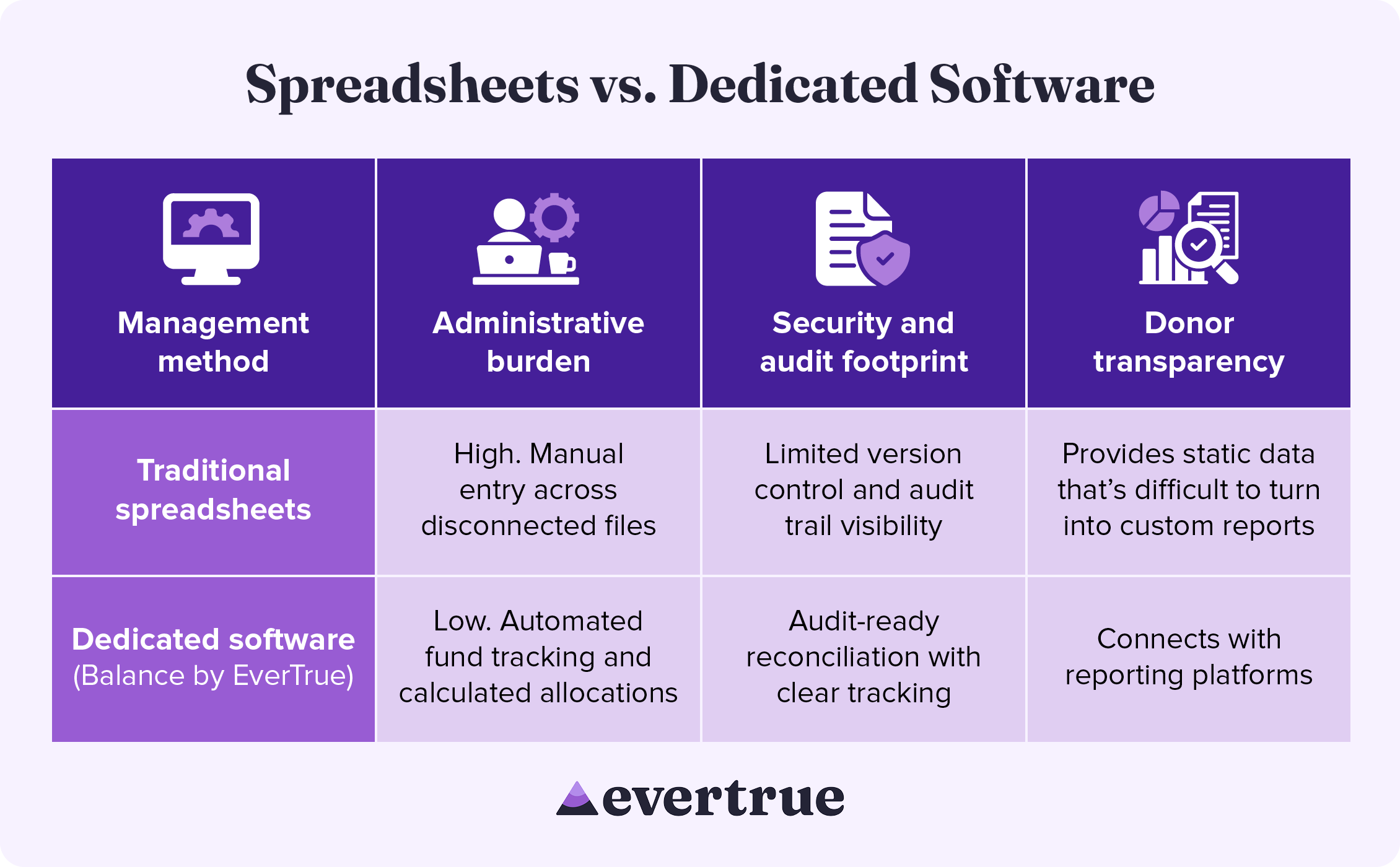
Dedicated endowment software brings accuracy and consistency to every part of the management process, from tracking individual funds to improving security. See how these solutions compare to a spreadsheet-based approach:
How These Methods Compare:
In managing your endowment with traditional spreadsheets, you may see:
- High administrative burden: Manual entry across disconnected systems
- Limited security and audit footprints: Reduced version control and audit trail visibility
- Difficulty with donor transparency: Spreadsheets provide only static data that is difficult to turn into custom results.
By using dedicated software, you are likely to find the following improvements:
- Lower administrative burden: Automated fund tracking and calculated allocations
- Enhanced security and audit footprint: Audit-ready reconciliation with clear tracking
- Greater donor transparency: Connects with reporting platforms
Dedicated endowment management software keeps your organization compliant while freeing up the time your team once spent manually managing spreadsheets.
Secure Your Endowment with Balance by EverTrue
Effective endowment management begins with excellent accounting. Balance by EverTrue handles unitization, applies spending rules, and produces audit-ready reports, so your team can spend more time on the donor relationships that built the fund in the first place.
- Turn your data into a clear picture of long-term impact. Combine accurate fund accounting with donor reporting that showcases impact.
- Connect with the tools you already use. Pair Balance with Impact by EverTrue and ODDER by EverTrue to create and deliver compelling digital endowment reports that you can send to donors with ease.
- Know where every fund stands in real time. Check market values, gift history, and available spending for any fund. Then, share view-only versions with your team, so everyone stays informed.
With Balance, your team can stop spending all your time on manual management and instead add balance to your endowment workflow.
Additional Resources
To learn more about managing your endowment and other ways that technology can help your organization, check out these additional resources:
- Webinar: Building a Seamless Relationship Between Endowment Finance and Advancement. In this webinar, we cover the keys to un-complicating your institution’s financial endowment reporting process. Explore how building a connection between your finance and advancement teams can lead to happier donors and happier staff.
- The Best Alumni Management Software Solutions in 2026. Alumni management software allows your university to maintain an active community that supports your school in a number of ways. Review top software solutions.
- Donor Segmentation: How Organizing Donors Boosts Retention. What is donor segmentation, and how can you use it to boost retention? Learn the need-to-know information in this guide from EverTrue’s fundraising experts.
