















Signal by EverTrue Implementation Guide
How to Implement Signal Successfully in 120 Days or Less
Introduction
Implementing Signal successfully is about more than just launching technology. It’s about aligning your teams, prioritizing key work, and engaging donors strategically. When done right, Signal can be fully integrated into your daily workflows within 120 days or less.
Take the University of Arkansas as an example. They completed their implementation in just 90 days by combining strong leadership commitment, a dedicated implementation owner, technical readiness, and effective cross-team collaboration.
This guide is designed to help you do the same — with a clear path to move from kickoff to full adoption, without losing momentum along the way. Think of it as your companion for staying organized and confident throughout the process.
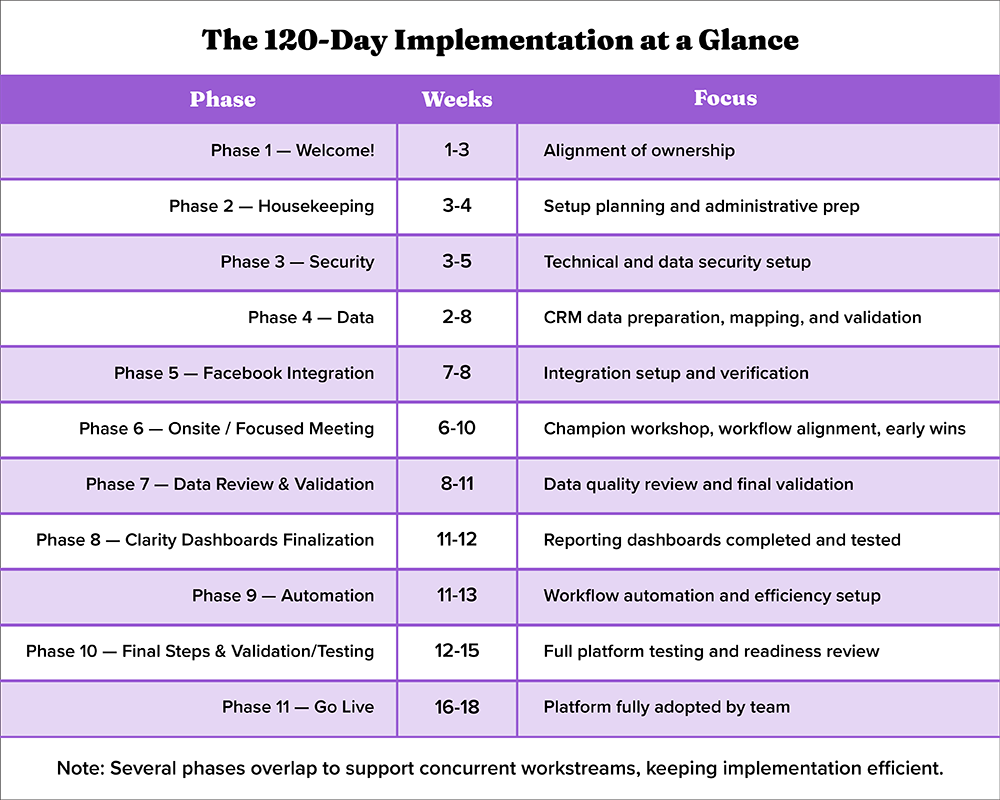
Here’s an overview of the phases in a typical 120-day implementation. While some phases overlap, each one contributes to building momentum and ensuring adoption:
Key Milestones
Some milestones you’ll aim to hit along the way include:
- Executive leadership confirmed
- Implementation owner assigned
- CRM integration configured
- Champion workshop delivered
- Biweekly usage review cadence established
Each milestone ensures your team stays on track and that adoption continues to gain momentum.
How to Use This Guide
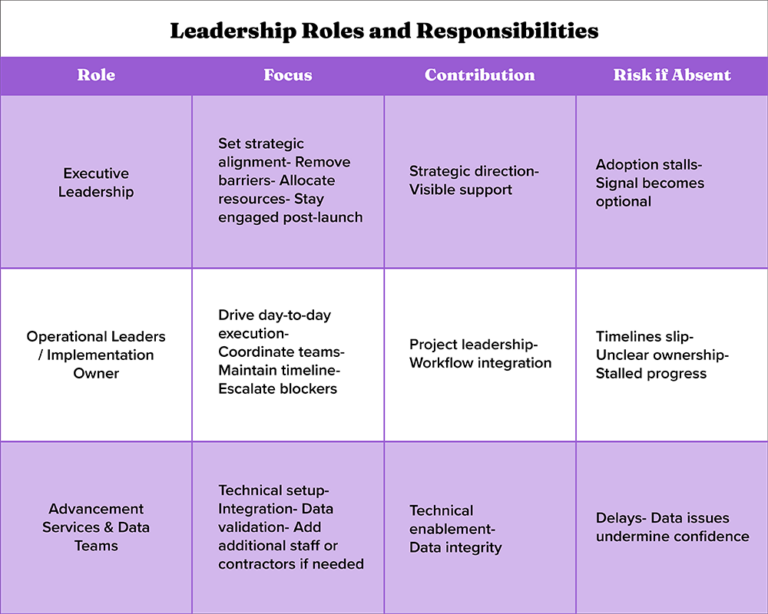
This guide is meant for executive leadership and operational leaders who will be actively involved in implementing Signal. Think of it as your reference for understanding what needs to happen, who’s responsible, and when critical actions should take place.
Use it to:
Plan Your Implementation
Start by defining leadership roles and responsibilities, identifying required resources, aligning stakeholders early, and establishing a realistic 120-day roadmap. Taking the time to plan upfront will help the team execute smoothly and avoid unnecessary delays.
Pressure-test Your Readiness
Confirm that implementation ownership is clear, identify any gaps that could slow progress, and make sure your team is aligned around shared expectations. Addressing these early ensures your implementation starts on strong footing.
Before You Begin: Minimum Requirements
The fastest implementations don’t start faster — they start more prepared.
Before kickoff, make sure you have:
- A committed executive sponsor (through and beyond launch)
- One dedicated implementation owner
- Confirmed technical resources
- CRM access and export capability validated
- Alignment on collaboration across teams
If any of these are missing, pause here.
Fixing them now is what protects your timeline later.
The First 120 Days Matter Most
The first 120 days aren’t just about setup. They define whether Signal becomes a core part of your workflow, or another tool your team gets to “later” Early actions that make the biggest difference include:
- Clear executive leadership engagement throughout implementation and post-launch
- One dedicated implementation owner to coordinate activities
- Technical resources allocated and prepared
- Cross-functional stakeholder alignment across teams
When those are in place, adoption doesn’t stall — it compounds.
What Successful Teams Have in Common
Across every strong implementation, the same conditions show up:
Leadership That Stays Involved
Not just at kickoff — throughout implementation and beyond.
Clear Ownership
One person owns progress. No ambiguity.
Technical Readiness
Data is clean. Integration is prioritized. Validation happens early.
Cross-Team Alignment
Fundraisers, operations, and data teams are working toward the same goals.
Willingness to Evolve
Teams don’t try to force old workflows into a new system — they improve them.
The 120-Day Implementation Framework
While the implementation timeline includes several overlapping technical phases, the framework below groups implementation into five core adoption phases that guide organizational alignment, activation, and long-term adoption.
Phase 1: Alignment and Readiness (Weeks 1–3)
Get everyone moving in the same direction before anything else begins.
This is where the fastest implementations win or lose momentum.
Before you touch data or workflows, you need clarity: Who owns this? Who’s involved? What does success look like?
What your team is focused on:
- Confirming your executive sponsor
- Assigning a dedicated implementation owner
- Completing kickoff
- Auditing CRM data
- Defining stakeholder roles
Where EverTrue supports:
- Leading kickoff
- Helping define ownership and resourcing
- Setting expectations for the 120-day path
By the end of this phase, you should have:
- A clearly identified executive sponsor (and they’re engaged)
- One implementation owner accountable for progress
- Kickoff completed with aligned expectations
- CRM data audited at a high level
- Stakeholders identified across teams
Why this matters: Misalignment here is the #1 cause of delays later. Clarity now saves weeks later.
Phase 2: Technical Setup and Configuration (Weeks 3–6)
Set the foundation so the platform actually works the way your team needs it to.
This phase overlaps with multiple technical workstreams — and that’s intentional.
You’re not just “setting up Signal.” You’re making sure it reflects your data, your workflows, and your goals.
What your team is focused on:
- Providing CRM access for integration
- Exporting and validating CRM data
- Assigning technical resources
- Reviewing early outputs
Where EverTrue supports:
- Guiding integration setup
- Reviewing data structure and mapping
- Supporting validation
- Configuring dashboards and workflows
By the end of this phase, you should have:
- CRM successfully connected
- Data mapped and validated
- Dashboards configured to reflect your priorities
- Workflows beginning to take shape
- Technical stakeholders aligned and engaged
Why this matters: If the data isn’t right, nothing else works. This is where confidence in the platform starts.
Phase 3: Champion Activation (Weeks 6–8)
Turn a rollout into real adoption.
This is where Signal stops being “a project” and starts becoming part of how your team works.
Instead of relying on one person, you activate a group of champions who bring Signal into their day-to-day workflows.
What your team is focused on:
- Participating in multi-day champion workshops (~15 participants)
- Aligning workflows across teams
- Identifying and creating early wins
Where EverTrue supports:
- Facilitating workshops
- Coaching on workflow design and adoption strategy
- Sharing best practices
By the end of this phase, you should have:
- A group of trained internal champions
- Defined workflows aligned to Signal
- Early wins identified and shared
- Initial usage happening beyond just one user
Why this matters: Adoption doesn’t scale through one person. It scales through champions.
Phase 4: Launch and Sustained Adoption (Weeks 8–12)
Make Signal part of your team’s rhythm — not a one-time rollout.
At this stage, Signal is live. But “live” doesn’t mean “adopted.”
The focus shifts to consistency:
How often it’s used, how it’s reviewed, and how it becomes embedded in how your team operates.
What your team is focused on:
- Running regular usage and activity reviews
- Holding leadership check-ins
- Completing success assessments
- Refining workflows based on real usage
Where EverTrue supports:
- Facilitating review sessions
- Advising on adoption strategy
- Identifying opportunities to improve usage
By the end of this phase, you should have:
- A consistent usage cadence (biweekly or better)
- Leadership actively reviewing progress
- Workflows being refined based on real data
- Signal integrated into day-to-day activity
Why this matters: Adoption isn’t a milestone — it’s a habit. This is where that habit gets built.
Phase 5: Optimization and Expansion (Weeks 12–18)
Turn adoption into long-term impact.
Once Signal is part of your workflow, the focus shifts again — from using it to getting more out of it.
This is where teams start to see compounding value.
What your team is focused on:
- Expanding adoption across additional users and teams
- Refining processes based on insights
- Solidifying reporting and success metrics
Where EverTrue supports:
- Providing optimization guidance
- Sharing benchmarks and best practices
- Identifying expansion opportunities
By the end of this phase, you should have:
- Broader adoption across teams
- Clear reporting and success metrics in place
- Refined workflows based on performance insights
- A repeatable cadence for ongoing optimization
Why this matters: This is where Signal shifts from a tool → to a system that drives results.
Proof in Practice: The University of Arkansas
The University of Arkansas didn’t just complete implementation – they did it within 90 days. Not because they rushed, but because they were aligned. They treated Signal as a strategic initiative from day one — and backed it up with the right structure.
Here’s what they did differently:
- Leadership stayed actively engaged beyond kickoff
- One person clearly owned implementation end-to-end
- Technical resources were allocated early (not reactively)
- Teams worked across functions, not in silos
- Signal was positioned as a strategic priority,not just a tool
- Champion workshops were prioritized to drive early adoption
The takeaway? While 120 days is a realistic timeline, accelerated implementation within 90 days is achievable when preparation and alignment come first.
A Shared Responsibility (and Why It Works)
The fastest implementations aren’t one-sided. They work because both teams are fully engaged — and clear on their role.
What EverTrue Brings
- A proven implementation methodology
- Hands-on guidance and support
- Technical integration expertise
- Adoption strategy and best practices
What Your Team Brings
- Executive leadership that reinforces priority
- A dedicated implementation owner
- Technical resources ready to execute
- Active participation throughout the process
- Willingness to evolve workflows and ways of working
When both sides show up fully, implementation doesn’t stall. It accelerates – and keeps accelerating.
Quick Self-Assessment
Rate each area from 1 to 5:
- Leadership engagement
- Internal ownership clarity
- Technical readiness
- Cross-team alignment
- Openness to change
Now, look at your total:
- 20+ → You’re set up to move quickly
- 15–19 → You’re close — tighten a few areas
- Below 15 → Pause and close gaps before kickoff
This isn’t about scoring perfectly, it’s about knowing where friction might show up before it does.
A Future of Faster Adoption
Signal implementation isn’t just about getting live.
It’s about building a system where Insight turns into action, teams move in sync, and outreach becomes consistent and intentional
With the right foundation, 120 days isn’t aggressive — it’s the norm.
And as teams like Arkansas have shown, when alignment comes first, you don’t just implement faster — you adopt better.
Ready to see what this could look like for your team?
Request a demo and explore Signal in action.