












You have solid donor relationships with reliable supporters, your fundraising messages inspire connection with your cause, and you have an optimal donation experience. But for some reason, your last fundraising appeal received below-average support. You quickly follow it up with another, and that one gets even fewer responses.
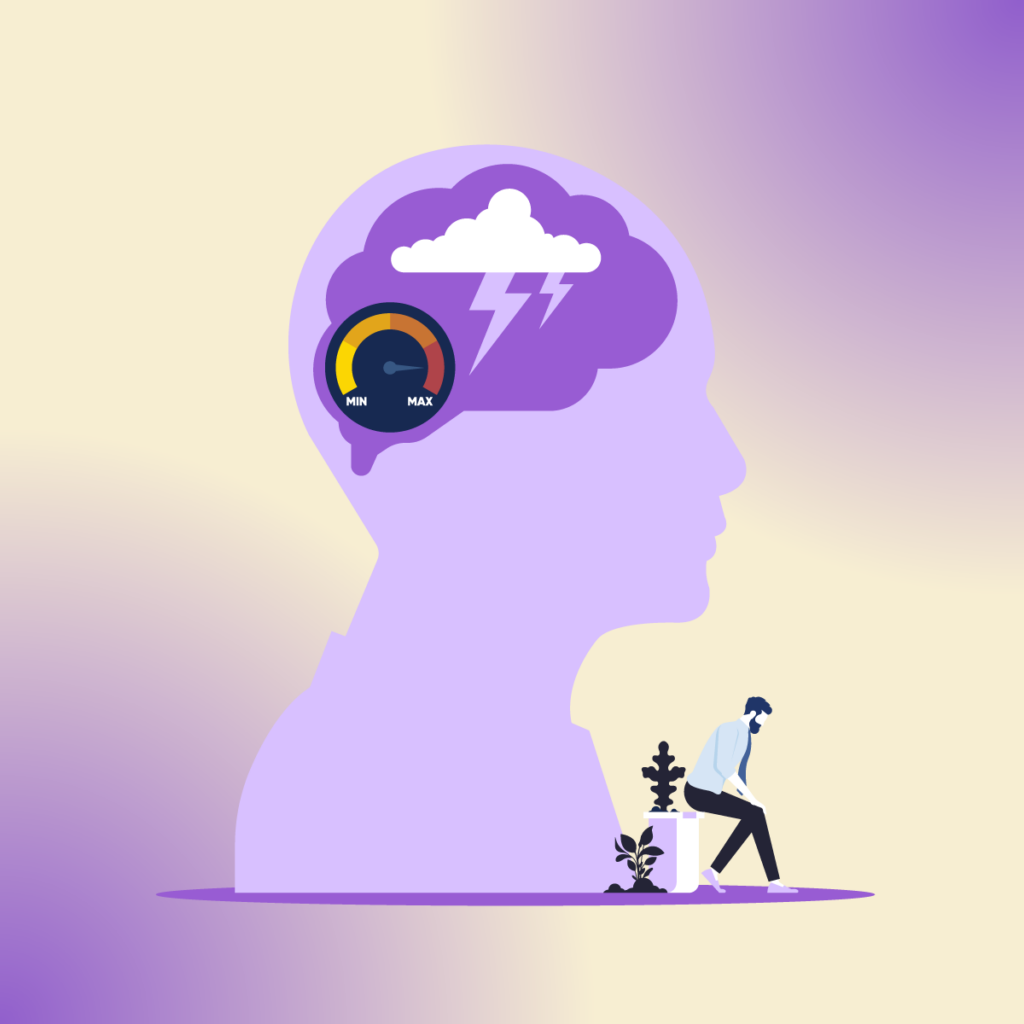
One reason for this scenario? Donor fatigue. Donor fatigue can impact even previously passionate supporters, hurting your nonprofit’s fundraising potential.
Fortunately, it is possible to counter and even prevent donor fatigue altogether. In this guide, we’ll share the top causes of donor fatigue and the solutions to each.

Donor Fatigue FAQ
What is donor fatigue?
Donor fatigue is a feeling supporters have when, due to stress, cynicism, or disinterest, they slow down their giving or even stop donating altogether. 70% of Americans report feeling donor fatigue, meaning it is a consistent issue that many nonprofits face.
Is donor fatigue real?
Yes. Some argue that donor fatigue isn’t real on the grounds that a strong donor appeal or a change in strategy can re-inspire giving. However, just because a donor can be re-engaged doesn’t mean they never experienced donor fatigue.
When your fundraising team reports signs of donor fatigue, take your staff’s concerns seriously and consider how you can respond to supporters’ shifting feelings before they lapse.
How can I tell if supporters are experiencing donor fatigue?
Use your fundraising, marketing, and donor management software to track common signs of donor fatigue, such as:
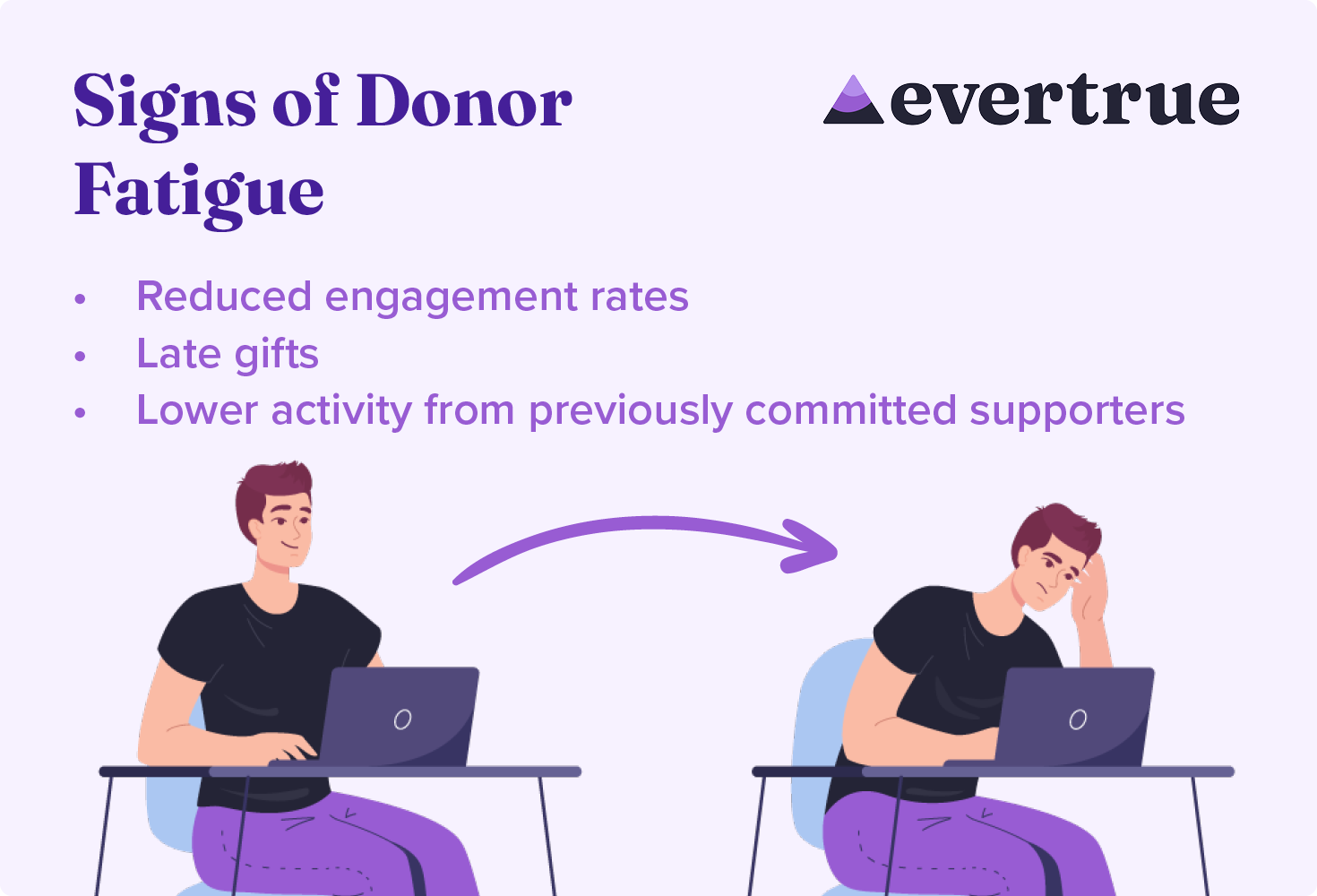
- Reduced engagement rates. Dips in the number of responses to emails, text messages, and social media posts may indicate that supporters are disengaging. Compare response rates across channels and content types to determine whether other factors—such as content topic or format—are impacting engagement or if it’s a sign of a larger trend, like donor fatigue.
- Late gifts. Track late responses to donation appeals, as well as recurring donors who start delaying their gifts.
- Lower activity from previously committed supporters. If you suspect donor fatigue is impacting your donor base, drill down into specific supporter data. Take a look at previously high-activity donors to see if they have pulled back their engagement, are making later gifts, or responding to fewer donation requests.
Keep in mind that donor fatigue is a recurring problem that your nonprofit will need to regularly take action to prevent and minimize. Make it a habit to review trends in donor behavior to spot donor fatigue and other engagement patterns that may impact your outreach strategy.
7 Donor Fatigue Causes and Their Solutions
1. Excessive Messages
While staying in regular contact is key to building donor relationships, it’s easy to overwhelm donors if you’re messaging them too frequently. This can be especially true for donors who give to multiple causes, as they will likely have several nonprofits competing for their attention in their inboxes.
When donors receive too many messages, rather than being excited to get an update from your nonprofit, they may feel decision paralysis over which one to open first, or even begin to feel that engaging with your messages is a chore.
The Solution
Set a communication cadence to avoid targeting any one donor too frequently. While there is no set minimum or maximum for how many messages you should send to a donor in a given time frame, a few general guidelines include:
- Unless there is an urgent situation, avoid sending outreach messages every day or multiple messages in one day.
- Create targeted lists for email blasts to avoid repetitive messaging, such as promoting your monthly giving program to supporters who already make recurring gifts.
- When building email sequences, ensure there is an adequate amount of time for supporters to respond to each message before sending the next one. For example, you might invite supporters to an upcoming event. Then, you would follow up a week later with supporters who have yet to RSVP. Finally, the last reminder message would arrive just a few days ahead of the event as a final call.
Of course, avoid reducing your message frequency too much, as doing so can cause supporters to lose touch with your nonprofit. At a minimum, ensure you’re reaching out to supporters at least once a month.
Additionally, you can use prospecting research and donor analytics tools to spot supporters who are actually likely to respond positively to a ramp-up in communication. For instance, DonorSearch by EverTrue analyzes your donor engagement data to pinpoint which supporters are the most likely to upgrade their giving, give again, or even become major donors with the right stewardship.

2. Too Many Donation Requests
Similar to receiving too many messages, even your most reliable annual donors may experience fatigue if they feel they are only being sent donation requests.
Often, nonprofits will identify frequent donors and see that as a signal to keep sending fundraising appeals. However, this can make supporters feel like an ATM, causing them to start ignoring your messages.
The Solution
Rather than reducing your total message volume, try varying your content.
Some nonprofits diversify their content by following the 3-1 rule. This approach involves sending three stewardship messages for every fundraising ask.
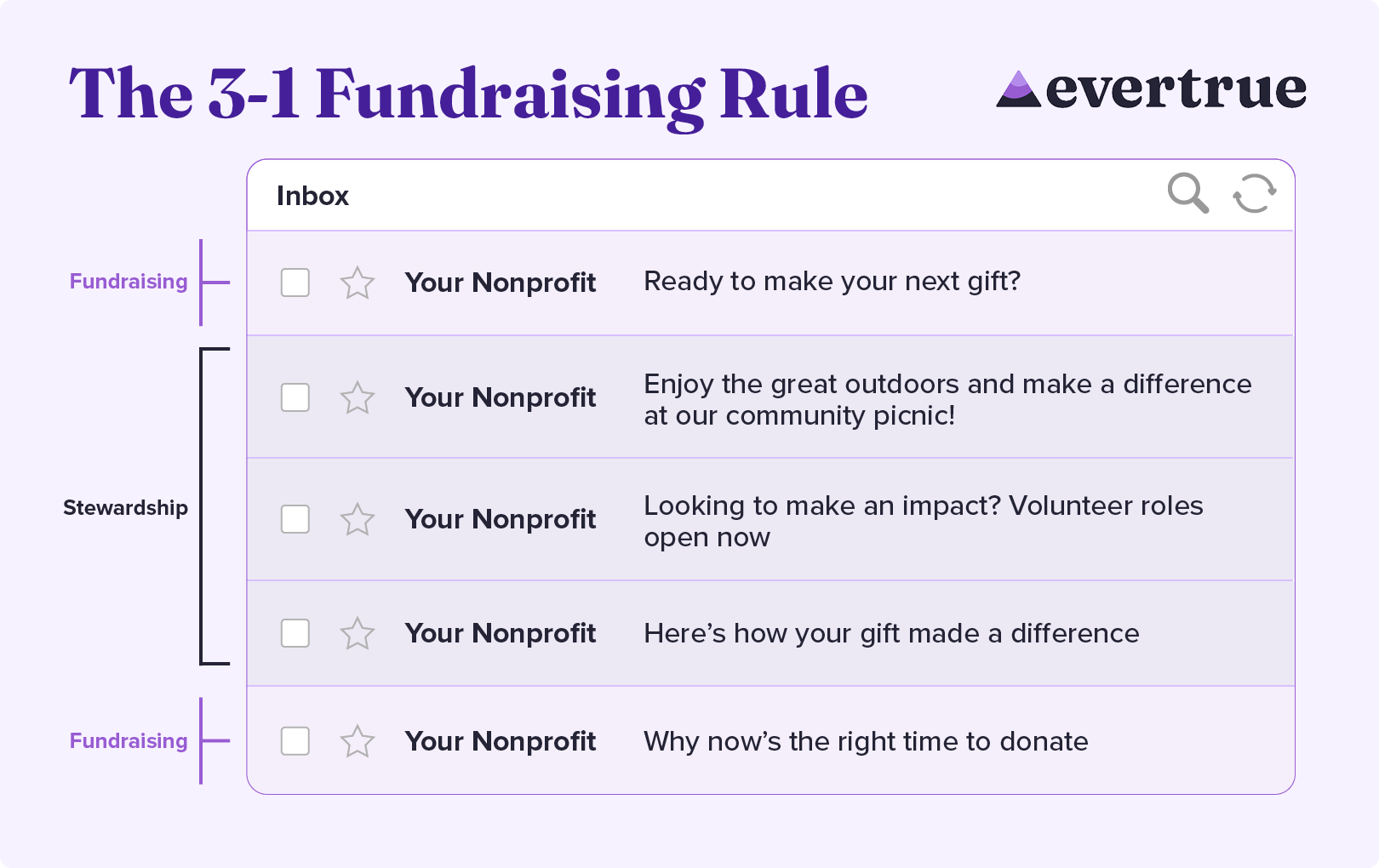
For example, rather than following up your regular monthly fundraising request with an ask for your crowdfunding campaign, you might instead share a program update, promote your volunteer program, or send a donor feedback survey.
Additionally, consider varying how you reach out to supporters. Rather than always communicating with donors via email, you can catch their attention anew by reaching them on new platforms. Try sending text messages, mailing letters, or even calling them on the phone.
3. Underappreciation
Donating and not receiving a “thank you” in return can make supporters doubt their choice to give. Appreciation messages let donors know that their specific gift is meaningful to your cause and confirm that you received it.
Without basic appreciation efforts, unacknowledged donors may question if their gifts matter, leading them to reduce their contributions or potentially stop giving altogether.
The Solution
Appreciation is a core part of donor stewardship. At a minimum, each supporter should receive an automatic email within 48 hours of their gift, thanking them for their contribution.
Additionally, ensure your appreciation efforts are proportionate to the gift amount. A simple thank-you email is likely enough for a $25 donation, whereas a supporter who gives $1,000 might get a handwritten card in the mail or even a video thank-you message.
Experiment with a range of appreciation efforts to connect with all of your supporters, preventing donor fatigue and inviting them to become a part of your nonprofit’s community. For example, you might host appreciation events or highlight a top donor every week in your newsletter.
4. False Urgency
Instilling a sense of urgency can be key to getting donors to submit their gifts. This is why limited-time giving events, like Giving Tuesday, are so effective.
However, issuing immediate calls to action too frequently can start to make donors doubt how urgent your fundraising needs really are. For example, if you send out a fundraising request on Monday, sharing how one of your nonprofit’s programs needs urgent support, a donor might feel motivated to contribute. Then, if the following Monday, your fundraising appeal emphasizes that a different program—or even the same one—needs immediate support again, donors may start to grow suspicious.
The Solution
When composing your fundraising requests, consider how urgent your needs actually are, or if there are other ways you can drive donations. Here are a few examples of when invoking a sense of urgency is effective:
- Your nonprofit’s community experiences a natural disaster or other immediate setback/threat.
- Your nonprofit is participating in or hosting a limited-time fundraiser, such as Giving Tuesday.
- There is an added benefit to supporters donating at this time, such as an active matching grant.
For other fundraisers, consider different strategies, such as making an emotional connection or showcasing your impact.
5. Emotional Burnout
A strong story can move a donor’s emotions, but when they receive intense stories every week from your nonprofit, other causes they support, and the news, it’s easy to get burnt out emotionally. When this happens, donors are less likely to respond to emotional appeals and may even feel a sense of hopelessness when it comes to solving your target issue.
The Solution
While your nonprofit should continue to tell emotionally moving stories about your community and mission, vary what types of stories you’re sharing and what emotions they’re meant to inspire.
For example, while a case for support for a recent campaign might highlight the immediate threats your community faces to urge immediate action, your next email blast might include a hopeful video interview with one of your program participants, where they discuss how much your nonprofit has helped them.
For each story you plan to share with your community, assess its likely emotional impact. The key is to avoid going too far in either direction—either making it seem like your cause is hopeless or already solved. Ultimately, strive to always give supporters a sense that your nonprofit is making a positive difference by presenting an inspiring vision of the future and sharing successes, while still being frank about obstacles you will need to work together to overcome.
6. Lack of Impact
If supporters feel that their gifts don’t matter, they are likely to become discouraged and may even stop giving altogether. This can go hand-in-hand with false urgency and overly frequent messaging; if donors continuously hear that your nonprofit is in desperate need of funding and nothing about the gifts they have already received, they may assume their gifts have no impact.
The Solution
Nonprofits should strive to demonstrate impact as much as possible. By doing so, you can show supporters the difference their gifts are making and help them visualize the potential outcomes of even greater donations.
A few ways you can showcase impact include:
- Impact reports. Nonprofits should create a number of reports to share with supporters, including program impact reports, which explain the impact a specific program had; endowment reports, which explain how an endowment invested its funds and how its dividends were used; and annual reports, which provide an overview of your nonprofit for the year.
- Campaign updates. After donors contribute to a campaign, provide follow-up updates. Let them know if campaigns hit their goals, what outcomes your programs have had on your community, and what new initiatives you’re launching. Keeping supporters in the loop helps them feel positive about past gifts and encourages them to give again to continue making an impact.
- Examples. Consider adding examples of the outcomes gifts can have on your donation page and in fundraising appeals. Rather than asking for a $50 donation alone, you might share how $50 can help you plant a certain number of trees, feed families in your community, or help pets find their forever homes. By continually tying impact to the act of donating, you can prevent donor fatigue and encourage more gifts.
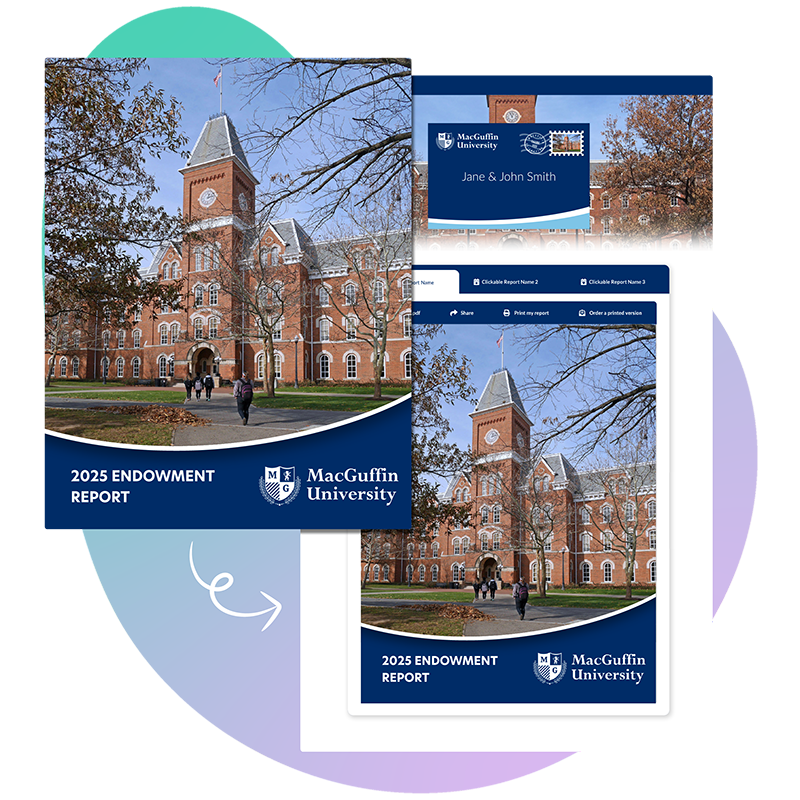
Additionally, when sharing impact messages like these, include visuals where possible. Photographs of your volunteers in action or your community benefiting from your programs can go a long way towards helping donors envision their impact.
7. Generic Messages Unrelated to Support Interests
If supporters regularly receive messages from your nonprofit that are unrelated to their interests, they’re less likely to engage with them. Relatedly, if supporters receive messages that feel generic or mass-produced, they may even become cynical about your nonprofit and its fundraising practices.
This is especially a concern for nonprofits that use AI tools. While AI fundraising software can help you hyper-personalize content to build even stronger connections with donors, poor use of AI—such as employing free, generic tools—can lead to robotic messages that fail to make an impact.
The Solution
Your nonprofit’s fundraising, marketing, and donor management software has the tools you need to ensure each donor receives tailored outreach. Use these tools to:
- Track donor interests. Every time a supporter interacts with your nonprofit, ensure you’re making a record of it. For example, a donor might show interest in your advocacy campaign. Or, an alumni donor at a university might share their excitement about your school’s volleyball team. By taking note of this data, you can send supporters content about the programs they’re the most passionate about and better shape future fundraising asks.
- Segment donors. Organize your donors into various mailing lists based on their interests, donor status, and other characteristics. This allows you to create email cadences that speak to specific groups of donors. For example, you might have a donor segment for supporters who live in your local area to invite to in-person events. Or, you may have a unique fundraising list for recurring donors that focuses on encouraging them to increase their regular gift, rather than make a new donation.
- Personalize content. To create personal messages at scale, build out templates for each of your donor segments. Then, fill in details unique to each supporter, like their name, engagement history, and past contributions.
AI tools can help with this process. Specialized fundraising AI can note where each supporter is in their donor journey and recommend next actions. AI can even identify trends in donor behavior to spot supporters who may be suffering from donor fatigue and at risk of lapsing, to help you re-engage them.
Start Fighting Donor Fatigue at Your Nonprofit
Any nonprofit can experience donor fatigue, and the key is to watch for the signals, implement solutions, and stay alert for changes in donor behavior. The right software can help you manage and engage your donors at scale, keeping donor fatigue at bay.
To start taking active steps to fight donor fatigue, we recommend exploring the following software solutions:
- Signal by EverTrue – Donor Engagement Software Solution. Get a donor engagement solution that helps your nonprofit connect with every corner of your donor pyramid with Signal by EverTrue.
- The Best Alumni Management Software Solutions. Alumni donors may struggle with donor fatigue throughout their years with your school. Discover tools for keeping them engaged.
- 14 Fundraising Software Solutions for Nonprofits. Fundraising software can help you track your donors and deliver messages that keep engagement high. Explore top fundraising software solutions for your nonprofit.