














The Modern Guide to Direct Mail
How fundraising teams are turning print into a high-performing channel — and pairing it with digital for even bigger results
Cutting Through the Noise
We believe generosity is personal. Donors don’t give because they were reached. They give because something made them feel known, whether that happens in an inbox or in a mailbox. That belief doesn’t change just because the channel is paper instead of pixels.
Here’s the situation your team is up against: Your donors see thousands of ads a day — emails, texts, banner ads, sponsored posts. By most estimates, they register only 1 to 10 percent of it.¹ Cutting through that noise is the job of every fundraising team, and it only gets harder as digital channels get louder.
Here’s the twist: the more crowded digital gets, the more valuable a physical mailbox becomes. Direct mail isn’t a nostalgia play. For many advancement and nonprofit teams, it’s the most underused advantage they have.
This guide breaks down why direct mail still works, what the data says about its performance compared to other channels, and how fundraising teams — from small annual funds to major university foundations — are pairing it with email, video, and social to build donor relationships that last. Whether you’re planning your first appeal or rethinking a program you’ve run for a decade, you’ll find a practical, current playbook here.
Direct Mail, By the Numbers
Direct mail doesn’t just feel effective — the data backs it up.
#2
Direct mail is the second-most popular way donors give, behind only online giving.
Double the Donation, Nonprofit Fundraising Statistics
4.9%
The average direct mail response rate is 4.9%
PDC Graphics, "What Metrics Should Nonprofits Use to Measure Direct Mail ROI?"
81%
81% of nonprofits plan to increase their direct mail investment this year.
DeepSync, 2025 Data and Fundraising Trends for Nonprofits
1–10%
The average person sees thousands of ads daily, but registers only 1–10% of them.
Forbes Business Development Council, "The Attention Economy"
Real teams are seeing it firsthand. Chicago Theological Seminary saw a 12% response rate on a mission-driven direct mail appeal — well above typical annual fund benchmarks. Hope College’s simple gift-anniversary mailing has sustained an ROI above 100:1, costing as little as one to two cents per dollar raised.
Why Donors Still Open the Mail

Someone had to print it, address it, stamp it, and mail it. That effort registers, even subconsciously. A donor who opens their mailbox and finds something with their name on it — especially something personalized with their giving history or program affiliation — experiences a moment of recognition that a mass email rarely creates.

You can’t pin an email to your refrigerator. A well-designed postcard can sit on a counter or a bulletin board for weeks, quietly reminding a donor of your mission long after they’ve opened it. Digital messages disappear the moment they’re read; print sticks around.

Donors are fatigued by screens, not just by fundraising asks. A physical piece of mail interrupts that routine in a way that feels welcome rather than intrusive — a moment of analog calm in an otherwise digital day.
Proof It Works: Direct Mail Case Studies

A postcard warms up a cold prospect
Many of the University of Memphis’s prospective donors had never received personalized, one-on-one outreach. The team’s leadership Gift Manager introduced a postcard-first strategy, using Pledgemine by EverTrue to send a personalized print piece before any digital outreach — then following up with a personalized ThankView video once donors were warmed up.
The result: new gifts, enthusiastic responses, and stronger, more receptive video follow-ups. One donor was so delighted they requested an extra postcard just to share with a friend.

Mission-driven mail grows engagement
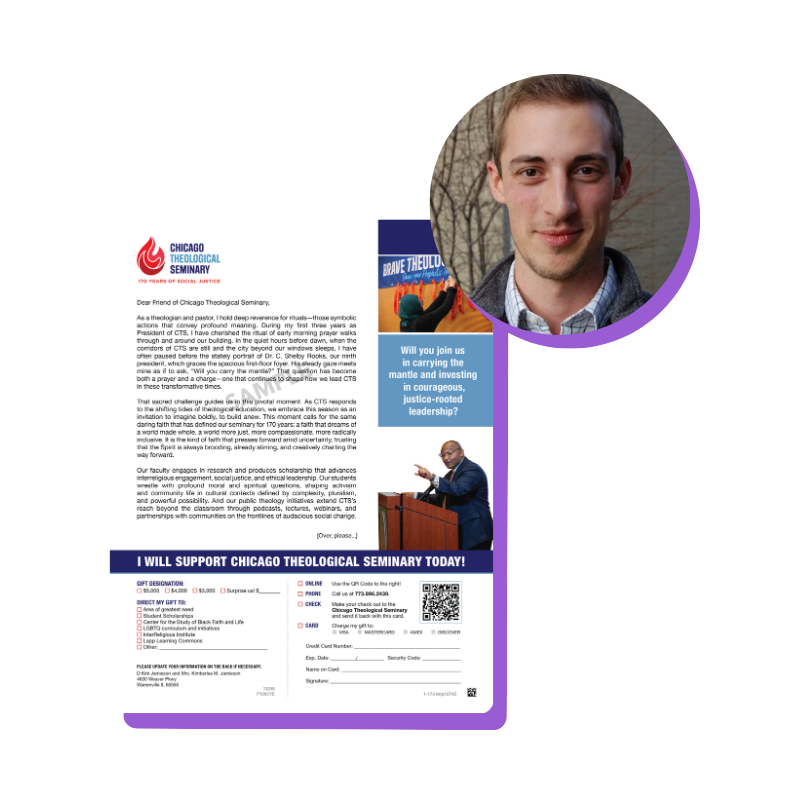
Chicago Theological Seminary’s annual fund had been leaning on short, transactional appeals — and performance wasn’t meeting expectations. Donor feedback pointed to a different need: more substance, more context, more connection to mission.
The team shifted to longer-form, mission-driven storytelling delivered through Pledgemine, and the results spoke for themselves: a 12% response rate, clear spikes in online giving following mail drops (even without a corresponding email), and donors writing back with reflections on what they’d read.

Segmentation turns broad outreach into results
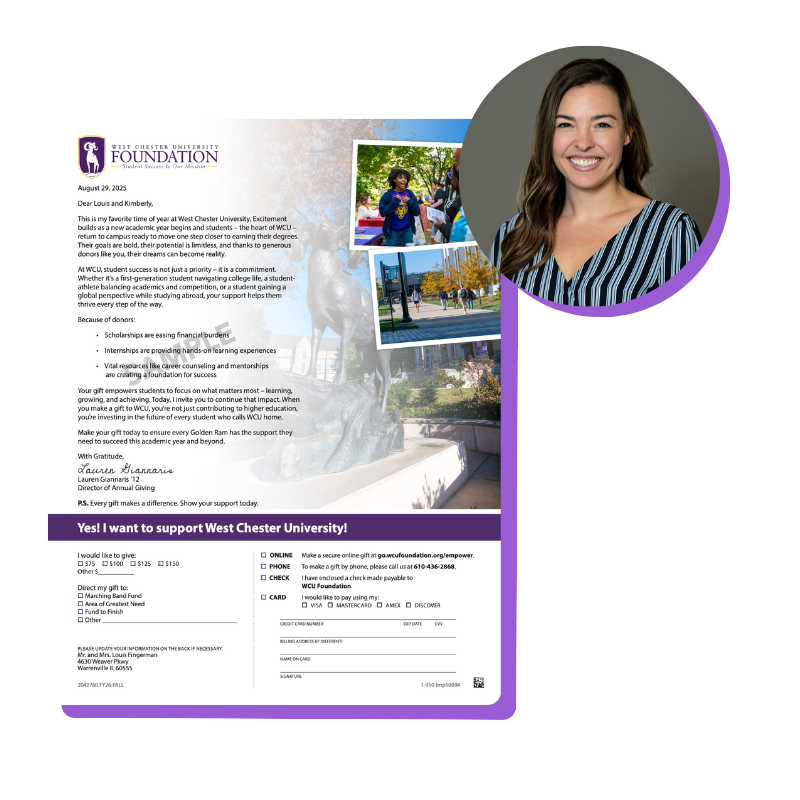
West Chester University Foundation’s annual giving outreach relied on broad, inconsistent lists rather than structured donor segmentation. Using Pledgemine to personalize messaging, visuals, and ask amounts by segment — paired with ThankView video from coaches and student-athletes — the foundation rebuilt its approach around donor progression.
The results: cyclical donor re-engagement grew from about 8% to 12%, a second ask became the strongest-performing segment at fiscal year-end, and a refined calendar year-end strategy generated an additional $80,000 year over year.
Honoring donor preferences at scale
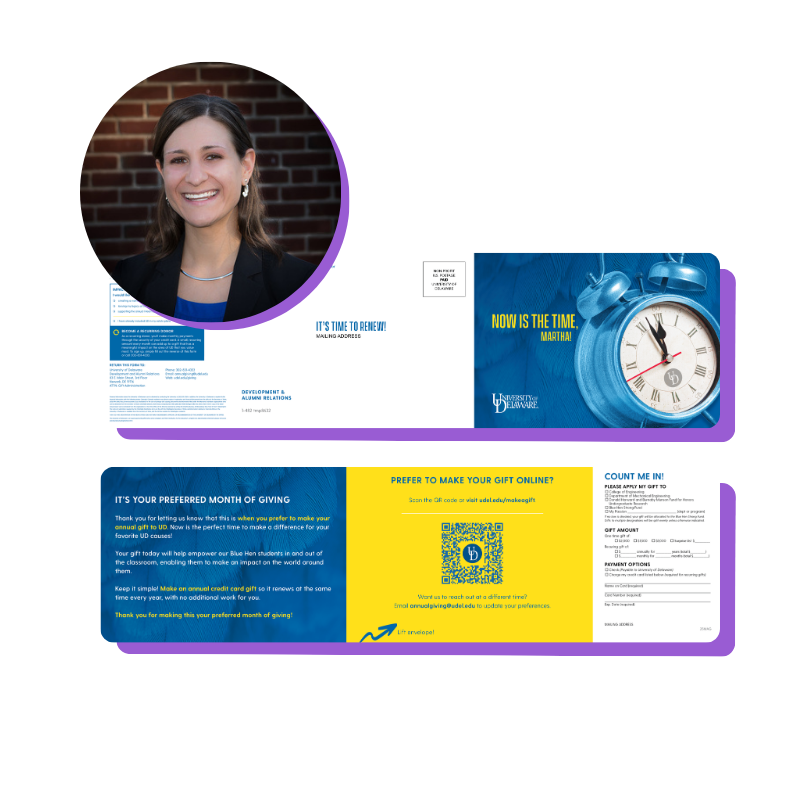
Donors told the University of Delaware that they were tired of over-solicitation and wanted to be contacted only at specific times of year. In response, the team built a Preferred Month of Giving program, letting donors choose their own outreach timing — then used Pledgemine to turn monthly CRM reports directly into ready-to-send, segmented mail audiences.
What was once a fully manual, letter-by-letter process is now a streamlined, report-driven workflow — one that’s reduced communication fatigue while sustaining steady, predictable giving from a highly engaged donor group.

One coordinated system across teams
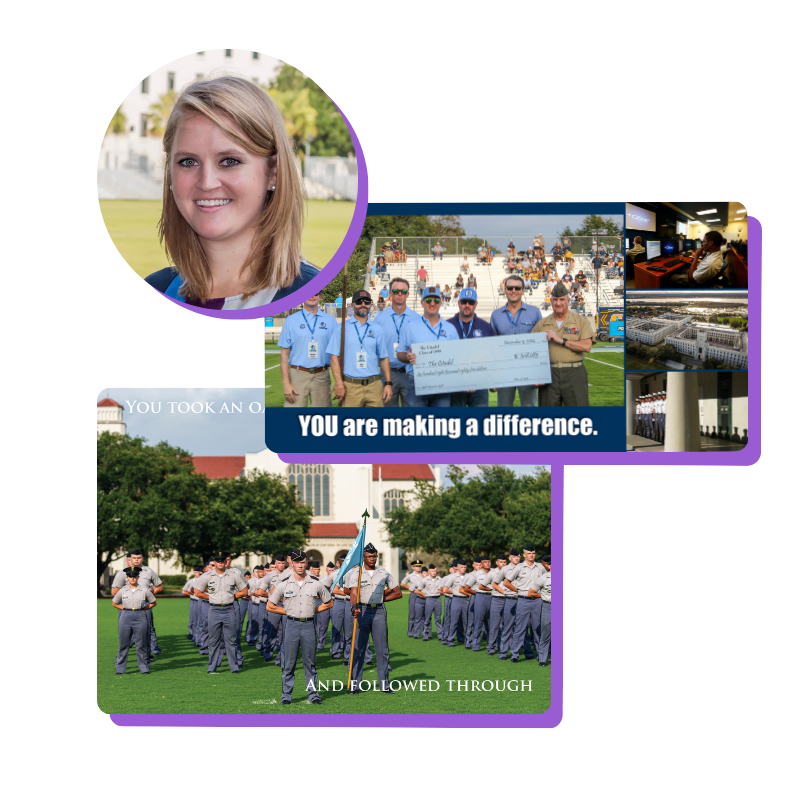
Pursuing a $50 million stretch goal, The Citadel Foundation needed to move past disconnected systems, limited donor visibility, and fragmented coordination across giving, stewardship, and major gifts teams. By unifying Signal, ThankView, and Pledgemine, the foundation built coordinated donor journeys — automated cadences for new and reactivated donors, real-time engagement tracking, and outreach prioritized by actual donor behavior.
The payoff: faster identification of new major-gift prospects, higher event attendance driven by personalized video invitations, and previously unresponsive donors re-engaging through structured follow-up.
Building a Modern Direct Mail Strategy
Segment before you send.
Don’t default to a broad, one-size-fits-all mailing list. Start with what you already know: stated communication preferences, previous response history, and long-term giving patterns. Build your segments around those signals instead of a static spreadsheet.
Choose content that earns attention.
Give donors something worth stopping for. Lean on visual formats like postcards, calendars, and impact maps to grab attention immediately. Use longer-form storytelling (a letter from leadership, a beneficiary’s story) to build a connection a quick digital message can’t.
Design for the physical moment.
Treat paper stock, print quality, and typography as part of the message, not an afterthought. Crisp graphics and quality materials signal that a piece is worth a donor’s attention; flimsy paper and blurry logos signal the opposite.
Build a realistic production calendar.
Map your key dates first (giving days, fiscal year-end, alumni weekends), then work backward to account for printing, addressing, and mail transit time. If you need a piece in mailboxes by a specific date, finalize your copy weeks earlier, not days.
Treat it like a digital channel and measure it.
Don’t let mail become a black box. Track delivery rate (how much mail reaches its destination), response rate (how many recipients take the desired action), and retention rate (how many direct mail donors give the following year again).
Making Direct Mail Part of a Multichannel Strategy
Direct mail performs best when it isn’t working alone. Across these case studies, a pattern emerges: mail opens the door, and digital channels build on the momentum.

University of Memphis paired Pledgemine postcards with ThankView video follow-ups — the postcard warmed the donor up; the video deepened the connection.

The Citadel Foundation unified Signal, ThankView, and Pledgemine so every touchpoint — print, video, and digital cadence — was coordinated around real donor behavior, not siloed by channel.

West Chester University Foundation combined Pledgemine’s segmented print with ThankView videos from coaches and student-athletes, creating a layered experience that resonated especially strongly with families.
What Actually Makes Direct Mail Personal (Not Just Printed)
It reflects who the donor actually is, not just their address. Giving history, program affiliation, class year, and other real signals should shape the piece, not just fill in a blank. That’s the difference between “Dear [First Name]” and a piece that reads like you know the relationship.
It’s built for the segment, not forced into one mold. A close-knit group of 200 loyal donors and a broad appeal to 20,000 prospects call for different messaging, different asks, and sometimes different print runs entirely. A program that can only produce one version at a time ends up flattening those differences instead of reflecting them.
It shows up on time, every time. A beautifully personalized piece that arrives after a giving day has already ended doesn’t build trust. It does the opposite. Production and delivery need to work backward from the moments that matter to your donors, not your print vendor’s schedule.
It’s measured like a relationship, not a mailer. Delivery, response, and retention data tell you whether a piece actually deepened a connection, not just whether it went out the door.
It fits into the fundraising moments donors already recognize: appeals, stewardship, event follow-up, impact reporting, instead of forcing generic marketing templates onto donor communication.
It works alongside the system that already knows your donors, instead of becoming one more disconnected tool your team has to manage by hand.
When a mail program gets these right, it stops being a print job and starts being part of the relationship.
How Pledgemine by EverTrue Helps
Personalization at scale shouldn’t require more headcount. Pledgemine by EverTrue helps fundraising teams create timely, personalized direct mail — postcards, letters, folded cards, stewardship pieces, and event materials — without the operational drag of juggling vendors, minimums, or slow production timelines.
With Pledgemine, teams can:
Start from templates designed specifically for appeals, stewardship, storytelling, and event-driven communication — or design a piece fully from scratch when you want complete creative control.
Go beyond a mail merge: shape the copy, imagery, and ask around giving history, program affiliation, class year, or custom fields.
Print exactly the quantity needed for a segment — no minimums, no waste.
Mail quickly enough to hit real fundraising deadlines: giving days, fiscal year-end, stewardship cycles, and reunions.
Respond fast when timing matters most — on-demand printing with no minimums means you can get a timely, personal piece into mailboxes quickly, whether that's a planned giving day or an unplanned moment your community needs to hear from you.
Track projects and proofs in one place, without juggling multiple print vendors.
And because Pledgemine sits alongside Signal (engagement and cadence automation) and ThankView (personalized video), direct mail doesn’t have to work in isolation. As The Citadel Foundation, West Chester University Foundation, and University of Memphis all show, mail is often most effective as one coordinated part of a broader donor engagement strategy. Direct mail that reads like it was written for one donor, sent to as many as you need.
Direct mail isn’t dead. It’s still the most personal thing in a mailbox.
Ready to see what a modern direct mail strategy could look like for your team?
Schedule a Pledgemine Demo